DIN rail energy meters make it easier to monitor electrical usage directly from a breaker panel, consumer unit, or control cabinet. The models in this roundup cover single-phase, three-phase, DC, CT-based, pulse-output, and Wi-Fi-connected applications.
Before choosing one, check the system voltage, maximum current, phase arrangement, display requirements, and whether you need remote access or basic local readings.
Best 10 Din Rail Energy Meters Picks for 2026
Best DC Monitoring Pick
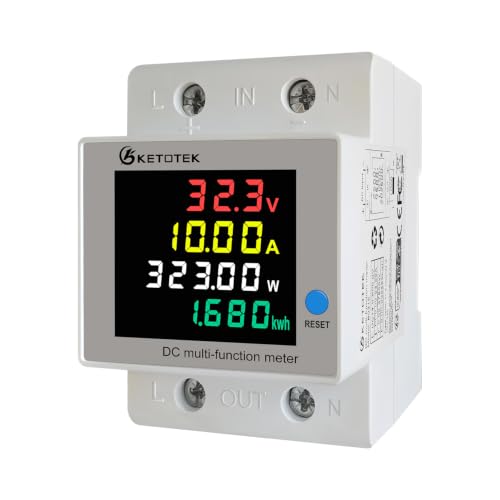
- Measures 14–600V DC, up to 63A
- Displays voltage, current, power, and kWh
- Stores energy data through power failures
Best For: Indoor solar, battery, and workshop DC monitoring
Best Simple Billing Meter

- Tracks single-phase electricity consumption
- Mounts on standard 35mm DIN rail
- Uses flame-retardant material and protected terminals
Best For: Apartments, rentals, schools, and small commercial installations
Best Multifunction AC Pick

- Monitors six AC electrical parameters
- Color LCD offers wide viewing visibility
- Supports inverter waveforms and stores kWh data
Best For: Solar inverters, RVs, and AC distribution panels
Best Pulse-Output Meter
Single-Phase DDM75S Energy Meter

- Passive pulse output supports AMR systems
- Compact six-module DIN rail design
- 5+1 display with power and pulse indicators
Best For: Remote monitoring of 220V single-phase systems
Smart Protection Pick

- Real-time V/A/W LCD monitoring
- Smart Life, Alexa, and Google Home control
- Adjustable voltage, current, and leakage protection
Best For: Smart homes needing remote monitoring and automated protection
Simple Display Choice
Single Phase 100A Energy Meter

- Six-parameter LCD readout
- 40–300V AC measurement range
- 178° wide viewing angle
Best For: Local monitoring in homes and industrial panels
Three-Phase Monitoring Pick
KWS-306WF Three-Phase Energy Meter

- Three-phase, four-wire DIN rail design
- 85–290V and up to 80A measurement
- App control with multiple protection functions
Best For: Industrial, commercial, and larger three-phase installations
Best Dual-Circuit Pick
KETOTEK Dual-Channel Energy Meter

- Monitors one or two circuits
- Includes two 100A CTs
- Color LCD with six readings
Best For: Tracking separate main and subcircuits
Best Easy-Install Option
DEWIN Single-Phase DIN Rail Meter

- Fits standard 35mm DIN rail
- Backlit 178-degree color LCD
- Stores data after power loss
Best For: General single-phase monitoring
Best for Inverter Monitoring

- Supports inverter sine-wave measurement
- Reads six electrical parameters
- Backlit 178-degree color LCD
Best For: Single-phase home and inverter monitoring
Best DC Monitoring Pick – KETOTEK DC Energy Meter
For shoppers comparing din rail energy meters for solar panels, battery systems, or other DC circuits, the KETOTEK combines voltage, current, power, and accumulated-energy readings in one compact meter. Its color display shows all four values simultaneously, while stored kWh data remains available after a power failure.
Best For: DIYers and electricians monitoring indoor DC circuits from 14 to 600 volts and up to 63 amps.
Pros:
- Measures DC voltage, current, active power, and energy.
- Color LCD provides simultaneous readings.
- Automatically saves accumulated kWh during power failures.
- Compact design fits standard DIN rails and carries CE and FCC certification.
Cons:
- Designed for DC circuits only, not standard AC household measurement.
- Indoor use only.
- Readings must remain within the 600 V and 63 A maximum ratings.
This is a versatile choice when detailed DC monitoring matters more than basic single-phase energy billing. The reset function also makes it practical for tracking separate measurement periods.
Best Simple Billing Meter – Watris Veiyi DDM75S
The Watris Veiyi DDM75S is a straightforward option for buyers who want din rail energy meters to track single-phase electricity use. Its 35mm DIN rail mounting, direct connection design, and flame-retardant housing suit installations where basic consumption monitoring and panel organization are priorities.
Best For: Apartments, rental properties, schools, shops, and other locations needing single-phase usage tracking.
Pros:
- Supports quick calculation and ongoing tracking of electricity consumption.
- Fits standard 35mm DIN rails under DIN EN50022.
- Flame-retardant housing is designed to resist heat, cold, wear, and fire.
- Offers standard S-type wiring, with U-type wiring as an option.
Cons:
- Its listed 10–40A range is narrower than higher-capacity multifunction meters.
- The notes do not specify an LCD or additional readings such as voltage and frequency.
- Installation requires choosing and correctly using the supported wiring method.
Choose this model when you need a compact single-phase consumption meter rather than a broad diagnostic instrument. Its standard rail format and protective terminal design are useful for organized electrical installations.
Best Multifunction AC Pick – QWORK 6-in-1 AC Power Meter
Among din rail energy meters for AC distribution boxes, the QWORK stands out for combining six readings on one color screen. It measures voltage, current, active power, energy, frequency, and power factor, with a built-in CT and support for non-standard sine waves from inverters.
Best For: Home distribution boxes, solar inverter setups, RV systems, and DIY AC monitoring up to 300 volts and 100 amps.
Pros:
- Displays six electrical parameters at once.
- HD color LCD has a 178-degree viewing angle for cabinet visibility.
- Stores cumulative energy data during power outages.
- Supports inverter waveforms and installs on standard 35mm DIN rail.
Cons:
- Designed for AC measurements rather than DC circuits.
- Its energy range is limited to 99,999 kWh.
- Correct installation is still required for the built-in CT and rail wiring.
This is the strongest fit in the group for users who want more than kWh totals. Frequency and power-factor readings add useful context when evaluating inverters, solar systems, or variable AC loads.
Best Pulse-Output Meter – Single-Phase DDM75S Energy Meter
For buyers seeking din rail energy meters that can connect to remote monitoring, this single-phase DDM75S adds a passive pulse output alongside its digital kWh display. Its compact six-module format saves panel space, while the two wiring options and extended terminal cover support practical installation.
Best For: Single-phase residential or light-commercial systems that use AMR equipment for remote energy collection.
Pros:
- Provides passive pulse output compatible with AMR systems.
- Uses a clear 5+1 digital display with separate status and energy-pulse LEDs.
- Fits standard 35mm DIN rail and occupies six 12.5mm modules.
- Measures active energy regardless of load-current direction.
Cons:
- Limited to single-phase, two-wire active-energy measurement.
- Listed for 10–40A operation and 220V, 50/60Hz systems.
- Pulse integration requires compatible AMR equipment and correct wiring.
This meter makes the most sense when remote pulse collection is part of the installation plan. It is less feature-rich than a multifunction display meter, but its compact form and AMR compatibility are valuable for straightforward energy metering.
Smart Protection Pick – WiFi Smart Energy Meter
For shoppers comparing din rail energy meters, this WiFi model combines real-time electrical monitoring with remote app control and adjustable protection settings. Its LCD shows voltage, current, and power, while Smart Life connectivity adds scheduling and voice-control options.
Best For: Smart homes and users who want remote monitoring, scheduling, and automatic voltage or leakage protection.
Pros:
- Displays real-time voltage, current, and power on a backlit LCD.
- Supports Smart Life app control plus Google Home and Alexa compatibility.
- Offers adjustable over-voltage, under-voltage, current, and leakage protection.
- Retains cumulative kWh, settings, and protection history after power outages.
Cons:
- Its smart features require app setup and a compatible network environment.
- Leakage auto-reconnect is disabled after three trips until the fault is resolved.
This is a versatile choice when protection and connected energy management matter as much as basic measurement. Choose it over a display-only meter if remote access and automation are priorities.
Simple Display Choice – Single Phase 100A Energy Meter
This single-phase meter is a straightforward option among din rail energy meters, with a colorful 178° viewing-angle LCD and six simultaneous readings. It measures voltage, current, active power, power factor, frequency, and accumulated energy for home or equipment monitoring.
Best For: Homeowners and panel builders seeking clear, local readouts without app-based controls.
Pros:
- Shows six electrical parameters on one LCD screen.
- Supports AC voltage measurements from 40 to 300V and current up to 100A.
- Wide 178° viewing angle improves readability from different positions.
- Compact, lightweight design suits industrial panels and home use.
Cons:
- No remote app, scheduling, or voice-control features are listed.
- It is intended for single-phase measurement rather than three-phase systems.
With its broad viewing angle and practical six-parameter display, this model fits installations where local visibility is the main requirement. It is a sensible basic monitor for panels, equipment, and household energy checks.
Three-Phase Monitoring Pick – KWS-306WF Three-Phase Energy Meter
For three-phase installations, this KWS-306WF stands out among din rail energy meters with a color screen, smartphone management, and broad measurement coverage. It supports AC voltage, current, power, frequency, power factor, and long-term kWh tracking for residential and industrial applications.
Best For: Three-phase homes, factories, rental properties, distribution cabinets, and other larger electrical systems.
Pros:
- Designed for three-phase, four-wire systems with a standard 35mm DIN rail slot.
- Measures 85–290V, up to 80A, and up to 23kW, plus frequency and power factor.
- Provides app-based remote and multi-device management.
- Includes over-temperature, voltage, current, power, and imbalance protection.
Cons:
- Its three-phase design may be unsuitable for simple single-phase installations.
- The supplied notes do not specify compatibility with Alexa or Google Home.
This is the strongest fit for users who need three-phase visibility, protective functions, and remote access in one DIN-rail unit. Its color display and extensive measurement range also make readings easier to review on-site.
Best Dual-Circuit Pick – KETOTEK Dual-Channel Energy Meter
For shoppers comparing din rail energy meters, the KETOTEK stands out by combining single- and dual-circuit monitoring in one compact unit. Its two 100A current transformers and color LCD make it suitable for tracking separate loads while viewing key readings at a glance.
Best For: Monitoring two circuits, such as main and subcircuits or separate household and common-area loads.
Pros:
- Supports single-circuit or dual-circuit monitoring without requiring two meters.
- Measures voltage, current, active power, energy, frequency, and power factor.
- Includes two 100A CTs and a full-view color LCD.
- Stores cumulative energy data through power interruptions and supports manual reset.
Cons:
- Its dual-channel feature may be unnecessary for users monitoring only one circuit.
- The supplied notes do not specify whether the included CTs are split-core.
This is the most flexible choice of the three when separate circuit tracking matters. Choose it for its dual-channel design rather than simply for basic single-phase measurement.
Best Easy-Install Option – DEWIN Single-Phase DIN Rail Meter
The DEWIN is a straightforward option among din rail energy meters, offering six readings on a color LCD and installation on a standard 35mm DIN rail. Its stored readings and broad stated measurement ranges suit general household, laboratory, market, and workshop monitoring.
Best For: Users wanting a single-phase meter with standard DIN rail mounting and an easy-to-read display.
Pros:
- Displays voltage, current, power, energy, frequency, and power factor.
- HD color LCD has backlighting and a 178-degree viewing angle.
- Stores energy data during shutdowns and resumes accumulation after power returns.
- Designed for screw-free installation on a standard 35mm DIN rail.
Cons:
- It is a single-phase meter, so it does not provide the KETOTEK’s dual-circuit monitoring.
- The listed power range differs from the other supplied meters, topping out at 45,000W.
DEWIN offers a practical balance of readable display features and simple DIN rail installation. It is a sensible pick for single-phase monitoring when dual-channel functionality is not needed.
Best for Inverter Monitoring – 6-in-1 AC Energy Meter
This 6-in-1 meter is a compact choice for shoppers comparing din rail energy meters for home consumption tracking. It measures the main electrical parameters across AC 40–300V and up to 100A, while its notes specifically state support for non-standard sine waves from inverters.
Best For: Monitoring single-phase household loads, including applications using inverter-generated power.
Pros:
- Measures voltage, current, active power, energy, frequency, and power factor.
- Supports measurement of non-standard sine waves from an inverter.
- Color LCD includes backlighting and a 178-degree viewing angle.
- Stores consumption data during outages and allows a five-second reset.
Cons:
- It is designed for single-phase devices and does not offer dual-channel monitoring.
- The supplied notes do not list included installation components.
Choose this model when inverter compatibility and household energy visibility are priorities. Its built-in CT design and clear display keep the feature set focused on single-phase monitoring.
How We Picked These Din Rail Energy Meters
We focused on the specifications that matter most in real installations: supported voltage and current ranges, single- or three-phase compatibility, measurement functions, installation format, display readability, and connection method. The selection includes compact meters for basic consumption tracking as well as multifunction units with current transformers, pulse outputs, color screens, or Wi-Fi monitoring.
Because electrical systems vary, a meter’s stated range should be treated as a starting point rather than a guarantee of universal compatibility. Always verify the wiring diagram, conductor arrangement, enclosure space, and local electrical requirements before installation.
Quick Comparison
- Basic single-phase monitoring: Choose a straightforward 10–40A or 40–300V meter when you only need local voltage, current, power, and kWh readings.
- Higher-current circuits: Look for 100A-rated models or units that use external CTs, especially when the measured conductor cannot pass directly through the meter.
- DC applications: Select a meter specifically rated for the required DC voltage and current; AC-only models are not suitable substitutes.
- Three-phase systems: Use a three-phase, four-wire meter designed for the system’s voltage and wiring configuration.
- Remote monitoring: Wi-Fi models are useful when consumption or protection status needs to be checked through a connected device.
Key Buying Factors for Din Rail Energy Meters
Electrical Compatibility
Confirm whether the meter supports AC or DC, the nominal voltage, maximum current, frequency, and number of phases. A 40–300V single-phase meter will not automatically work in a three-phase installation or on a high-voltage DC circuit.
Direct Connection or Current Transformer
Direct-wired meters are often simple to install on lower-current circuits. CT-based models can be more flexible for larger conductors and may support dual-channel monitoring, but the CT orientation and wiring must be correct for accurate readings.
Measurements and Display
Common readings include voltage, amperage, watts, frequency, power factor, and accumulated kilowatt-hours. A large LCD or color screen helps with local inspection, while a pulse output is useful for connecting the meter to a building-management or logging system.
Smart Features and Protection
Wi-Fi connectivity can add remote data access, alerts, or control features, but it also introduces setup and network dependencies. If the unit includes over- or under-voltage protection, check its trip settings and reset behavior before relying on it as part of a protection strategy.
Who Should Buy Which Din Rail Energy Meters?
Homeowners and small workshops will usually benefit from a simple single-phase LCD meter with a suitable current rating. Installers and panel builders may prefer multifunction models with clear displays, pulse outputs, or CT inputs for easier integration. Commercial users should consider three-phase meters where applicable and prioritize measurement range, logging, and installation documentation. Users managing remote or hard-to-access equipment may find a Wi-Fi model worthwhile, provided the network and app support meet their needs.
Finally, installation should be performed by a qualified person familiar with the relevant electrical standards. De-energize circuits before working, use appropriate protection, and confirm that the selected DIN rail meter is approved for the intended system.