The right battery disconnect switch gives you fast control over onboard power, helps prevent unwanted battery drain, and adds an important layer of safety when your boat is stored or serviced.
These 10 picks cover simple on/off switches, multi-position selectors, waterproof designs, and heavy-duty models for different marine electrical setups.
Best 10 Battery Disconnect Switches for Boats Picks for 2026
Best Heavy-Duty Value
Nilight 90015A On/Off Battery Switch

- 12–48V DC compatibility
- IP66 housing with rear terminal cover
- Includes mounting bolts and two-year warranty
Best For: Simple master battery cutoff on boats and other DC systems
Best Premium Selector
Blue Sea e-Series 4-Position Switch

- Four-position battery selector
- Ignition protected for gasoline boats
- Surface or rear-panel mounting options
Best For: Multi-battery marine systems requiring selection flexibility
Best Dual-Battery Control
Seachoice Battery Select Switch

- Selects, charges, or parallels batteries
- 12–50V system compatibility
- UL listed and ignition protected
Best For: Two-battery marine systems needing manual selection
Best Compact On/Off
Blue Sea Systems m-Series Battery Switch

- Compact design for tight mounting areas
- Surface, front, or rear mounting
- Ignition protected with removable knob
Best For: Space-limited boat installations needing simple on/off control
Best All-Around Kit
SUNMORN 12V-48V Disconnect Switch

- Includes 6AWG cables and crimped lugs
- IP66 sealed rotary housing
- Red/green status indicator
Best For: Boat owners wanting a complete standard top-post installation kit
Best Side-Post Option
Malictele 275A Battery Disconnect

- Direct side-post battery connection
- IP67-rated construction
- Supports 12V-48V systems
Best For: Side-post boat and RV battery installations
Best Compact High-Current Switch
300A Marine Battery Disconnect
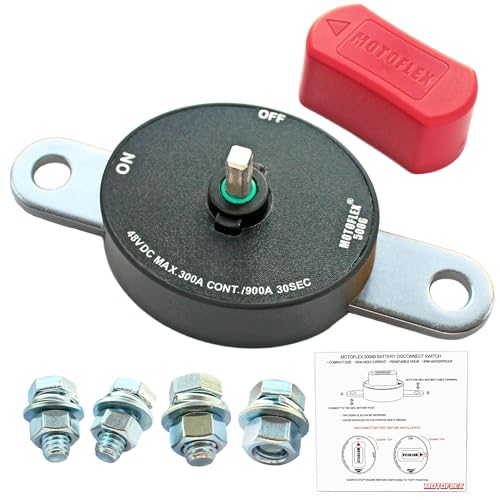
- 300A continuous, 900A cranking capacity
- Compact 1.5-inch height
- IP66 housing with removable knob
Best For: Tight marine or RV engine compartments requiring high current capacity
Two-Pack Heavy-Duty Pick
275A 12V-48V Battery Disconnect Switch
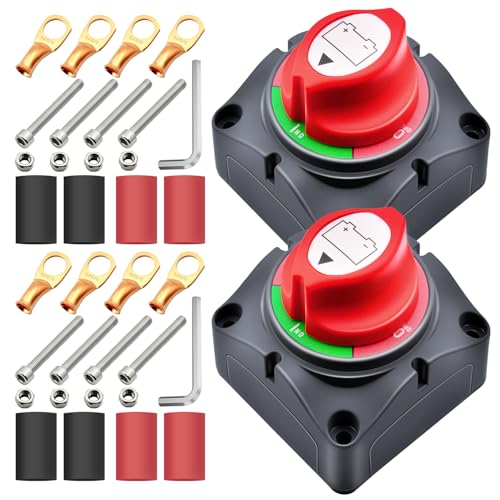
- 275A continuous rating at 12V
- 12V-48V DC compatibility
- Includes two switches and wiring hardware
Best For: Simple dual-switch boat or RV installations
Battery-Bank Control Pick
300A 1-Both-2-Off Rotary Switch

- Four-position bank selection
- 300A continuous rating
- Ignition-protected and IP66-rated design
Best For: Dual-battery boats needing select, combine, or off control
Simple Marine Protection Pick
300A Ignition-Protected ON/OFF Switch

- 300A continuous rating
- 12V-48V DC system compatibility
- Includes mounting screws
Best For: Single-circuit boat battery isolation
Best Heavy-Duty Value – Nilight 90015A On/Off Battery Switch
For boat owners seeking battery disconnect switches for boats, the Nilight 90015A is a straightforward on/off isolator for DC systems from 12 to 48 volts. Its waterproof ABS housing, rear terminal cover, and included mounting bolts make it a practical choice for cutting power when a boat is stored or not in use.
Best For: Boats, RVs, trailers, and other 12–48V systems needing a simple master disconnect.
Pros:
- Supports 12–48V DC systems with high stated current capacities.
- IP66-rated housing and rear cover help protect terminals and reduce short-circuit risk.
- Simple two-position on/off operation, with a two-year warranty included.
Cons:
- Provides only on/off control, not battery selection or combining.
- Its listed specifications include varying current ratings, so confirm the rating for your installation.
This is a practical, budget-oriented disconnect for isolating a single battery bank. Choose it when uncomplicated power cutoff matters more than multi-battery management.
Best Premium Selector – Blue Sea e-Series 4-Position Switch
The Blue Sea Systems e-Series selector is designed for boat electrical systems that need more than a basic disconnect. Its four-position rotary selector supports multiple battery-management configurations, while ignition protection makes it suitable for installation in the engine room of gasoline-powered boats.
Best For: Gasoline-powered boats with multiple batteries or more complex battery-selection needs.
Pros:
- Four-position selector enables flexible battery-system operation.
- Ignition protected for engine-room installation on gasoline-powered boats.
- Compact design supports surface or rear-panel mounting.
- Tinned copper studs accept multiple cables and the face has tactile textures for low-light operation.
Cons:
- More complex than a basic on/off disconnect.
- Its 32V DC rating limits use in higher-voltage systems.
With a 325A rating and a limited lifetime warranty, this switch is aimed at durable marine installations. It is a strong fit when battery selection and flexible mounting are priorities.
Best Dual-Battery Control – Seachoice Battery Select Switch
Among battery disconnect switches for boats, the Seachoice Battery Select Switch is built for setups with two or more batteries. It allows the operator to select batteries for starting, charging, or parallel operation, and its 12–50V range suits many marine electrical systems.
Best For: Boat owners managing two or more batteries under 50 volts.
Pros:
- Supports battery selection, charging, starting, and parallel operation.
- Rated for systems under 50V, with 250A continuous and 360A intermittent capacity.
- UL listed, ignition protected, and CE approved.
Cons:
- Larger listed dimensions may require more panel space.
- The IP00 specification does not indicate an ingress-protection rating.
- It is a multi-position selector rather than a simple single on/off cutoff.
This switch offers useful control for traditional dual-battery arrangements. It makes sense when selecting or combining batteries is more important than a compact, basic disconnect.
Best Compact On/Off – Blue Sea Systems m-Series Battery Switch
The Blue Sea Systems m-Series is a compact on/off option for boat owners comparing battery disconnect switches for boats. It offers surface, front-panel, or rear-panel mounting, ignition protection for gasoline-boat engine rooms, and a removable knob that can help prevent unintended current flow during service.
Best For: Space-constrained boat installations needing a durable, single-circuit on/off switch.
Pros:
- Compact design with three mounting choices.
- Ignition protected for suitable engine-room installations on gasoline-powered boats.
- Tin-plated copper studs accept multiple cables.
- Luminous label improves low-light readability, and the knob is removable.
Cons:
- Offers on/off control only, without battery-selection functions.
- The listed specifications cite both a 32V maximum and a 48V operating-voltage figure, so verify compatibility before installation.
This is a well-equipped compact disconnect for a straightforward marine DC circuit. Its flexible mounting and marine-focused construction make it especially useful where panel space is limited.
Best All-Around Kit – SUNMORN 12V-48V Disconnect Switch
For shoppers comparing battery disconnect switches for boats, the SUNMORN stands out as a complete installation kit for standard SAE top-post batteries. Its sealed rotary design, visible status indicator, and included 6AWG cables make it practical for boats, RVs, and other equipment that sits unused between trips.
Best For: Boat owners who want an included cable kit and a clearly visible on/off status indicator.
Pros:
- Includes two pre-crimped 6AWG tinned-copper cables with lugs and adhesive heat shrink.
- IP66-rated sealed design helps protect internal contacts from water and debris.
- Red/green indicator and positive rotary detent make the switch easy to check and less likely to move accidentally.
- Supports 12V, 24V, and 48V systems with a 275A current rating.
Cons:
- Fits standard SAE top posts, not oversized marine terminals.
- Not UL or CE certified.
- The supplied details specify DIY and marine use rather than a universal professional installation.
The SUNMORN is a convenient choice when you want the switch and basic wiring parts together. Confirm your battery-post size and installation clearance before ordering, and follow the included safety guidance during installation.
Best Side-Post Option – Malictele 275A Battery Disconnect
If your boat or vehicle uses a side-post battery, the Malictele is one of the more targeted battery disconnect switches for boats. Its removable-bolt design connects directly to the battery, while the IP67 construction and copper contacts are suited to power isolation across 12V-48V systems.
Best For: Boat, RV, and vehicle owners who need a side-post disconnect with a direct battery connection.
Pros:
- Side-post format can simplify installation without extra battery cables or connectors.
- Removable bolts support maintenance and replacement.
- IP67 protection and copper contacts are specified for use in harsh environments.
- 275A rating supports 12V-48V battery systems.
Cons:
- Designed for side-post batteries, so it may not suit standard top-post battery layouts.
- The package includes the switch only; cables and additional connectors are not listed.
- Its 4.9-inch length may require checking available mounting space.
The Malictele makes the most sense when battery-terminal compatibility is the priority. Verify that your battery has the appropriate side-post arrangement and plan the installation around its panel-mount dimensions.
Best Compact High-Current Switch – 300A Marine Battery Disconnect
For battery disconnect switches for boats installed in tight engine compartments, this compact 12V-48V model offers a low-profile housing and high current capacity. It can be installed on the negative side as recommended, or on the positive side when clearance and wiring requirements allow.
Best For: Marine and RV installations needing a compact, high-current disconnect with a removable knob.
Pros:
- 300A continuous and 900A cranking ratings handle demanding 12V-48V applications.
- IP66 housing and tin-plated copper terminals help resist water and corrosion.
- Compact 1.5-inch height is intended for limited engine-bay space.
- Removable red knob can help prevent unauthorized operation.
Cons:
- Switching off the system can erase stored radio or other electronic memory.
- The supplied hardware uses different bolt sizes, so terminal and clearance compatibility should be checked.
- The product notes recommend negative-side installation, which may not match every boat’s existing wiring layout.
This is a strong fit where space and current capacity matter more than included wiring accessories. Check the terminal-hole and bolt requirements before installation, and account for any electronics that lose memory when power is disconnected.
Two-Pack Heavy-Duty Pick – 275A 12V-48V Battery Disconnect Switch
For shoppers comparing battery disconnect switches for boats, this two-pack offers a straightforward ON/OFF setup for 12V-48V DC systems. Its 275A continuous rating at 12V, insulated terminals, and included wiring accessories make it practical for marine, RV, automotive, and other heavy-duty installations.
Best For: Boat owners who need two simple, surface- or panel-mount disconnect switches.
Pros:
- Supports 12V-48V DC systems with a 275A continuous rating at 12V.
- ABS housing and tinned copper studs are designed for corrosion resistance and conductivity.
- Includes two switches, copper lugs, heat-shrink tubing, bolts, nuts, and hex wrenches.
- Color-coded ON/OFF positions provide clear operation.
Cons:
- It is a single-circuit ON/OFF design, without battery-bank selection.
- The package contains two switches, which may be more than needed for a single installation.
This is a useful value-oriented choice when you want simple power isolation and a backup or second switch. Verify cable sizing, terminal fit, and the intended negative-cable installation before mounting.
Battery-Bank Control Pick – 300A 1-Both-2-Off Rotary Switch
Among battery disconnect switches for boats, this rotary model stands out for managing two battery banks rather than only opening one circuit. Its 1-Both-2-Off arrangement lets you select either bank, combine both, or disconnect the system, while the make-before-break design is intended to avoid interrupting power during switching.
Best For: Boats, yachts, and RVs with dual battery banks and a need for selectable or combined power.
Pros:
- Four-position 1-Both-2-Off selector supports isolated or combined battery-bank operation.
- Make-before-break contacts are designed for uninterrupted switching between banks.
- 300A continuous rating and up to 48V DC operating voltage suit higher-demand systems.
- Ignition-protected design and IP66 rating support marine-oriented installation.
Cons:
- The multi-position layout is more complex than a basic ON/OFF switch.
- Only four mounting screws are listed as included; wiring accessories are not specified.
This is the most versatile option in the group for a dual-bank electrical system. Its larger rotary format and multiple positions make it important to plan access, labeling, and wiring carefully before installation.
Simple Marine Protection Pick – 300A Ignition-Protected ON/OFF Switch
For a straightforward installation, this ON/OFF model is one of the simpler battery disconnect switches for boats. It supports 12V-48V DC systems, uses tinned copper studs, and provides ignition protection with a stated 300A continuous rating for marine, RV, truck, and automotive applications.
Best For: Boat owners seeking a single-circuit master disconnect with included mounting screws.
Pros:
- Simple two-position ON/OFF operation is easy to understand and use.
- Rated for 300A continuously, with stated 900A crank and 500A five-minute ratings.
- Flame-retardant housing and ignition-protected design suit marine environments.
- Included mounting screws and a spacious, partitioned housing can simplify wiring.
Cons:
- It controls one circuit and does not provide dual-bank selection or combining.
- The listed IP54 rating offers less enclosure protection than an IP66-rated option.
This switch is a practical fit when your boat needs basic battery isolation rather than battery-bank management. Its accessible housing and included hardware may help reduce installation effort, but confirm the system voltage, cable capacity, and mounting location first.
How We Picked the Best Battery Disconnect Switches for Boats
We focused on the specifications that matter most in a marine installation: voltage compatibility, current capacity, switching configuration, weather resistance, ignition protection, terminal design, and ease of installation. The selection includes established marine brands such as Blue Sea Systems and Seachoice, along with versatile higher-amperage alternatives for boats, RVs, and other 12V-to-48V systems.
Because electrical layouts vary, a switch’s listed rating should be checked against your battery bank, engine-starting load, inverter, and accessory circuits. A product that works well for a small boat may not be suitable for a large house-bank or high-current starter system.
Quick Comparison
- Basic on/off control: Best for isolating a single battery or bank during storage, maintenance, or emergencies.
- Selector switches: Useful when a boat has two battery banks and you need to choose battery 1, battery 2, both, or off.
- High-current models: Consider these for demanding starter, inverter, or auxiliary-battery applications, provided their continuous and intermittent ratings match your system.
- Waterproof and ignition-protected designs: Preferable in exposed compartments or areas where fuel vapors may be present.
Key Buying Factors for Battery Disconnect Switches for Boats
Switch Type and Circuit Layout
An on/off switch is the simplest choice for one battery bank. A 1-2-both-off selector provides more flexibility, but it must be wired correctly to avoid accidentally combining batteries or compromising charging equipment.
Voltage and Amperage Ratings
Confirm that the switch supports your system voltage, such as 12V, 24V, or 48V. Also check continuous, intermittent, and cranking ratings rather than relying only on a headline amp number. The switch should comfortably handle the maximum load connected to it.
Marine Protection and Terminals
Look for corrosion-resistant construction, sealed housings, waterproofing, and ignition protection when appropriate. Make sure the terminal studs accept your cable size and that you can fit suitable lugs, washers, and protective boots.
Installation and Maintenance
Mount the switch where it is easy to reach but protected from spray and accidental impact. Use marine-grade cable, correctly sized overcurrent protection, secure connections, and a dry mounting surface. Disconnect power before installation and follow the manufacturer’s wiring diagram.
Who Should Buy Which Battery Disconnect Switches for Boats?
Choose a simple on/off model if you need straightforward battery isolation for a small boat, auxiliary bank, or seasonal storage. Choose a selector switch if your boat uses two batteries and you want controlled selection between banks. Choose a heavy-duty, high-amperage switch for larger engines, inverters, or demanding electrical systems—but verify the complete rating and cable compatibility first. For exposed or fuel-sensitive installations, prioritize waterproof and ignition-protected construction over the lowest price.