The right solar extension cable helps position panels for better sunlight without creating unnecessary voltage drop, connection problems, or outdoor safety concerns.
We compare 10 popular 10AWG and 12AWG options in practical lengths from 20 to 50 feet, focusing on conductor size, connector compatibility, durability, and RV or portable-power use.
Best 10 Solar Extension Cables Picks for 2026
Low-Loss Choice
BougeRV 20-Foot 10AWG Solar Extension Cable

- 10AWG tinned copper helps minimize power loss
- IP67, UV-resistant, and rated -40°F to 194°F
- Includes an extra connector and bare-wire end
Best For: Outdoor arrays needing flexible, lower-loss connections
Practical Mid-Range Pick
Renogy 20FT 12AWG Solar Extension Cables

- 20-foot black-and-red pair with male/female connectors
- UV-resistant, waterproof, and TÜV tested
- Designed to create space between panels and controller
Best For: Routine solar-panel extension runs
Long-Run Heavy-Duty Pick
Bateria Power 30FT 10AWG Solar Cable

- Includes two 30-foot 10AWG cables
- IP68 protection with UV- and corrosion-resistant insulation
- Comes with waterproof connectors and two zip ties
Best For: RV, roof, boat, and long outdoor PV runs
Certified 30-Foot Alternative
energeaster 10AWG Solar Extension Cable

- 30-foot black-and-red 10AWG pair
- TÜV and UL certified with IP67 protection
- UV-resistant XLPE insulation rated -40°F to 194°F
Best For: Certified outdoor panel-to-controller connections
Best for Long Runs
Oududianzi 10AWG 30-Ft Solar Extension Cables

- 30-foot red-and-black cable pair
- Tinned copper with XLPE/XLPO protection
- IP68 connector ring and plug-and-play ends
Best For: Outdoor systems needing extended panel placement
Best for Straightforward Setup
Energeaster 10AWG 20-Ft Solar Extension Cable

- 10AWG tinned copper conductors
- IP67 weather and UV resistance
- Self-locking male/female connectors
Best For: Panel-to-charge-controller connections
Best for Added Cable Protection
Bateria Power 10AWG 30-Ft Solar Cable
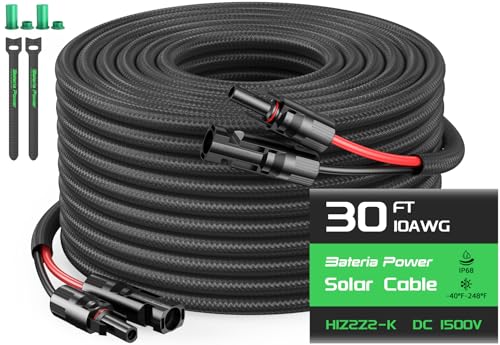
- Flame-retardant protective sleeving
- IP68 connectors with dust caps
- -40°F to 248°F stated temperature range
Best For: Outdoor home and RV systems needing extra abrasion protection
Long-Run Certified Pick
Vansdon 30-Foot 10AWG Solar Extension Cables

- 30-foot red-and-black cable pair
- 10AWG tinned copper conductors
- IP67 and outdoor-rated construction
Best For: RV and photovoltaic systems needing a certified 30-foot cable pair
Flexible Setup Option
JXMXRPV 33-Foot 10AWG Solar Cable

- 33 feet of added cable reach
- 10AWG, 6mm² solar wire
- UV-resistant and waterproof design
Best For: Installations needing flexible panel positioning and a 33-foot extension
Extra-Length Choice
Vansdon 50-Foot 10AWG Solar Extension Cables
- 50-foot black-and-red cable pair
- 10AWG, 6mm² tinned copper wire
- IP67 waterproof and weather resistant
Best For: RV and photovoltaic systems needing a longer 50-foot outdoor run
Low-Loss Choice – BougeRV 20-Foot 10AWG Solar Extension Cable
For solar extension cables that prioritize lower resistance and outdoor durability, the BougeRV 20-foot 10AWG pair is a strong option. Its tinned copper conductors, UV-resistant XLPE insulation, and included extra connector support flexible solar-panel placement and controller connections.
Best For: Outdoor solar arrays where minimizing power loss and extending panel reach are priorities.
Pros:
- 10AWG tinned copper construction is designed to minimize power loss.
- UL and TÜV certification, plus UV-resistant XLPE insulation, support outdoor use from -40°F to 194°F.
- IP67 sealing and built-in connector locks help resist water, dust, and accidental disconnection.
- Includes an extra connector and a bare-wire end for flexible installations.
Cons:
- At 20 feet, it may not provide enough reach for larger or widely spaced installations.
- The 10AWG design may be more cable than needed for lower-current setups.
Choose this set when you want a robust 10AWG cable with multiple connection options and documented protection for demanding outdoor conditions.
Practical Mid-Range Pick – Renogy 20FT 12AWG Solar Extension Cables
The Renogy 20-foot 12AWG pair offers a straightforward way to add space between solar panels and a charge controller. These solar extension cables have male and female connectors, sunlight-resistant insulation, waterproof construction, and TÜV testing for PV applications.
Best For: Standard solar-panel extensions where a ready-to-use 20-foot black-and-red pair is sufficient.
Pros:
- Includes matching 20-foot black and red cables with male and female connectors.
- UV-resistant and waterproof construction is suited to indoor or outdoor use.
- TÜV logo printing provides an at-a-glance indication of PV-application testing.
- Built-in connectors lock onto compatible panel or system connections.
Cons:
- 12AWG conductors are not as substantial as the 10AWG options in this roundup.
- The package includes cables only, with no stated extra connectors or accessories.
- Its 20-foot length may be limiting for larger installations.
This is a sensible fit for uncomplicated installations that need moderate additional distance without extra components or a longer cable run.
Long-Run Heavy-Duty Pick – Bateria Power 30FT 10AWG Solar Cable
When a longer run is more important than compact cable length, the Bateria Power set supplies separate 30-foot black and red 10AWG cables. These solar extension cables use tinned copper conductors, IP68 protection, UV-resistant XLPE/XLPO insulation, and preinstalled waterproof connectors.
Best For: RV, roof, boat, and other outdoor photovoltaic systems that need 30 feet of reach per cable.
Pros:
- Two 30-foot 10AWG cables provide substantially more reach than 20-foot alternatives.
- IP68 protection and UV-, corrosion-, and fire-resistant insulation support extended outdoor use.
- Preinstalled male and female connectors use a stable locking and unlocking design.
- Includes two cable zip ties to help organize the installation.
Cons:
- The 30-foot pair weighs about 1.48 kg, making it less convenient to transport and manage.
- Longer cable runs may require more careful routing and organization.
Its combination of length, 10AWG conductors, and IP68 protection makes this the most suitable choice here for installations that need extended outdoor routing.
Certified 30-Foot Alternative – energeaster 10AWG Solar Extension Cable
The energeaster pair combines 30-foot reach with 10AWG tinned copper conductors and preinstalled male and female connectors. For solar extension cables intended for outdoor systems, its TÜV and UL certifications, IP67 weather protection, and XLPE insulation provide useful installation-focused safeguards.
Best For: Outdoor solar-panel and charge-controller connections requiring a 30-foot black-and-red pair.
Pros:
- 30-foot black and red cables offer extended reach for panel-system layouts.
- 10AWG tinned copper is designed to reduce power loss and resist oxidation.
- IP67 protection, UV resistance, and an operating range of -40°F to 194°F suit harsh outdoor environments.
- TÜV and UL certifications and self-locking connectors support a secure installation.
Cons:
- The notes specify a maximum current of 30A, which may limit higher-current applications.
- No cable-management accessories are listed in the package contents.
- Compatibility is described for similar connector types, so connector matching should be checked first.
This cable is a well-rounded 30-foot option when certification, weather resistance, and straightforward male-to-female connections matter more than included accessories.
Best for Long Runs – Oududianzi 10AWG 30-Ft Solar Extension Cables
For longer cable runs, these solar extension cables pair 10AWG tinned copper conductors with a 30-foot red-and-black set. The XLPE/XLPO construction, weather resistance, and included connectors make them a practical option for outdoor solar installations where durability and flexible panel placement matter.
Best For: Home, RV, boat, and other outdoor solar systems needing a 30-foot cable pair.
Pros:
- Includes one 30-foot red cable and one 30-foot black cable for polarity identification.
- Tinned pure copper is designed for conductivity and improved corrosion resistance.
- XLPE insulation and an XLPO jacket are rated for -40°F to 194°F and outdoor exposure.
- IP68 waterproof connector ring and plug-and-play male/female connectors support secure connections.
Cons:
- The 30-foot length may be excessive for compact installations.
- 10AWG cable can be heavier and less convenient to route than thinner wire.
Choose this set when you want extra reach and robust outdoor protection. Verify your system’s connector type, voltage, and current requirements before installation.
Best for Straightforward Setup – Energeaster 10AWG 20-Ft Solar Extension Cable
This 10AWG solar extension cable set offers a more manageable 20-foot length for connecting panels to charge controllers or related equipment. Its tinned copper conductors, UV-resistant construction, and male/female locking connectors are suited to outdoor solar wiring.
Best For: Solar panel and charge-controller connections where a 20-foot extension is sufficient.
Pros:
- 10AWG tinned copper construction is designed to reduce power loss and resist corrosion.
- IP67 waterproofing, dust resistance, UV resistance, and high-temperature protection support outdoor use.
- XLPE dual-sheath construction is rated for operation from -40°F to 194°F.
- Male and female self-locking connectors can be joined for longer cable runs.
Cons:
- The supplied notes contain conflicting length information, listing both 20 feet and 40 feet.
- Connector compatibility should be confirmed with the existing solar equipment before purchase.
This is a practical choice for buyers who want a 10AWG cable with a locking connector system and outdoor-oriented protection. Confirm the actual package length and system specifications before ordering.
Best for Added Cable Protection – Bateria Power 10AWG 30-Ft Solar Cable
These 10AWG solar extension cables add a flame-retardant protective sleeve to help handle abrasion, tangling, and repeated coiling. With 30 feet of cable, IP68 waterproof connectors, dust caps, and a stated operating range of -40°F to 248°F, they are built for demanding outdoor solar setups.
Best For: Home and RV installations where abrasion protection and high-temperature resistance are priorities.
Pros:
- Heavy-duty flame-retardant sleeving helps protect against dragging, tangling, and daily wear.
- TÜV-approved XLPO insulation and jacket provide UV, flame, and weather resistance.
- Rated for environments from -40°F to 248°F, according to the supplied product notes.
- Includes IP68 male and female waterproof connectors plus dust caps.
Cons:
- The protective sleeve may add bulk compared with an unsleeved solar cable.
- Compatibility still needs to be checked against the specific inverter, controller, or battery system.
Consider this cable when physical protection and a broad temperature rating matter as much as reach. Its 30-foot length suits outdoor routing, but confirm connector and electrical specifications for your system.
Long-Run Certified Pick – Vansdon 30-Foot 10AWG Solar Extension Cables
These Vansdon solar extension cables provide a 30-foot red-and-black pair for connecting panels to a charge controller or other compatible solar equipment. The 10AWG tinned copper conductors, installed male and female connectors, and outdoor-focused insulation make them a practical choice when you need a durable cable run for an RV or photovoltaic system.
Best For: RV owners and outdoor solar setups needing a certified 30-foot cable pair.
Pros:
- Includes one 30-foot black cable and one 30-foot red cable.
- 10AWG tinned copper construction is designed to reduce power loss.
- IP67 waterproofing, UV resistance, and a -40°C to 90°C temperature range support outdoor use.
- Preinstalled male and female connectors use a self-locking design.
Cons:
- The 30-foot length may not suit installations requiring longer runs.
- Connector compatibility should be confirmed before purchase.
With TUV, CE, and RoHS certifications plus a stated 54A rating, this pair offers substantial specifications for a mid-length solar connection. Its two-year warranty is an added consideration for buyers prioritizing documented coverage.
Flexible Setup Option – JXMXRPV 33-Foot 10AWG Solar Cable
This 33-foot solar extension cable is intended to add reach between solar panels, inverters, and related components. Its 6mm², 10AWG wire and red-and-black color coding can help with flexible panel placement, while the supplied male-to-female connectors are designed for a secure connection.
Best For: Solar installations that need a slightly longer-than-standard extension for flexible component placement.
Pros:
- Provides 33 feet of additional cable reach.
- Uses 10AWG, 6mm² wire for solar system connections.
- Weather-resistant construction is described as UV resistant and waterproof.
- Male-to-female connectors are included for straightforward installation.
Cons:
- The notes do not specify certifications or a temperature range.
- The listing identifies one cable, so buyers needing a complete red-and-black pair may need to verify the package contents.
This is a straightforward choice when extra reach is the priority. Before ordering, confirm whether the single listed cable and its connector configuration match your system’s polarity and wiring plan.
Extra-Length Choice – Vansdon 50-Foot 10AWG Solar Extension Cables
For panels positioned farther from a charge controller or related equipment, this Vansdon set supplies one 50-foot black cable and one 50-foot red cable. These solar extension cables use 10AWG, 6mm² tinned copper wire with installed connectors, making the pair suited to longer outdoor runs in RV and photovoltaic applications.
Best For: Larger outdoor solar layouts and RV installations that require a 50-foot cable pair.
Pros:
- Includes matching 50-foot black and red cables for a long connection run.
- 10AWG tinned copper conductors are designed for conductivity and corrosion resistance.
- IP67 waterproofing and double-protection insulation support outdoor use.
- Self-locking male and female connectors are installed at the cable ends.
Cons:
- A 50-foot run may be excessive for compact systems and can require more cable management.
- Connector gender details in the listing should be checked against the equipment being connected.
This pair stands out when reach matters more than compactness. Its stated 57A rating, weather-resistant construction, and two-year warranty make it a practical long-run option, provided the connector arrangement fits your system.
How We Picked the Best Solar Extension Cables
We focused on the factors that matter most when extending a photovoltaic connection: wire gauge, cable length, connector design, outdoor durability, and ease of installation. The products in this roundup include common 10AWG and 12AWG cables, pre-attached male and female connectors, and lengths suited to portable solar generators, RVs, vans, cabins, and home backup setups.
We also considered whether a cable is sold as a single run or matched pair. A pair is often more convenient because it provides both positive and negative leads, while longer cables may offer more flexibility at the cost of added resistance, bulk, and storage difficulty.
Quick Comparison
| Best For | Recommended Type | What to Look For |
|---|---|---|
| Short portable setups | 20-foot cable | Flexible construction and compatible connectors |
| RV and rooftop panel placement | 30- to 33-foot cable | 10AWG copper conductors and weatherproof ends |
| Long-distance routing | 50-foot cable | Low voltage-drop design and secure cable management |
| Frequent outdoor use | UV- and flame-resistant cable | Durable insulation and sealed connectors |
Key Buying Factors for Solar Extension Cables
Wire Gauge and Voltage Drop
Lower gauge numbers indicate thicker wire. Most of the options here use 10AWG conductors, which are a practical choice for many portable and RV solar systems. The 12AWG Renogy option can work well for shorter runs and moderate current. As cable length and system amperage increase, voltage drop becomes more important, so avoid choosing a long cable solely because it is inexpensive.
Length and Cable Management
Choose the shortest length that lets you place the panel safely in full sun. Extra cable can create loops, trip hazards, and unnecessary electrical loss. For 30 feet or more, plan how the cable will be secured and protected from sharp edges, heat, standing water, and vehicle traffic.
Connectors and Weather Protection
Confirm that the male and female connectors match the connectors on your panels, charge controller, or solar generator. Waterproof or IP68-rated connectors are useful outdoors, but they still need to be fully seated and kept free of dirt. Do not force incompatible plugs together or rely on adapters that are not rated for the system.
Conductor and Insulation Quality
Tinned copper, UV-resistant insulation, and flame-retardant protective sleeving can improve durability in demanding environments. Check the product specifications for temperature, current, and voltage ratings before installation.
Who Should Buy Which Solar Extension Cables?
Choose a 20-foot cable for compact portable power stations, balcony panels, or setups where the controller stays close to the array. A 30- to 33-foot 10AWG cable is a versatile choice for most RV and ground-based installations. Select a 50-foot option when shade, vehicle placement, or roof layout requires substantial distance, but verify voltage-drop limits first.
For the simplest installation, select a matched pair with preinstalled connectors. If you are building a custom system, prioritize exact connector compatibility and electrical ratings over brand or length alone. Before buying any of these Solar Extension Cables, compare your panel output, cable run, connector type, and charge-controller requirements.