A dependable battery disconnect switch can help prevent parasitic drain, simplify RV storage, and provide a convenient way to isolate the house battery during maintenance or emergencies.
These 10 options cover common top-post and side-post installations, multiple voltage ranges, heavy-duty current ratings, and weather-resistant designs. Before choosing, confirm your battery-terminal style, system voltage, available space, and expected load.
Best 10 Battery Disconnect Switches for Rvs Picks for 2026
Heavy-Duty Pick
Nilight 12-48V Waterproof Battery Switch

- 12-48V compatibility
- IP66 housing with rear terminal cover
- 275A continuous rating at 12V
Best For: High-capacity RV and battery-bank installations
Premium Marine-Grade Pick
Blue Sea Systems m-Series On/Off Switch

- Compact 2.7-inch design
- Surface, front, or rear mounting
- Tin-plated copper cable studs
Best For: Compact RV panels and marine-style installations
Complete-Kit Pick
SUNMORN 12-48V Disconnect with Cables

- Includes two pre-crimped 6AWG cables
- IP66 sealed rotary design
- Red/green on/off indicator
Best For: DIY installations on standard SAE top-post batteries
Keyed Security Pick
200A RV Battery Cut-Off Switch

- 12-24V operation
- Includes two removable keys
- IP54 water-resistant case
Best For: Basic RV setups needing removable-key control
Best Heavy-Duty Value
Spurtar 200A Battery Disconnect Switch

- 200A continuous, 1,000A intermittent rating
- Supports 12–48V DC systems
- Includes lugs, heat shrinks, and insulators
Best For: High-current RV and vehicle battery isolation
Best Side-Post Design
Malictele 275A Side-Post Battery Switch

- 275A rating for 12–48V systems
- Direct side-post battery connection
- IP67-rated construction
Best For: Compatible side-post RV battery installations
Best Compact Marine-Grade Option
300A Waterproof Battery Disconnect
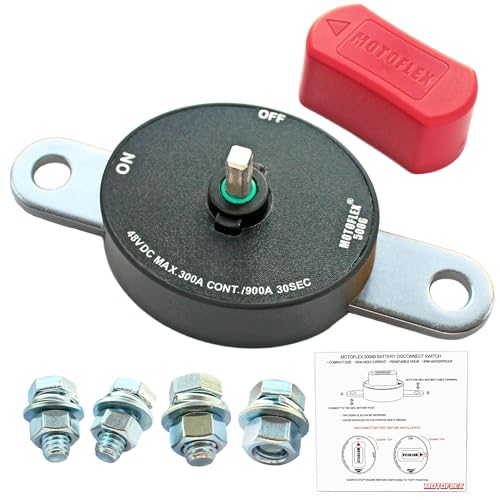
- 300A continuous, 900A crank rating
- 1.5-inch height for tight spaces
- IP66 housing with corrosion-resistant terminals
Best For: Compact, high-current RV and marine installations
Best High-Current Pick
12V-48V 275A Rotary Disconnect

- 275A continuous and 1250A cranking rating
- Supports 12–48V DC systems
- Includes mounting hardware and cable-access plates
Best For: High-current RV and multi-vehicle installations
Best Side-Post Pick
275A Waterproof Battery Cutoff

- Connects directly to side-post batteries
- 275A continuous and 1250A cranking rating
- IP65 housing with insulated rear cover
Best For: RVs using compatible side-post battery connections
Heavy-Duty Pick – Nilight 12-48V Waterproof Battery Switch
For shoppers comparing battery disconnect switches for RVs, the Nilight 90015A is a heavy-duty on/off isolator designed for 12-48V systems. Its waterproof housing, insulated rear cover, and high current ratings make it a practical choice for RVs, campers, trailers, trucks, and battery banks.
Best For: RV owners who need a high-capacity master disconnect for a 12-48V electrical system.
Pros:
- Supports 12-48V systems with 275A continuous, 455A intermittent, and 1250A momentary ratings at 12V.
- Waterproof IP66-rated design with an ABS housing and rear terminal cover.
- Includes four mounting bolts and can be used alone or locked together with another switch.
- Backed by a two-year warranty.
Cons:
- Its relatively large, heavy-duty design may be more than needed for smaller RV electrical setups.
- The supplied specifications contain inconsistent temperature and current details, so verify system requirements before installation.
The Nilight is a strong option when current capacity and weather resistance are priorities. Confirm the mounting space and cable-terminal fit before buying.
Premium Marine-Grade Pick – Blue Sea Systems m-Series On/Off Switch
The Blue Sea Systems m-Series is a compact option for battery disconnect switches for RVs, especially where mounting flexibility and durable electrical connections matter. It offers surface, front, or rear mounting, plus a removable knob to help prevent unintended current flow during service.
Best For: RV or marine-style installations that need a compact, flexible, and ignition-protected disconnect.
Pros:
- Compact design supports installation in tight spaces.
- Allows surface, front, or rear mounting for flexible panel placement.
- Tin-plated copper studs accept multiple cables and provide durable connection points.
- Ignition-protected construction is suitable for engine-room locations in gasoline-powered boats.
Cons:
- The listed 32V maximum DC rating may not suit higher-voltage systems.
- Its marine-focused features may be unnecessary for a basic RV disconnect installation.
Choose this model when a compact footprint, adaptable mounting, and marine-grade construction are more important than broad voltage range. Check the system voltage and cable arrangement before installation.
Complete-Kit Pick – SUNMORN 12-48V Disconnect with Cables
The SUNMORN is a convenient choice among battery disconnect switches for RVs because it includes two pre-crimped 6AWG tinned copper cables. Its sealed rotary design, red/green status indicator, and positive detent make it easy to install and check at a glance when an RV is parked.
Best For: DIY RV owners who want a visible disconnect switch with included cables for a standard SAE top-post battery.
Pros:
- Includes two 6AWG cables with tinned copper lugs and adhesive heat shrink.
- IP66 sealed design resists water and corrosion, with a stated operating range of -40°F to 221°F.
- Red/green indicator shows whether power is on or off without drawing power when off.
- Positive rotary detent helps resist accidental switching from vibration or bumps.
Cons:
- Fits standard SAE top-post batteries, not oversized marine terminals.
- It is not UL or CE certified.
- The supplied notes recommend keeping it away from plastic battery boxes and avoiding sparks during connection.
This SUNMORN kit simplifies a basic inline positive-cable installation and adds useful visual feedback. Confirm the battery-post style, cable size, and certification requirements for your application.
Keyed Security Pick – 200A RV Battery Cut-Off Switch
For RV owners looking for battery disconnect switches for RVs with a simple keyed control, this surface-mount isolator uses a rotary knob and two removable keys. It is designed for 12-24V systems and helps eliminate battery drain when an RV, camper, truck, or boat is stored.
Best For: Basic 12-24V RV setups where removable-key control and straightforward surface mounting are useful.
Pros:
- Supports 12-24V systems with a 100A rated current and 200A maximum withstand current at 12V.
- Two removable keys help prevent the power supply from being switched on when the key is removed.
- Water-resistant IP54 case helps protect the keyhole from exposure.
- Brass and copper components are used for the terminals and contact materials.
Cons:
- Its 12-24V range is narrower than models designed for 48V systems.
- IP54 protection is lower than the IP66 rating offered by some alternatives.
- The supplied details list a 1-position specification despite describing on/off operation, so confirm the intended wiring before installation.
This switch is a practical, budget-oriented fit when keyed removal is a priority. Verify the current demands, terminal dimensions, and mounting surface before choosing it for an RV.
Best Heavy-Duty Value – Spurtar 200A Battery Disconnect Switch
For RV owners comparing battery disconnect switches for RVs, the Spurtar offers a straightforward panel-mount solution for isolating 12–48V DC systems. Its 200A continuous rating, included wiring accessories, and clearly marked toggle make it practical for routine storage and maintenance.
Best For: RVs and other vehicles needing a high-current, easy-to-operate battery shutoff.
Pros:
- Supports 200A continuous and 1,000A intermittent current.
- Works with 12–48V systems across RVs, campers, boats, trucks, and more.
- Includes copper lugs, heat shrinks, and rubber terminal insulators.
- Clearly marked ON/OFF toggle operates with a positive click.
Cons:
- Panel mounting may require suitable installation space and hardware.
- Its IP55 rating is lower than the more weather-resistant options in this roundup.
The Spurtar is a well-equipped choice when you want a conventional toggle switch and useful installation accessories in one kit. Verify cable size, clearance, and system current before installation.
Best Side-Post Design – Malictele 275A Side-Post Battery Switch
The Malictele is one of the more specialized battery disconnect switches for RVs, using a side-post layout for direct battery connection. Its removable bolts are intended to simplify installation, maintenance, and replacement while providing a 275A-rated on/off isolation point.
Best For: RVs, campers, and boats using a compatible 12–48V side-post battery setup.
Pros:
- Side-post design can connect directly to the battery without additional cables or connectors.
- 275A current rating suits many higher-demand vehicle systems.
- Removable bolts support maintenance and replacement.
- IP67-rated construction is designed for demanding environments.
Cons:
- Side-post compatibility may limit fitment compared with more universal designs.
- The package includes the switch only, so additional installation components may be needed.
This switch makes the most sense when your RV battery and available clearance match its side-post configuration. Confirm terminal compatibility and mounting dimensions before ordering.
Best Compact Marine-Grade Option – 300A Waterproof Battery Disconnect
For buyers seeking compact battery disconnect switches for RVs, this 12–48V model is designed for limited installation space and can be fitted on the negative battery side. It combines a 300A continuous rating with tin-plated copper terminals, a removable knob, and a temperature-rated PA66 housing.
Best For: RVs and marine vehicles needing a compact, high-current disconnect for storage or parasitic-drain prevention.
Pros:
- 300A continuous and 900A crank-amp rating.
- Compact 1.5-inch height suits restricted engine-bay spaces.
- IP66 construction and corrosion-resistant tin-plated copper terminals.
- Removable red knob can help prevent unauthorized operation.
Cons:
- Switching off the system can erase stored radio or electronic memory.
- Installation requires checking clearance and selecting the appropriate terminal side.
- It is surface-mounted and may need careful placement in an RV compartment.
This is a strong fit for compact RV installations where current capacity and environmental resistance matter. Because it disconnects the whole battery system, plan for electronics that need continuous power or memory retention.
Best High-Current Pick – 12V-48V 275A Rotary Disconnect
For shoppers comparing battery disconnect switches for RVs, this rotary master switch is a versatile choice for 12–48V DC systems. It supports 275A of continuous power for up to one hour, with higher intermittent and cranking ratings, and uses a surface-mount design with screw terminals.
Best For: RV owners needing a high-current, manually operated disconnect that can also work with cars, trucks, boats, and other DC equipment.
Pros:
- Handles 275A continuous, 455A intermittent, and 1250A cranking loads.
- Works with 12–48V DC systems.
- Includes mounting screws, protective caps, and removable side plates for cable access.
- ABS housing and tinned copper studs support durable installation.
Cons:
- Requires surface mounting and screw-terminal cable connections.
- Rotary installation may be less convenient than a battery-post-mounted design.
This is a practical option when current capacity and broad voltage compatibility matter most. Its manual on/off operation also helps limit battery drain while an RV is stored.
Best Top-Post Option – 250A Negative Battery Disconnect
If you want battery disconnect switches for RVs with a straightforward battery-post installation, this Joinfworld top-post model is designed for the negative terminal. Its two-position on/off control supports 12–48V systems and is rated for 250A continuous and 1000A cranking current.
Best For: RVs, campers, boats, and vehicles using a compatible tapered negative battery post.
Pros:
- Installs directly on a negative top battery post.
- Rated for 250A continuous and 1000A cranking current.
- Uses a simple on/off lever for quick power isolation.
- Includes a copper clamp and tapered post, with an IP65 rating and two-year warranty.
Cons:
- Designed for top-post batteries rather than side-post batteries.
- Its 250A continuous rating is lower than the higher-current alternatives in this roundup.
The direct negative-terminal design can simplify installation when your RV battery layout is compatible. It is a convenient choice for preventing excessive discharge during storage without adding a separate surface-mounted switch.
Best Side-Post Pick – 275A Waterproof Battery Cutoff
For RVs equipped with side-post batteries, this Joinfworld switch offers a direct connection without requiring additional parts. It supports 12–48V DC systems, carries 275A continuously for up to one hour, and includes a rear cover to insulate the terminals.
Best For: RVs, campers, trucks, boats, and other vehicles with compatible side-post battery connections.
Pros:
- Designed for direct side-post battery installation.
- Rated for 275A continuous, 455A intermittent, and 1250A cranking loads.
- Uses M10 tinned copper studs and a copper conductive sheet.
- IP65-rated housing and rear terminal cover provide added protection.
Cons:
- Only suits installations compatible with side-post batteries.
- The side-post format may require more available mounting space than a top-post clamp.
This is the most targeted choice for an RV with side-mounted battery terminals. Its high current ratings and insulated rear cover make it well suited to isolating the battery during storage or maintenance.
How We Picked the Best Battery Disconnect Switches for Rvs
We compared these Battery Disconnect Switches for Rvs by looking at the specifications most likely to affect real-world installation and use: voltage compatibility, continuous or maximum current capacity, terminal style, construction, weather resistance, included keys, and the switch’s intended application. We also considered whether each design is better suited to a house battery, auxiliary battery bank, or compact emergency-shutoff installation.
Ratings and features can vary by seller and revision, so verify the current product specifications before ordering. A switch should never be selected by appearance alone; its terminals and internal contacts must be suitable for the cable size and electrical load in your RV.
Quick Comparison
| Feature | What to compare | Why it matters |
|---|---|---|
| Connection style | Top-post or side-post | Must match the battery and available mounting space. |
| Voltage range | 12V, 24V, 48V, or a broader rating | Ensures compatibility with your battery system. |
| Current capacity | Continuous and peak amperage | Helps prevent overheating under normal and startup loads. |
| Environmental protection | Waterproof or corrosion-resistant construction | Useful in battery compartments exposed to moisture, dirt, or road spray. |
| Access control | Removable or included keys | Adds convenience and can discourage unauthorized use. |
Key Buying Factors for Battery Disconnect Switches for Rvs
Match the Battery Connection
Top-post switches install on standard battery posts, while side-post models attach through a side-terminal connection. Check the battery layout and measure the surrounding clearance before purchasing. A switch that fits electrically may still interfere with a cover, cable, or compartment door.
Size the Switch for the System
Choose a voltage rating equal to or greater than your RV’s battery system voltage. The amperage rating should also exceed the highest expected continuous load, with enough margin for inverter startup, motor loads, or other short-duration surges. Do not use a small auxiliary switch as a substitute for a properly rated high-current master disconnect.
Consider the Installation Environment
For exterior compartments, marine-style battery bays, or damp storage areas, prioritize corrosion-resistant and weather-resistant construction. Even a sealed switch benefits from clean, tight cable connections and protection from direct water pooling.
Think About Everyday Operation
An on/off switch is useful for seasonal storage and maintenance, but turning off the wrong battery may also disable alarms, memory functions, solar charging, or other equipment. Follow your RV and battery-system instructions, and disconnect shore power and charging sources as required before servicing.
Who Should Buy Which Battery Disconnect Switches for Rvs?
Choose a straightforward heavy-duty master switch if you want a simple way to isolate an RV house battery during storage or repairs. A top-post model is usually the practical choice for conventional batteries with accessible top terminals. Select a side-post switch when the battery uses side connections or the installation has limited vertical clearance.
If your RV includes an inverter, large 12V loads, or multiple batteries, prioritize a high-current model and confirm the manufacturer’s continuous rating rather than relying only on a headline peak figure. Buyers who park in wet or dusty conditions should favor waterproof or corrosion-resistant construction, while those seeking added control may prefer a design with removable keys. When in doubt, compare the switch rating with the battery manufacturer’s guidance and have a qualified technician verify the installation.