A remote-controlled battery disconnect switch can help prevent parasitic drain, improve vehicle storage security, and make power isolation more convenient. The right choice depends on your vehicle’s system voltage, maximum current, installation space, and preferred control features.
We compare 10 popular options ranging from compact 12V units to higher-capacity 12V/24V models with LED displays, smart voltage protection, and anti-theft functions.
Best 10 Remote Controlled Battery Disconnect Switches Picks for 2026
Best Overall
Heavy-Duty Remote Battery Disconnect
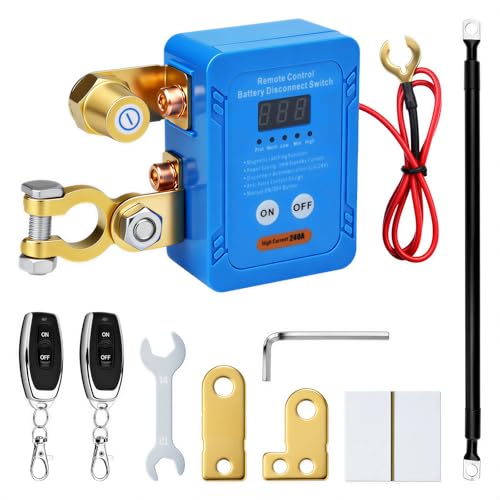
- 240A continuous, 500A one-second surge rating
- 12V/24V support with LED voltage display
- Includes remotes, wiring, hardware, and adapters
Best For: Broad vehicle compatibility and a complete installation kit
Best Smart Protection
250A Remote Battery Disconnect

- 250A capacity with 1mA standby draw
- Automatic shutoff below 11.8V
- Vertical or horizontal mounting options
Best For: 12V vehicles under 3.0L needing automatic battery protection
Best Compact Option
140A 12V/24V Remote Disconnect
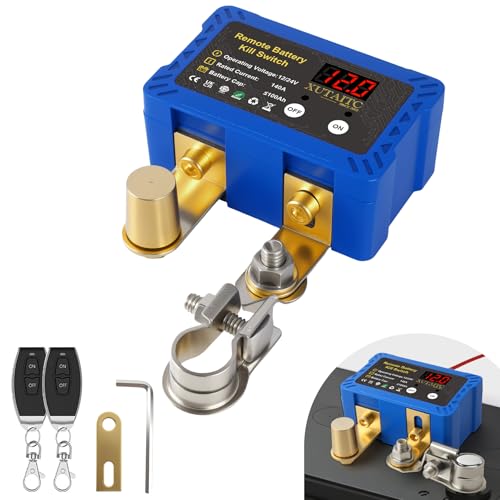
- Supports 8V–30V battery systems
- LED voltmeter with low-voltage protection
- Compact IP65 housing with flexible mounting
Best For: Moderate-current vehicles with limited installation space
Best High-Surge 12V Pick
RVBOATPAT 240A Remote Kill Switch
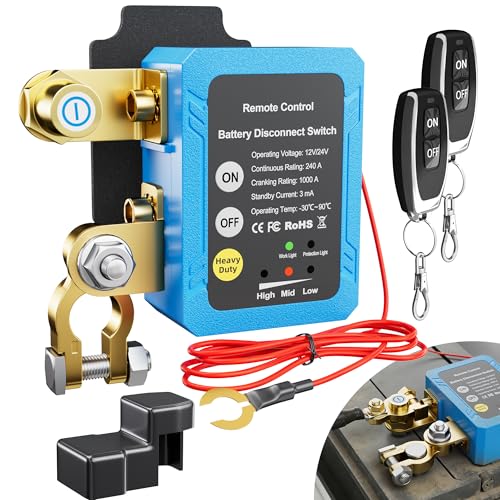
- 240A continuous and 1000A instant-current rating
- 3mA standby draw with 11.8V shutoff
- Remote lockout helps prevent shutdown while driving
Best For: High-current 12V cars, trucks, RVs, and boats
Smart 250A Protection
Dual-Control Remote Battery Disconnect

- 12V/24V, 250A design for multiple vehicle types
- Remote and manual controls with LED confirmation
- 0.7mA standby draw helps reduce battery drain
Best For: Stored vehicles needing remote convenience and manual backup
Simple 12V Security
250A Remote Battery Kill Switch
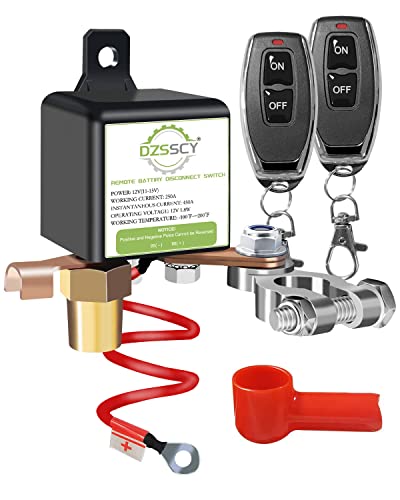
- 250A rating with up to 450A instantaneous current
- Negative-terminal installation for 12V vehicles
- Remote shutoff helps address parked-vehicle battery drain
Best For: 12V cars, trucks, RVs, and motorcycles needing basic remote isolation
Heavy-Duty Smart Control
Positive-Terminal 12V/24V Disconnect

- 300A continuous and 1000A cranking capacity
- Automatic 12V/24V detection with smart voltage protection
- 3mA standby draw plus two remote controls
Best For: High-current vehicles and long-term storage applications
Smart Safety Pick

- 240A capacity for 12V vehicles
- 0.003A standby current
- Remote, manual, and voltage-based protection
Best For: Low-drain battery isolation for cars, trucks, and RVs
Multi-Voltage Choice

- Supports 12V and 24V systems
- 240A continuous, 500A instant rating
- Two remotes plus LED voltmeter
Best For: Cars, boats, RVs, and other 12V/24V vehicles
High-Capacity Option
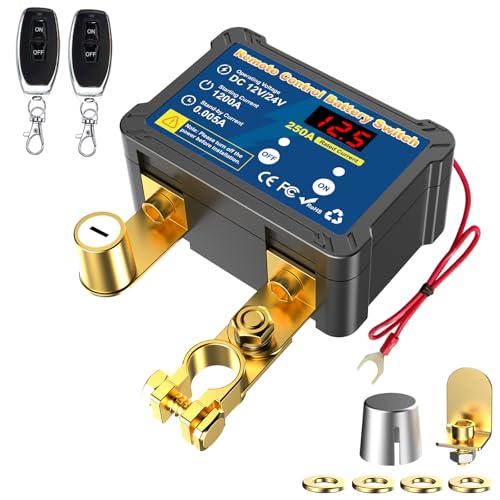
- 250A continuous and 1200A cranking rating
- 0.005A standby current
- 30–70m remote range with manual override
Best For: Demanding 12V cars, trucks, RVs, boats, and motorcycles
Best Overall – Heavy-Duty Remote Battery Disconnect
For drivers comparing remote controlled battery disconnect switches, this 12V/24V model combines remote shutoff, voltage monitoring, and a high 240A continuous rating. Its included hardware and side-terminal adapters make it a practical choice for cars, trucks, RVs, boats, and ATVs.
Best For: Vehicle owners who want broad compatibility, anti-theft protection, and an included installation kit.
Pros:
- Supports 12V/24V systems with 240A continuous and 500A one-second surge capacity.
- LED display provides real-time voltage monitoring with stated ±0.5V accuracy.
- Includes two remotes, 10AWG wiring, mounting hardware, wrenches, terminal clamps, and side-terminal adapters.
- Flame-retardant ABS housing and gold-plated copper terminals are rated for temperatures from -22°F to 194°F.
Cons:
- Not recommended for heavy-duty construction vehicles or engines with starting currents above 600A.
- The large accessory kit may be more than needed for a simple installation.
This is the most versatile option in the group for users who value a complete kit and 12V/24V flexibility. Confirm your vehicle’s starting-current demands before installation.
Best Smart Protection – 250A Remote Battery Disconnect
This 12V remote controlled battery disconnect switch is designed to reduce battery drain during storage while handling loads up to 250A. Its LED display, automatic low-voltage shutoff, and flexible mounting plates suit a range of vehicles under 3.0L.
Best For: Owners of 12V cars, boats, RVs, trailers, trucks, ATVs, UTVs, and motorcycles seeking automatic battery protection.
Pros:
- Handles up to 250A and draws only 1mA in standby mode.
- LED voltage monitoring automatically shuts off below 11.8V after 120 seconds.
- Remote operation is disabled above 13.6V to help prevent accidental power loss while driving.
- Included metal plates support vertical or horizontal mounting in a compact 3.3 x 2.4 x 1.4-inch housing.
Cons:
- Designed for 12V systems rather than 12V/24V applications.
- Its stated vehicle range is limited to vehicles under 3.0L.
The automatic voltage rules make this a useful choice for parked vehicles and users who want added protection against deep discharge. Check the 12V requirement and engine-size limitation before buying.
Best Compact Option – 140A 12V/24V Remote Disconnect
Among remote controlled battery disconnect switches, this 140A model stands out for its compact form and support for 8V–30V battery systems. It adds an LED voltmeter, remote control, and automatic low-voltage protection for stored or regularly used vehicles.
Best For: Cars, boats, RVs, trucks, ATVs, UTVs, and motorcycles with 50Ah–100Ah batteries and moderate current requirements.
Pros:
- Works across 8V–30V systems and is rated for 140A.
- Built-in LED voltmeter and latching relay use ultra-low standby power.
- Automatically disconnects after 300 seconds at specified low-voltage conditions.
- IP65-rated housing supports flat or side-mount installation with adjustable connection tabs.
Cons:
- Its 140A rating is lower than the 240A and 250A alternatives.
- Designed for negative-terminal connection, so installation compatibility should be confirmed first.
- Remote operation is disabled during specified charging-voltage ranges.
This is a sensible space-saving pick when the vehicle’s current demand fits its 140A rating. Verify battery capacity, terminal arrangement, and mounting space before installation.
Best High-Surge 12V Pick – RVBOATPAT 240A Remote Kill Switch
This 12V remote controlled battery disconnect switch is built for high-current vehicle applications, with 240A continuous capacity and a stated 1000A instantaneous rating. Its magnetic latching relay, automatic shutoff, and driving-safety lockout make it suited to cars, trucks, RVs, and boats.
Best For: 12V vehicle owners who need high surge handling and low standby consumption for storage or marine use.
Pros:
- Rated for 240A continuous current and up to 1000A instant current.
- Uses only 3mA in standby and cuts power at a critically low 11.8V.
- Remote control is disabled during engine cranking or when voltage exceeds the stated safe range.
- IP65-rated construction and negative-terminal installation suit cars, trucks, RVs, and boats.
Cons:
- Only supports 12V systems.
- Installation is designed around the negative battery terminal, which may not suit every setup.
- The product details specify a 30°C lower temperature rating, offering less cold-weather information than some alternatives.
With its high stated surge capacity and low standby draw, this switch is attractive for larger 12V starting systems and stored vehicles. Confirm terminal placement and electrical requirements before fitting it.
Smart 250A Protection – Dual-Control Remote Battery Disconnect
This 250A option is a versatile choice among remote controlled battery disconnect switches for 12V and 24V cars, trucks, RVs, trailers, ATVs, and boats. It combines key-fob control with a manual button, while its low 0.7mA standby draw helps reduce battery drain during storage.
Best For: Owners who want remote and manual control, broad vehicle compatibility, and a battery-saving disconnect for parked or stored vehicles.
Pros:
- Supports 12V and 24V systems with a 250A current rating.
- Offers both remote and manual ON/OFF operation with five green status LEDs.
- Very low 0.7mA standby current helps limit long-term battery drain.
- Includes smart voltage behavior intended to help prevent accidental shutdown at low voltage.
Cons:
- Fits tapered battery posts measuring only 15–17mm.
- The external antenna must be extended for improved remote range.
- Installation requires securely tightened screws and is not intended for industrial equipment.
Choose this model if status feedback and dual-control convenience matter as much as basic battery isolation. Verify the battery-post dimensions and installation requirements before ordering.
Simple 12V Security – 250A Remote Battery Kill Switch
This 12V model is a straightforward pick among remote controlled battery disconnect switches for cars, trucks, RVs, trailers, campers, and motorcycles. It is designed to disconnect the negative battery terminal remotely, helping address battery drain during parking while adding a basic anti-theft measure.
Best For: 12V vehicle owners looking for a relatively simple negative-terminal installation and remote battery shutoff.
Pros:
- Rated for 250A with instantaneous current up to 450A.
- Remote operation can help reduce battery drain while the vehicle is parked.
- Designed for installation at the negative terminal, with a simplified wiring arrangement.
- Suitable for several 12V applications, including cars, trucks, RVs, campers, and motorcycles.
Cons:
- Supports 12V systems only.
- Installation notes specifically caution against disconnecting the positive terminal.
- The supplied information does not indicate a manual control mode or low-standby-current specification.
This is a practical, focused choice if your vehicle uses a 12V battery and you prefer a negative-terminal remote disconnect. Follow the installation guidance carefully to avoid issues with the vehicle’s battery or electrical circuit.
Heavy-Duty Smart Control – Positive-Terminal 12V/24V Disconnect
This DaierTek model stands out among remote controlled battery disconnect switches for its positive-terminal installation, automatic 12V/24V detection, and heavy-duty current handling. Its smart controls are designed to prevent remote shutdown during charging or driving conditions, while the magnetic latching relay draws just 3mA in standby.
Best For: High-current vehicles and stored cars, trucks, RVs, boats, trailers, ATVs, and UTVs needing smart voltage protection and positive-terminal control.
Pros:
- Automatically supports both 12V and 24V systems without manual setup.
- Rated for 300A continuous current and 1000A cranking current.
- Uses only 3mA in standby and includes automatic low-voltage battery protection.
- Provides remote and manual ON/OFF control and includes two remotes.
Cons:
- Positive-terminal installation may require more care than a basic negative-terminal disconnect.
- Its smart remote function is disabled when charging voltage exceeds the stated thresholds.
- The product is larger than a minimal battery-terminal switch, measuring 5 x 4.3 x 1.5 inches.
This is the strongest fit of the three for demanding applications where current capacity, voltage-aware operation, and low standby consumption are priorities. Confirm available mounting space and follow the positive-terminal wiring instructions before installation.
Smart Safety Pick – 12V Remote Kill Switch
This 12V remote battery disconnect switch is designed for cars, trucks, and RVs where battery preservation and remote control are priorities. Its magnetic switch uses only 0.003A in standby, while voltage-based safeguards help prevent unwanted operation while driving and automatic drain during low-voltage conditions.
Best For: Vehicle owners seeking remote and manual battery isolation with very low standby consumption.
Pros:
- 240A rating for compatible 12V vehicle electrical systems
- Automatically disconnects after 120 seconds when voltage falls below 11.8V
- Remote control is disabled above 13.2V to help prevent accidental operation while driving
- Includes a manual control option for maintenance or emergencies
Cons:
- Designed for 12V systems rather than 24V applications
- Installation requires connecting and mounting the switch correctly
With remote and manual control, low standby draw, and automatic voltage protection, this is a practical choice for parked vehicles that need stronger battery-drain prevention.
Multi-Voltage Choice – 12V/24V Smart Disconnect
This remote controlled battery disconnect switch supports 12V and 24V vehicle systems and is rated for 240A continuous current. It combines two wireless remotes, low-voltage cutoff protection, an LED voltmeter, and a design intended for cars, trucks, boats, RVs, and motorcycles.
Best For: Owners of mixed 12V/24V vehicles who want voltage monitoring and remote anti-theft control.
Pros:
- Supports both 12V and 24V applications
- Handles 240A continuous and up to 500A instantaneous current
- Includes two wireless remote fobs and an LED voltmeter
- Alerts and disconnects after low-voltage conditions to help prevent over-discharge
Cons:
- Remote operation is disabled above 13.7V/26.3V, requiring manual operation
- Its listed IP0 rating indicates no stated ingress protection
The dual-voltage support and built-in voltage display make this a flexible option, especially when battery status visibility matters as much as remote switching.
High-Capacity Option – 250A Remote Battery Switch
This 12V remote controlled battery disconnect switch pairs a 250A continuous rating with a magnetic latching relay and a stated standby draw of 0.005A. It also offers remote operation from a listed 30–70 meter range, manual override, and adjustable shims for standard or undersized battery posts.
Best For: 12V vehicle owners who want higher continuous capacity, flexible battery-post fit, and dual control.
Pros:
- 250A continuous rating and 1200A cranking-current rating
- Low 0.005A standby current for long-term parking
- Remote range listed at 30–70 meters, plus manual override
- Compatible with cars, trucks, RVs, boats, and motorcycles
Cons:
- Limited to 12V systems
- Voltage protection temporarily disables the remote above 13.6V
- Correct installation and battery-post fitment are still required
Its 250A capacity and adjustable installation hardware give this model a strong fit for demanding 12V applications, while the low standby draw helps reduce parked-vehicle battery loss.
How We Picked the Best Remote Controlled Battery Disconnect Switches
We focused on the specifications that matter most in real vehicle installations: supported voltage, continuous current capacity, terminal design, remote-control operation, low standby draw, voltage protection, housing durability, and useful status indicators. The selection includes options for everyday cars as well as trucks, RVs, boats, and other 12V or 24V systems.
Because product listings can vary by seller and production batch, confirm the current specifications, wiring diagram, included accessories, and installation instructions before purchase.
Quick Comparison
| Feature | What to look for | Best suited to |
|---|---|---|
| Voltage | 12V or selectable 12V/24V compatibility | Cars, trucks, RVs, boats, and commercial equipment |
| Current rating | Typically 140A, 240A, or 250A | Match the rating to the vehicle’s electrical load |
| Display | LED voltage or status readout | Owners who want quick battery checks |
| Smart protection | Voltage-based shutoff or battery-saving functions | Long-term storage and drain prevention |
| Standby consumption | Low idle draw, ideally specified in milliamps | Vehicles stored for extended periods |
Key Buying Factors for Remote-Controlled Battery Disconnect Switches
Voltage and Current Capacity
Choose a switch that supports your battery system and has enough capacity for the connected electrical load. A 12V-only model is appropriate for many passenger vehicles, while a 12V/24V unit offers greater flexibility. Do not treat the advertised peak rating as a substitute for a clearly stated continuous rating, especially on trucks, RVs, or marine systems.
Installation and Terminal Placement
Check whether the switch is designed for the positive or negative battery terminal and measure the available space before ordering. Cable length, lug size, mounting orientation, and access to the remote receiver can affect installation. Disconnect the battery and follow the supplied wiring instructions; professional installation is sensible when high-current wiring or auxiliary systems are involved.
Battery Protection and Control Range
Remote operation is convenient, but control range and reliability vary. Smart voltage protection may help reduce battery drain, while a low standby draw is especially important during storage. An LED voltmeter can provide useful information, but it should not replace a dedicated multimeter when diagnosing charging or battery faults.
Safety and Durability
Look for secure terminals, appropriate insulation, a robust or flame-retardant housing, and clear status feedback. A disconnect switch is not a replacement for a properly rated fuse, circuit breaker, or anti-theft system. Install it where it remains protected from water, heat, abrasion, and accidental short circuits.
Who Should Buy Which Remote Controlled Battery Disconnect Switches?
For standard cars: Choose a compact 12V model with a straightforward remote and a suitable current rating.
For trucks and RVs: Favor a 240A or 250A option, provided its continuous capacity and cable connections match the vehicle.
For boats and mixed-voltage systems: A 12V/24V model can provide useful flexibility, but verify marine-suitable placement and weather protection.
For long-term storage: Prioritize low standby consumption, smart voltage protection, and clear confirmation that the battery has been isolated.