The right solar extension cable helps position panels for better sunlight without forcing you to compromise on connection security, weather resistance, or power delivery. This roundup compares 10 popular 12-gauge options in practical lengths and connector configurations.
Whether you are wiring an RV setup, portable power station, or small off-grid array, the best choice depends on more than cable length. Connector compatibility, conductor quality, insulation, and installation conditions all matter.
Best 10 12 Gauge Solar Extension Cables Picks for 2026
Reliable Reach
Renogy 20FT 12AWG Solar Extension Cables

- 20-foot red and black cable pair
- UV-resistant, waterproof, TUV tested
- Locking male-to-female connectors
Best For: Extending compatible outdoor solar-panel wiring
Compact Plug-In Pick
10FT 12AWG Solar Panel Extension Cable

- 10-foot black and red pair
- Pre-crimped solar connectors
- IP67, UV-resistant outdoor design
Best For: Short extensions for RV, boat, and home systems
Long-Run Heavy Duty
WindyNation 30FT 12 AWG PV Cable Pair

- 30 feet each of red and black cable
- Pure copper, UL4703-approved PV wire
- IP67 connectors and direct-burial rating
Best For: Longer or more demanding photovoltaic cable runs
Flexible Mixed-End Option
BougeRV 20 Feet 12AWG Solar Cable

- 20-foot red and black copper pair
- Weatherproof for heat and cold
- Solar connector on one end, bare end on the other
Best For: Charge-controller setups needing a mixed-end cable
Best Heavy-Duty Run
WindyNation 12 AWG 50-Foot Solar Cable Pair

- 50 feet each of red and black 12 AWG cable
- Pure copper conductors and preinstalled PV connectors
- UL4703, IP67, outdoor, and direct-burial rated
Best For: Longer, demanding outdoor solar cable runs
Best Compact Extension
BougeRV 12 AWG 10-Foot Solar Cable
- Includes matching 10-foot black and red cables
- Copper 12 AWG construction helps limit power loss
- Connector on one end and bare wire on the other
Best For: Short panel-to-controller connections
Best Corrosion Resistance
Energeaster 12 AWG 20-Foot Solar Cable

- Tinned copper improves corrosion and oxidation resistance
- IP67, UV-resistant, and high-temperature XLPE construction
- UL and TÜV certified with locking PV connectors
Best For: Harsh outdoor solar environments
Lightweight Flat Pick

- Flat profile routes through tight gaps
- IP68 outdoor protection
- Installed locking connectors
Best For: Compact RV and outdoor solar setups
Long-Run Choice
2x30FT 12AWG Solar Extension Cable
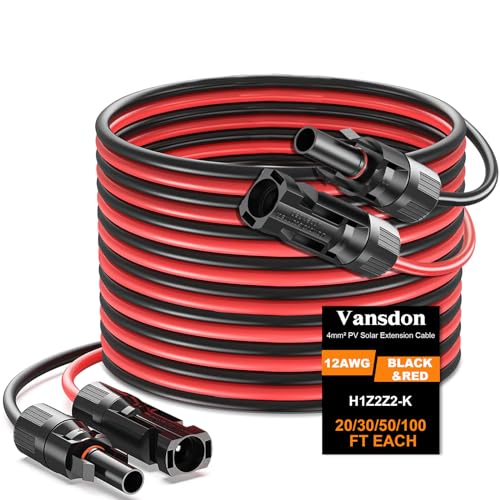
- 30-foot red and black cable pair
- IP67 and wide temperature rating
- Preinstalled locking MC4 connectors
Best For: Longer RV, boat, and outdoor solar runs
Routing Flexibility Pick
20FT 12AWG Tinned Copper Cable

- Tinned copper 12AWG construction
- Includes extra connector pair and ties
- Flexible bare-wire routing option
Best For: Home and RV systems needing adaptable installation
Reliable Reach – Renogy 20FT 12AWG Solar Extension Cables
For shoppers comparing 12 gauge solar extension cables, this Renogy set provides 20 feet of additional reach in both black and red. The male-to-female connectors are designed to lock onto compatible built-in solar cables, helping create more space between panels and a charge controller.
Best For: Extending outdoor solar-panel wiring when you want a matched red-and-black pair with weather-resistant construction.
Pros:
- Includes one 20-foot red cable and one 20-foot black cable.
- Male-to-female connectors support plug-and-play extension of compatible solar cables.
- UV-resistant, waterproof, weatherproof cable with TUV testing and markings.
- Suitable for indoor or outdoor use and backed by a one-year warranty.
Cons:
- Includes cables only, without additional installation components.
- Confirm connector and system-voltage compatibility before purchase.
This is a straightforward choice for adding separation between a solar array and charge controller. Its matched colors, locking connectors, and outdoor-rated construction make it practical for common extension jobs.
Compact Plug-In Pick – 10FT 12AWG Solar Panel Extension Cable
This 10-foot pair is a practical option when you need 12 gauge solar extension cables without a long surplus of wire. Both cables arrive with solar connectors crimped onto the ends, allowing compatible panels and charge controllers to be connected with minimal preparation.
Best For: RV, boat, home, and other outdoor solar setups needing a shorter plug-and-play extension.
Pros:
- Supplies one 10-foot black cable and one 10-foot red cable.
- Pre-crimped male and female solar connectors simplify installation.
- IP67 waterproof connector design helps limit water and dust intrusion.
- TUV and UL certified, with UV-resistant insulation rated from -31°F to 90°F.
Cons:
- Provides less reach than the 20- and 30-foot alternatives.
- Verify that the connectors match the existing solar equipment.
Choose this set when a compact extension is enough and easy installation matters. Its outdoor-focused insulation and connector sealing make it well suited to exposed solar wiring.
Long-Run Heavy Duty – WindyNation 30FT 12 AWG PV Cable Pair
For longer runs, WindyNation supplies 12 gauge solar extension cables as 30-foot black and red leads. The cables use pure copper conductors, weatherproof PV connectors, and heavy-duty XLPE insulation for demanding indoor or outdoor photovoltaic installations.
Best For: Larger-distance solar-panel wiring where long cable lengths, flexible conductors, and robust outdoor ratings are priorities.
Pros:
- Includes 30 feet each of black and red cable for 60 feet total.
- Pure copper conductors are designed for low resistance and electrical efficiency.
- UL4703-approved 600-volt PV cable supports wet, dry, and direct-burial applications.
- IP67 connectors and XLPE insulation resist water, heat, cold, UV exposure, and abrasion.
Cons:
- The longer pair weighs more than shorter extension options.
- Long cable lengths may be excessive for compact solar installations.
- Confirm the connector configuration, as the supplied listing includes PV connectors on the cables.
This is the strongest fit in the group for extended routing and harsher installation conditions. Its certification, conductor construction, and broad temperature range add confidence for more demanding PV wiring projects.
Flexible Mixed-End Option – BougeRV 20 Feet 12AWG Solar Cable
BougeRV offers a 20-foot pair of 12 gauge solar extension cables made with copper and designed to reduce power loss associated with smaller-diameter wiring. Each lead has a solar connector at one end and a bare end for connection to a compatible solar charge controller.
Best For: Solar systems that need 20 feet of extension and a connector-to-bare-wire layout for charge-controller installation.
Pros:
- Includes one 20-foot black cable and one 20-foot red cable.
- 12AWG copper construction is intended to minimize power loss.
- Weatherproof wiring is designed for extreme heat and cold.
- Connector-to-bare-wire configuration can suit panels paired with a charge controller.
Cons:
- Bare ends require the appropriate termination or connection at the controller.
- Confirm that the connector arrangement matches your system before ordering.
- The supplied notes do not specify a certification standard.
This cable pair stands out when you need a longer extension with a preconnected solar end and flexible bare-end installation. It is a useful choice for compatible systems where the charge controller connection will be completed separately.
Best Heavy-Duty Run – WindyNation 12 AWG 50-Foot Solar Cable Pair
For longer outdoor runs, the WindyNation pair is a substantial option among 12 gauge solar extension cables. It includes 50 feet each of red and black cable, pure copper conductors, and preinstalled PV connectors for connecting compatible solar equipment.
Best For: Larger solar setups that need long, weather-resistant cable runs and clearly color-coded polarity.
Pros:
- Includes 50 feet each of red and black 12 AWG cable.
- Pure copper conductors are designed to reduce electrical resistance.
- UL4703-rated XLPE insulation supports outdoor, UV, temperature, abrasion, and direct-burial use.
- IP67 weatherproof connectors are factory-installed and compatible with standard PV connectors.
Cons:
- The 100-foot combined cable length may be more than needed for compact installations.
- At 2.9 pounds, it is less lightweight than shorter cable pairs.
This is the most robust choice of the three for extended outdoor installations. Its long length, direct-burial rating, and heavy-duty construction make it especially practical when durability and routing flexibility matter.
Best Compact Extension – BougeRV 12 AWG 10-Foot Solar Cable
The BougeRV cable pair is a straightforward choice when you need a shorter length of 12 gauge solar extension cables. It includes one 10-foot black cable and one 10-foot red cable, with a connector on one end and bare wire on the other for connections to a solar charge controller.
Best For: Compact solar setups that need a short panel-to-controller extension with color-coded cables.
Pros:
- Includes a 10-foot black and 10-foot red cable for a 20-foot total pair.
- Uses copper conductors and 12 AWG sizing to help minimize power loss.
- Weatherproof construction is designed for extreme heat and cold.
- Connector-and-bare-wire configuration can connect a solar panel to a charge controller.
Cons:
- Shorter length provides less routing flexibility than the 50-foot WindyNation option.
- The bare-wire ends may require additional connection hardware or termination work.
With its modest length and simple layout, this BougeRV option fits installations where the panel and controller are relatively close together. It is a practical way to add reach without managing excess cable.
Best Corrosion Resistance – Energeaster 12 AWG 20-Foot Solar Cable
The Energeaster pair adds tinned copper conductors and reinforced outdoor protection to the 12 gauge solar extension cables category. It provides 20 feet of cable per listed unit, with male and female connectors and a locking design for joining compatible cables.
Best For: Outdoor solar arrays where corrosion resistance, weather protection, and cable-to-cable locking are priorities.
Pros:
- Tinned pure copper is designed to improve corrosion and oxidation resistance.
- XLPE dual-sheath insulation is rated for temperatures from -40°F to 194°F.
- IP67 waterproofing and UV resistance support harsh outdoor use.
- UL and TÜV certifications are listed, with male and female self-locking connectors.
Cons:
- The listing presents both 20-foot unit count and 40-foot item-length information, so package length should be confirmed before ordering.
- Its connector format is intended for compatible PV connector types and may not fit every system without verification.
This Energeaster cable stands out for its tinned copper and broad temperature rating. It is a strong fit for exposed installations, provided the stated package length and connector compatibility match your setup.
Lightweight Flat Pick – 20FT 12AWG Flat Solar Cable
If you need 12 gauge solar extension cables for a compact RV or outdoor photovoltaic setup, this 20-foot flat cable emphasizes easy routing and storage. Its 12AWG twisted-copper construction is designed to support conductivity while the flat profile slips through narrow gaps.
Best For: RVs, boats, and outdoor solar installations where flexible routing and compact storage matter.
Pros:
- Flat design is easier to route through gaps and coil for storage.
- IP68 protection and a UV-, corrosion-, and fire-resistant PVC jacket support outdoor use.
- Includes installed male and female connectors with a self-locking design.
- Rated for up to 30A and 600V according to the supplied specifications.
Cons:
- At 20 feet, it may be too short for widely separated panels and controllers.
- Its temperature range is narrower than some competing cables in this roundup.
This is a practical choice when a lightweight, low-profile cable is more important than maximum length. The flat construction and IP68 rating make it especially appealing for portable or neatly routed systems.
Long-Run Choice – 2x30FT 12AWG Solar Extension Cable
For longer panel-to-controller runs, these 12 gauge solar extension cables provide a matched 30-foot red-and-black pair. Tin-plated copper conductors, weather-resistant insulation, and preinstalled MC4-style connectors make them suited to larger outdoor routing needs.
Best For: RVs, boats, solar plants, and installations requiring a clearly identified 30-foot positive and negative cable pair.
Pros:
- Includes one 30-foot red cable and one 30-foot black cable for polarity identification.
- Tin-plated conductive copper is designed to reduce power loss and resist corrosion.
- IP67 protection, UV resistance, and a stated -40°F to 194°F operating range support demanding outdoor use.
- Preinstalled male and female connectors can be locked together to extend the run.
Cons:
- The 60-foot total pair may be more cable than needed for compact installations.
- Longer cable runs can require careful planning to avoid unnecessary routing and voltage loss.
This option stands out for its length, matched color pair, and broad outdoor specifications. It is a strong fit when panels are positioned well away from the charge controller or battery area.
Routing Flexibility Pick – 20FT 12AWG Tinned Copper Cable
These 12 gauge solar extension cables combine 20-foot red and black leads with an extra connector pair and cable ties. The tinned copper wire is UL certified according to the supplied notes, while the flexible routing options are useful when connecting panels to a battery or controller.
Best For: Home, RV, and photovoltaic projects that need flexible routing, extra connectors, and a choice of cable lengths.
Pros:
- Uses 12AWG 100% tinned copper wire for conductivity and durability.
- IP67 sealing helps protect against water and dust, while the sheath resists scratches and outdoor wear.
- Includes an extra male/female connector pair and ties.
- Available in multiple lengths, with a stated two-year warranty.
Cons:
- One end is bare wire, so the included MC4 connector requires manual installation.
- Manual connector fitting may be less convenient for users wanting a fully preassembled cable.
The bare-wire configuration gives this cable useful installation flexibility, particularly when routing through walls or connecting directly to a controller. Choose it if you are comfortable installing a connector and want the included accessories.
How We Picked These 12 Gauge Solar Extension Cables
We selected these cables based on the needs of common solar installations, including RVs, portable panels, charge controllers, and small off-grid systems. Our comparison focuses on wire gauge, available lengths, included male and female connectors, weather-resistant construction, and practical installation flexibility.
Because product specifications and connector standards can vary, verify the listing details before ordering. In particular, check whether the advertised length describes one cable or the combined length of a red-and-black pair.
Quick Comparison
| Best For | Recommended Length | What to Look For |
|---|---|---|
| Compact portable setups | 10 feet | Easy routing with minimal excess cable |
| Typical RV and rooftop layouts | 20 feet | Balanced reach and manageable cable runs |
| Widely spaced panels | 30 feet or longer | Extra reach, secure routing, and voltage-drop awareness |
Key Buying Factors for 12 Gauge Solar Extension Cables
Length and Voltage Drop
Choose the shortest cable that comfortably reaches between components. Longer runs add resistance and can reduce efficiency, especially at higher current. Measure the complete path, including bends and routing around equipment, rather than estimating a straight-line distance.
Connector Compatibility
Most solar extension cables use MC4-style male and female connectors, but similar-looking connectors are not automatically interchangeable. Confirm that the cable connectors match your panels, charge controller, inline fuses, and branch connectors. A pair with factory-installed connectors is usually simpler than crimping your own ends.
Conductor and Insulation Quality
Look for genuine 12 AWG or approximately 4 mm² conductors, tinned copper where specified, and insulation intended for outdoor photovoltaic use. UV-resistant, temperature-tolerant insulation is important when cables will remain exposed to sun, rain, and changing temperatures.
Weatherproofing and Routing
Water-resistant connectors help protect exposed junctions, but they should be fully seated and supported rather than left under tension. Keep cables away from sharp edges, hot surfaces, standing water, and areas where vehicles or foot traffic can damage them. Use clips or ties without crushing the insulation.
Polarity and Cable Identification
Red and black cables make positive and negative leads easier to identify during installation. Before connecting the system, verify polarity with the equipment documentation or a multimeter. Reversing polarity can damage some charge controllers and power stations.
Who Should Buy Which 12 Gauge Solar Extension Cables?
Choose a 10-foot option for compact portable panels or short connections between a panel and nearby controller. A 20-foot pair is the most versatile choice for many RV, balcony, and backyard systems. Select 30-foot or 50-foot cables when panels need to be positioned farther from a battery or controller, but calculate voltage drop before committing to a long run.
For first-time installers, prioritize clearly labeled red-and-black pairs with preattached connectors. Experienced users may prefer longer cable options or additional connector pairs for custom routing. In every case, match the cable to the system’s current, connector type, and environment instead of choosing by length or price alone.