Energy meters with data logging make it easier to understand when, where, and how electricity is being used. By recording measurements over time, they can reveal peak demand, wasted power, unusual loads, and equipment problems that a one-time reading may miss.
This roundup covers options for homeowners, landlords, electricians, facilities teams, and industrial users—from Wi-Fi monitors and clamp meters to three-phase analyzers with advanced logging and waveform features.
Best 10 Energy Meters with Data Logging Picks for 2026
Best 3-Phase Pick
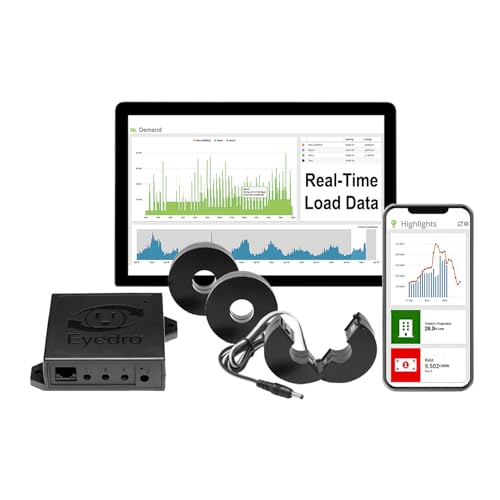
- Real-time three-phase electrical readings
- 24/7 cloud history with cost tracking
- WiFi or Ethernet and non-invasive CT sensors
Best For: Commercial panels, solar systems, and three-phase monitoring
Best for Professional Testing

- Portable three-phase power-quality analyzer
- Non-dismantling Rogowski-coil testing
- Waveform, vector, and histogram displays
Best For: Engineering inspections and distribution-system maintenance
Best for Light-Level Logging

- Logs light readings to an SD card
- Measures foot-candles and lux
- Optional J/K thermocouple support
Best For: Lighting assessments and ambient illumination records
Best Whole-Home Option
Eyedro Smart Home Energy Monitor

- Tracks home use or solar production in real time
- Stores 24/7 data without a subscription
- WiFi or Ethernet with two 200A sensors
Best For: Homeowners monitoring utility use, costs, or one solar source
Bluetooth Clamp Logging

- Bluetooth monitoring with TXT and Excel export
- 1,000A clamp with True RMS measurement
- Also tests voltage, resistance, capacitance, and temperature
Best For: Portable electrical troubleshooting with app-based data logging
Three-Phase Cloud Monitoring

- 24/7 cloud history with cost and usage views
- Wi-Fi or Ethernet connectivity
- Includes three non-invasive 1,000A flex-core CTs
Best For: Three-phase facilities and solar monitoring with long-term records
Submeter Data Retention

- Designed for ANSI Form 2S single-phase installations
- EEPROM helps retain readings through outages
- Pulse output and Modbus support integration
Best For: Rental units, RV power, garages, and fixed sub-panel monitoring
Best Multi-Circuit Logger

- Monitors up to four three-phase circuits
- FTP server and RS485 connectivity
- Harmonic and phase analysis
Best For: Multi-circuit industrial power monitoring
Best Connected Home Monitor

- Tracks grid and solar energy flow
- Tuya and Smart Life app access
- Exports up to one year of history
Best For: Single-phase homes with solar monitoring
Best Portable Power Analyzer

- 32GB logger with waveform graphics
- 0–9999A measurement range
- Compatible with Rogowski coils
Best For: Portable three-phase power-quality testing
Best 3-Phase Pick – Eyedro 3-Phase Energy Meter
For commercial panels, larger properties, and solar setups, this Eyedro is one of the more capable energy meters with data logging. It provides real-time three-phase readings and keeps 24/7 usage history in the MyEyedro platform, with WiFi or Ethernet connectivity and no subscription fee.
Best For: Three-phase monitoring, solar and net-metering applications, and users who want long-term consumption and cost history.
Pros:
- Measures kWh, watts, amps, volts, power factor, and cost in real time.
- Supports multiple three-phase voltage configurations up to 600V.
- Uses non-invasive split-core sensors and offers WiFi or wired Ethernet.
- Includes 24/7 history, rate structures, reports, alerts, and bill projections without a subscription.
Cons:
- Designed for three-phase systems rather than basic residential single-phase monitoring.
- The net-metering plugin requires two compatible meters to separate grid use from solar generation.
- European power adapters are sold separately.
This is a strong choice when detailed three-phase records and cost analysis matter more than a minimal installation. Its broad voltage support and cloud history make it especially useful for ongoing energy management.
Best for Professional Testing – Mi550 Handheld Energy Logger
This handheld analyzer suits engineers and maintenance teams seeking energy meters with data logging capabilities for field testing. Its open-type Rogowski coil or voltage-type CT connection allows non-dismantling measurements, while waveform, vector, and histogram displays support power-quality analysis.
Best For: Distribution-system inspection, maintenance, and portable three-phase power-quality testing.
Pros:
- Supports non-invasive testing with open Rogowski coils or voltage-type CTs.
- Displays waveforms, vector diagrams, and histograms.
- Measures systems up to 600V and includes multilingual display support.
- Portable handheld format is suited to engineering and maintenance work.
Cons:
- Its technical interface and accessories may be more than casual users need.
- The supplied measurement range is tied to the included 10A–1000A NRC100 coils.
- The notes do not specify a built-in memory capacity or detailed export workflow.
The Mi550 is oriented toward diagnostic work rather than permanent household monitoring. Choose it when flexible current sensing and visual power-quality information are priorities.
Best for Light-Level Logging – REED R8100SD Data Logger
The REED R8100SD is a data-logging instrument, but it measures illumination rather than electrical consumption. It may be relevant alongside energy meters with data logging when evaluating lighting performance, with readings in foot-candles or lux and storage through its integrated SD memory card.
Best For: Logging ambient light levels, checking lighting conditions, and recording temperature with an optional thermocouple.
Pros:
- Measures light in both foot-candles and lux.
- Includes real-time logging with an integrated SD memory card.
- Uses a detachable light sensor with photo diode and color-correction filters.
- Offers optional type J/K thermocouple temperature measurement.
Cons:
- It is a light meter, not an electrical energy-consumption meter.
- Temperature measurement requires a type J/K thermocouple option.
- Its usefulness for energy monitoring is limited to lighting-related assessments.
Consider this model only if your project involves illumination data or a broader facility audit. For logging watts, amps, or utility consumption, a dedicated electrical energy monitor is a better fit.
Best Whole-Home Option – Eyedro Smart Home Energy Monitor
Homeowners looking for energy meters with data logging will find this Eyedro a practical whole-home option. It tracks electricity use or production in real time, keeps 24/7 data in MyEyedro, and connects through 2.4GHz WiFi or Ethernet without a recurring subscription.
Best For: Whole-home electricity monitoring, household energy savings, and single-grid or single-solar tracking.
Pros:
- Reports consumption or production in dollars, watts, amps, and volts.
- Includes two 200A directional sensors for home monitoring.
- Provides real-time tracking and 24/7 cloud access without a subscription.
- Supports WiFi or Ethernet and includes the power adapter and Ethernet cable.
Cons:
- A single unit cannot monitor grid energy and solar generation simultaneously.
- Separating grid use from solar production requires two units and the Net Meter plugin.
- It supports 2.4GHz WiFi rather than newer WiFi bands.
This is a straightforward choice for homeowners who want accessible usage history and actionable cost information. Solar users should plan carefully around the single-meter limitation if they need separate grid and generation records.
Bluetooth Clamp Logging – Kethvoz 570SAPP Clamp Meter
For portable energy meters with data logging, the Kethvoz 570SAPP combines clamp-style current measurement with Bluetooth connectivity and broad multimeter functionality. Its 1,000A jaw, True RMS AC readings, and app-based export make it useful for troubleshooting and recording electrical measurements without disconnecting conductors.
Best For: Electricians, maintenance work, and users who need portable measurements with smartphone monitoring and exported logs.
Pros:
- Bluetooth app supports remote monitoring and Max/Min/average values.
- Exports measurement data in TXT or Excel format.
- Measures AC/DC current up to 1,000A, voltage, resistance, capacitance, frequency, and temperature.
- Large 45mm jaw enables non-contact current measurement around suitable conductors.
Cons:
- It is a handheld tester rather than a permanently installed whole-system energy monitor.
- Current readings require hot and neutral conductors to be separated.
- App connectivity requires a compatible smartphone or tablet.
The 570SAPP is a versatile choice when data logging needs to travel with the technician. Choose it for diagnostic flexibility rather than continuous circuit-level consumption tracking.
Three-Phase Cloud Monitoring – Eyedro 1000A Energy Meter
For connected energy meters with data logging, the Eyedro three-phase system provides continuous usage history through Wi-Fi or Ethernet. It records power, energy, current, voltage, power factor, and cost, making it suited to installations where real-time visibility and longer-term trend analysis matter.
Best For: Three-phase properties, solar and net-metering setups, and users who want 24/7 cloud history without a software subscription.
Pros:
- Maintains full 24/7 usage history with hourly, daily, weekly, and monthly views.
- Supports 2.4GHz Wi-Fi or wired Ethernet connections.
- Includes three 1,000A flex-core CTs with 4-inch openings and non-invasive installation.
- Reports kWh, watts, amps, volts, power factor, costs, and bill projections.
Cons:
- Designed for three-phase systems, so it may not suit simple single-phase applications.
- Solar consumption-versus-generation breakout requires two Eyedro monitors.
- The included power adapter is North American; European Type C adapters are sold separately.
The Eyedro is the strongest fit here for permanent, networked monitoring and historical reporting. Its cloud platform and flexible rate support make it especially practical for facilities evaluating consumption, costs, or solar performance over time.
Submeter Data Retention – Digital 120/240V kWh Submeter
Among energy meters with data logging, this digital submeter is aimed at fixed 120/240V single-phase installations rather than portable testing. Its LCD readout, EEPROM memory, pulse output, and Modbus communication support usage tracking for sub-panels, rental units, RV power, workshops, and solar-related applications.
Best For: Landlords, RV owners, garages, and small buildings needing dedicated kWh submetering and retained readings.
Pros:
- Fits standard ANSI Form 2S, 4-jaw socket bases for 120/240V single-phase systems.
- EEPROM memory helps retain data during power outages.
- Pulse output and Modbus communication support system integration.
- LCD, pulse, and reverse-flow indicators provide clear operating and wiring feedback.
Cons:
- It is limited to 120/240V single-phase applications.
- Installation involves meter-box, panel, or sub-panel wiring rather than clamp-on placement.
- The supplied notes do not specify wireless connectivity or cloud-based logging.
This meter makes sense when you need a dedicated submeter for allocation, billing support, or circuit visibility. Its retained memory and communication outputs add integration value, while the fixed socket-style format narrows installation compatibility.
Best Multi-Circuit Logger – ME431 Ethernet Energy Meter
For commercial or industrial setups that need energy meters with data logging, the ME431 stands out for simultaneous monitoring of up to four three-phase circuits. Its color display, FTP server, RS485 connectivity, and harmonic analysis support more detailed onsite power evaluation and data handling.
Best For: Multi-circuit electrical monitoring and detailed three-phase power analysis.
Pros:
- Monitors up to four three-phase circuits simultaneously.
- Supports wide-range, no-disconnection current measurement.
- Includes a 2.0-inch TFT color LCD, FTP server, and RS485 communication.
- Analyzes harmonics and phase-related measurements.
Cons:
- Its feature set may be more extensive than needed for simple residential monitoring.
- The supplied notes do not specify wireless connectivity or mobile-app support.
The ME431 is a strong choice when circuit coverage and technical analysis matter more than a basic plug-in monitoring experience. Its built-in data-export options are particularly useful for ongoing records and reporting.
Best Connected Home Monitor – WiFi Solar Energy Meter
For homeowners seeking energy meters with data logging, this single-phase monitor combines clamp-based measurement with WiFi access and app-based records. It can track grid consumption and solar generation, while the Tuya or Smart Life app provides historical views and export options.
Best For: Single-phase homes with solar systems that need remote monitoring and historical consumption records.
Pros:
- Monitors two-way energy flow for grid consumption and solar generation.
- Provides remote access through the Tuya or Smart Life app.
- Records usage by hour, day, month, and year, with more than one month of retention.
- Supports exporting hourly, daily, monthly, and up to one year of historical data.
Cons:
- Designed for single-phase measurement rather than three-phase monitoring.
- The 80A CT clamp accommodates lines up to 10.2 mm, which may limit installation compatibility.
- Requires WiFi for remote app monitoring.
This model is the most approachable option for connected household energy tracking, particularly where solar and grid flows both need to be reviewed. Confirm the circuit rating, conductor size, and installation wiring before purchase.
Best Portable Power Analyzer – Mi550 Three-Phase Data Logger
Engineers comparing energy meters with data logging may prefer the portable Mi550 when three-phase power-quality work and waveform review are priorities. It combines a 32GB data logger with waveform graphics, a broad 0–9999A measurement range, and compatibility with open-type Rogowski coils.
Best For: Portable three-phase power-quality testing and non-intrusive engineering measurements.
Pros:
- Includes 32GB of onboard data-logging capacity.
- Offers waveform graphics for reviewing measured signals.
- Measures three-phase power with a stated accuracy class of 0.5s.
- Supports 0–9999A measurement and open-type Rogowski coils.
Cons:
- Its engineering-oriented functions may be excessive for basic energy tracking.
- The supplied notes do not specify wireless connectivity or cloud/app access.
- Rogowski coils are required for compatible non-intrusive wire testing.
The Mi550 is a practical fit for field technicians and engineers who need portable three-phase analysis with substantial local storage. Its waveform display and Rogowski-coil compatibility add flexibility for demanding measurement tasks.
How We Picked These Energy Meters with Data Logging
We selected products across the main use cases rather than treating every meter as interchangeable. The lineup includes connected home monitors, handheld meters, submeters for rental properties, three-phase instruments, and professional analyzers. We considered measurement capability, logging method, installation requirements, connectivity, current range, phase support, and the likely skill level of the buyer.
Because specifications and included accessories can vary by configuration, verify the product listing before purchase. Pay particular attention to whether current transformers, software, cables, memory cards, and mounting hardware are included.
Quick Comparison
| Best For | Look For | Products In This Roundup |
|---|---|---|
| Whole-home monitoring | Wi-Fi connectivity, app access, and suitable CT capacity | Eyedro Smart Home, Smart Energy Monitor |
| Three-phase systems | Three-phase measurement, higher voltage ratings, and flexible sensors | Eyedro 3-Phase, ME431, Mi550 analyzers |
| Landlord submetering | Correct 120/240V configuration, kWh display, and code-compliant installation | Digital Electric Sub Meter |
| Portable troubleshooting | Clamp access, internal storage, screen readability, and power-quality functions | Mi550, handheld flexible-CT logger |
| Basic electrical testing | TRMS accuracy, auto-ranging, Bluetooth, and data capture | Kethvoz Clamp Meter |
Key Buying Factors for Energy Meters with Data Logging
Electrical System and Measurement Range
Start with the system you need to measure: single-phase or three-phase, residential or commercial, and the expected voltage and current. A meter must be rated for the installation, and its CTs must fit the conductor while supporting the maximum load. Flexible Rogowski coils are useful around large or crowded conductors, while standard split-core CTs are often convenient for home panels.
Logging Method and Data Access
Check how readings are stored and retrieved. Wi-Fi and Ethernet models are useful for remote dashboards and ongoing monitoring, while SD-card or internal-memory instruments can work well in field investigations. Confirm logging intervals, storage capacity, export formats, time-stamping, and whether the required app or software remains supported.
Accuracy and Useful Measurements
Energy totals may be enough for billing or trend tracking, but troubleshooting often requires voltage, current, power factor, frequency, demand, harmonics, or waveform capture. Choose a professional analyzer only when those extra measurements justify its cost and learning curve.
Installation and Safety
Panel-mounted and hardwired meters should be installed by a qualified professional. Look for appropriate voltage and safety ratings, insulated CTs, clear wiring instructions, and a design that does not require unnecessary exposure to energized conductors.
Who Should Buy Which Energy Meters with Data Logging?
- Homeowners: Choose a Wi-Fi monitor with app access and appropriately sized CTs for simple consumption tracking.
- Landlords: Use a dedicated single-phase submeter when separately tracking a tenant, unit, workshop, or outbuilding.
- Electricians and maintenance teams: Select a portable clamp-based logger for surveys, load balancing, and intermittent fault investigation.
- Commercial and industrial users: Favor three-phase Ethernet or Wi-Fi meters with higher current capacity and centralized data access.
- Power-quality specialists: Choose a full analyzer with waveform recording and advanced diagnostics rather than a basic energy monitor.