The right charge controller helps protect your battery, regulate solar input, and keep a small off-grid system working reliably. PWM controllers remain a practical choice for compatible 12V and 24V setups where affordability and simplicity matter.
We compared 10 PWM solar charge controllers across current ratings, battery compatibility, displays, weather resistance, lithium support, and installation features to help you choose the right fit.
Best 10 Pwm Solar Charge Controllers Picks for 2026
Best Overall
Renogy Adventurer 30A PWM Controller

- 30A capacity with automatic 12V/24V detection
- Supports sealed, gel, flooded, and lithium batteries
- Flush mount, LCD monitoring, and four-stage charging
Best For: RV and off-grid systems needing capacity and battery flexibility
Best for Marine Use
Renogy Voyager 20A Waterproof PWM Controller

- IP67 waterproof housing for marine and outdoor use
- 20A four-stage PWM charging
- LCD reports voltage, current, energy, and errors
Best For: Boats and exposed installations with moderate solar capacity
Best Budget Features
Upgraded 30A PWM Controller with USB

- 30A automatic 12V/24V operation
- Dual 5V/2.5A USB outputs
- LCD, parameter memory, timer control, and protections
Best For: Lead-acid systems needing USB charging and load scheduling
Best Compact Option
Renogy Wanderer 10A PWM Controller
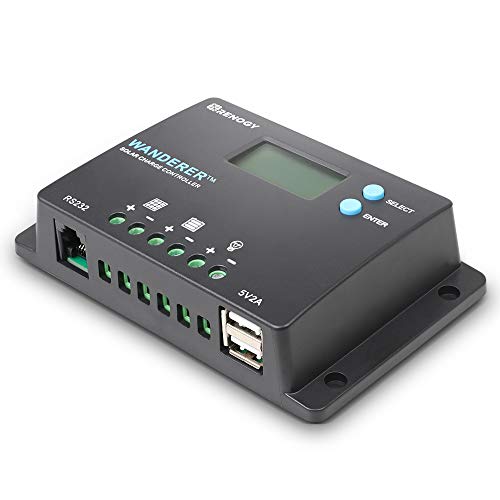
- Compact 10A controller for 12V/24V systems
- Four-stage charging with AGM, gel, flooded, and lithium support
- LCD, USB ports, load control, and protective functions
Best For: Small RV, marine, and space-constrained off-grid systems
Best Twin-Pack Value
2-Pack 30A PWM Solar Charge Controller

- Two controllers included
- Automatic 12V/24V support
- LCD display and built-in protections
Best For: Lead-acid battery systems needing a spare or second controller
Best Connected Option
ECO-WORTHY 30A Bluetooth PWM Controller

- Built-in Bluetooth monitoring
- Supports 12V/24V systems
- Works with lithium phosphate batteries
Best For: App-connected monitoring of mixed battery systems
Best RV-Focused Choice
Renogy Wanderer Li 30A PWM Controller

- Supports lithium and lead-acid batteries
- Compact 12V design for RVs and boats
- Four-stage charging and protective safeguards
Best For: Compact 12V RV, marine, and off-grid systems
Best Weatherproof Pick
Compact 10A Waterproof PWM Controller

- IP67 waterproof housing
- 12V/24V automatic detection
- Simple LED status indicators
Best For: Small outdoor RV, boat, and car solar systems
Best for Lithium Batteries

- Backlit LCD monitoring
- Supports multiple lithium chemistries
- 450W/900W 12V/24V capacity
Best For: RV and off-grid systems using lithium or lead-acid batteries
Best Budget Feature Set

- Backlit LCD and adjustable timer
- Dual 5V/2A USB ports
- 12V/24V lead-acid and lithium support
Best For: Small DIY systems needing scheduled loads and USB charging
Best Overall – Renogy Adventurer 30A PWM Controller
The Renogy Adventurer is a versatile choice among pwm solar charge controllers, combining 30A capacity, automatic 12V/24V detection, an LCD display, and a flush-mount design. It supports sealed, gel, flooded, and lithium batteries, making it suitable for more demanding RV and off-grid installations.
Best For: RV owners and off-grid users who want higher capacity, battery flexibility, and built-in monitoring.
Pros:
- Supports 12V/24V systems and several battery chemistries, including lithium.
- Uses bulk, boost, float, and equalization charging phases.
- Flush-mount design, backlit LCD, temperature compensation, and multiple protections.
Cons:
- Its 30A capacity and larger design may be more than small solar setups require.
- The unit is designed for negative-ground systems.
Choose the Adventurer when installation flexibility and battery compatibility matter more than having the smallest controller. Its LCD and optional DC Home App connectivity also make routine system checks easier.
Best for Marine Use – Renogy Voyager 20A Waterproof PWM Controller
The Renogy Voyager is one of the more practical pwm solar charge controllers for exposed marine and outdoor installations. Its IP67 waterproof housing, 20A rating, automatic 12V/24V sensing, and LCD readout provide useful protection and visibility around boats and other water-prone setups.
Best For: Boat owners and outdoor users who need waterproof construction and straightforward charging information.
Pros:
- IP67-rated design is suitable for spray, rain, and condensation.
- Four-stage PWM charging helps manage AGM, gel, and flooded batteries.
- LCD shows charging current, energy, temperature, voltage, and error codes.
Cons:
- Lithium charging requires manual selection.
- Its 20A rating may not suit larger solar arrays.
The Voyager is a strong fit when environmental sealing is a priority. It offers useful monitoring and several protective functions without requiring a larger controller for moderate marine systems.
Best Budget Features – Upgraded 30A PWM Controller with USB
This upgraded 30A unit is a feature-focused option among pwm solar charge controllers, with automatic 12V/24V adaptation, an LCD display, adjustable load timing, and dual USB outputs. It is intended for lead-acid batteries only, so verify battery compatibility before installation.
Best For: Home, commercial, or DIY lead-acid systems needing USB charging and adjustable load control.
Pros:
- 30A rating with automatic 12V/24V system adaptation.
- Dual USB outputs provide up to 5V/2.5A for mobile devices.
- LCD monitoring, parameter memory, timer settings, and automatic protections.
Cons:
- Only suitable for lead-acid batteries; it should not charge lithium or nickel-metal hydride batteries.
- Requires careful installation order and a flat, well-ventilated mounting location.
This controller makes sense for buyers who value convenience features over broad battery compatibility. Its USB ports and timer controls are useful, but the lead-acid-only limitation should guide the purchasing decision.
Best Compact Option – Renogy Wanderer 10A PWM Controller
The Renogy Wanderer 10A is a compact choice among pwm solar charge controllers for smaller 12V/24V systems. It offers four-stage charging, automatic or manual load control, an LCD, USB charging, and support for AGM, gel, flooded, and lithium batteries with the appropriate settings.
Best For: Small RV, marine, and DIY off-grid systems where space and low controller capacity are priorities.
Pros:
- Compact housing fits RV electrical cabinets and marine control panels.
- Supports 12V/24V systems with four-stage charging and battery-type flexibility.
- Includes LCD monitoring, USB ports, load-control modes, and multiple protections.
Cons:
- The 10A rating limits it to smaller solar arrays and loads.
- Lithium operation requires manual activation or settings.
- IP32 protection is intended for sheltered conditions rather than direct water exposure.
The Wanderer is a practical space-saving controller for modest systems. Select it when its 10A capacity matches your array and you want monitoring and USB charging in a small enclosure.
Best Twin-Pack Value – 2-Pack 30A PWM Solar Charge Controller
This two-pack of 30A PWM solar charge controllers is a practical choice when you need matching regulators for multiple small solar systems or a spare unit. It automatically supports 12V or 24V setups and includes an LCD display for checking settings and charging information.
Best For: Lead-acid battery systems using open, AGM, or GEL batteries, including home, commercial, and basic off-grid installations.
Pros:
- Two controllers are included, offering useful backup or multi-system flexibility.
- Automatically supports 12V and 24V systems.
- LCD display allows parameter adjustment and status monitoring.
- Includes overcurrent, short-circuit, reverse-connection, and open-circuit protection.
Cons:
- Not compatible with lithium batteries.
- USB outputs are limited to 5V/3A charging.
- Correct connection order is important during installation.
Among PWM solar charge controllers, this set stands out for quantity and straightforward adjustability. Confirm that your system uses a supported lead-acid battery chemistry before choosing it.
Best Connected Option – ECO-WORTHY 30A Bluetooth PWM Controller
The ECO-WORTHY 30A controller adds Bluetooth monitoring to a conventional PWM setup, making it easier to review system information through an app. It supports 12V and 24V systems, offers an LCD display, and works with several battery types, including lithium phosphate.
Best For: Users who want app-based monitoring for lead-acid, gel, or lithium phosphate battery systems.
Pros:
- Built-in Bluetooth supports wireless operation and app integration.
- Compatible with 12V and 24V systems.
- Supports lead-acid, gel, and lithium phosphate batteries.
- Provides three-stage PWM charging plus multiple protection functions.
Cons:
- Bluetooth range is up to 98 feet in open-field conditions.
- Discharge current is rated at 10A.
- Requires installation in a flat, well-ventilated location because it can heat during operation.
This is one of the more convenient PWM solar charge controllers for users who value remote status checks. Its battery support is broader than many basic units, but installation ventilation and the 10A discharge limit deserve attention.
Best RV-Focused Choice – Renogy Wanderer Li 30A PWM Controller
The Renogy Wanderer Li is a compact 30A PWM solar charge controller designed for 12V RV, boat, and off-grid systems. It supports LiFePO4, AGM, gel, and flooded batteries, with chemistry-specific charging stages and LED status indicators.
Best For: Compact 12V RV, marine, and off-grid installations using lithium or lead-acid batteries.
Pros:
- Supports LiFePO4, AGM, gel, and flooded battery types.
- Offers bulk, boost, float, and automatic equalization charging stages.
- Compact housing with IP32-rated casing and rail or wall mounting.
- Includes safeguards against reverse polarity, overcharging, overload, and short circuits.
Cons:
- Designed for 12V systems rather than automatic 12V/24V operation.
- Uses LED indicators instead of an LCD display.
- Bluetooth monitoring requires the separately added BT-1 module.
For RV-oriented PWM solar charge controllers, the Wanderer Li offers useful battery-chemistry flexibility in a small enclosure. Verify the 25V PV input specification and consider the optional monitoring module if app access is important.
Best Weatherproof Pick – Compact 10A Waterproof PWM Controller
If you need a compact option among PWM solar charge controllers for an outdoor 12V or 24V setup, the SOLPERK 10A controller emphasizes weather resistance, simple installation, and straightforward status monitoring. It supports up to 150W at 12V or 300W at 24V and works with AGM, GEL, and flooded deep-cycle batteries.
Best For: Small RV, boat, car, and other outdoor solar systems where waterproof construction and simple LED indicators matter.
Pros:
- IP67 waterproof design for outdoor use.
- Automatic 12V/24V voltage identification with three-stage PWM charging.
- Supports AGM, GEL, and flooded batteries with multiple protection features.
- Compact SAE plug-and-play installation with included mounting holes.
Cons:
- The 10A limit is intended for smaller solar systems.
- LED indicators provide less detail than an LCD display.
- The supplied notes do not indicate lithium-battery compatibility.
This is a practical choice when durability and uncomplicated operation are more important than advanced readouts or high current capacity. Its 10A rating makes it best suited to modest solar charging applications.
Best for Lithium Batteries – BougeRV 30A PWM Controller
For shoppers comparing PWM solar charge controllers with broader battery support, the BougeRV Li 30A model combines a backlit LCD with programmable settings for lead-acid and several lithium battery types. It handles up to 450W on 12V systems or 900W on 24V systems, with a maximum PV input voltage of 55V.
Best For: RV and off-grid users who want detailed monitoring and compatibility with LiFePO4, ternary lithium, LTO, and traditional batteries.
Pros:
- Backlit LCD cycles through PV input current and battery voltage.
- Supports SLD, FLD, GEL, AGM, SLA, LiFePO4, ternary lithium, and LTO batteries.
- 30A capacity supports larger 12V and 24V solar inputs.
- Includes lithium settings and a lithium-battery jumpstart function.
Cons:
- Installation requires following the specified battery-first wiring sequence.
- The controller is larger than the compact 10A alternative.
- It is a PWM controller rather than an MPPT model.
The BougeRV stands out for battery flexibility and readable information. Its 30A rating and lithium-oriented settings make it the most versatile choice here, provided the wiring and battery-type configuration are handled correctly.
Best Budget Feature Set – 30A PWM Controller with Timer
This 30A unit is one of the more feature-focused PWM solar charge controllers for small off-grid projects. It offers a backlit LCD, adjustable timer, dual USB charging, automatic 12V/24V detection, and support for lead-acid and manually selected lithium battery modes.
Best For: DIY solar projects, garden lights, small trailers, boats, gate openers, and applications needing scheduled load control.
Pros:
- Three-stage PWM charging supports up to 360W at 12V or 720W at 24V.
- LCD displays voltage, charging current, and operating mode.
- Adjustable timer automates connected loads such as pumps and fans.
- Dual 5V/2A USB ports provide convenient device charging.
Cons:
- Lithium batteries require manual mode selection before connecting solar panels.
- The product notes contain conflicting capacity wording, describing it as both 30A and a budget 10A controller.
- Installation must follow the battery-first connection sequence to avoid damage.
Its timer, memory, USB ports, and self-recovering protections give this controller strong everyday convenience for small systems. Verify the intended system size and configuration carefully, especially when using lithium batteries.
How We Picked the Best Pwm Solar Charge Controllers
We evaluated these controllers by matching their stated amperage and voltage ranges with common solar applications, including RVs, boats, cabins, vehicles, and small backup systems. We also considered battery chemistry support, protection features, display quality, mounting flexibility, outdoor durability, and useful extras such as USB ports, Bluetooth, timers, and load control.
Because product specifications can vary by seller or revision, verify the listing details before purchase—especially maximum solar input, battery voltage, lithium compatibility, and waterproofing claims.
Quick Comparison
| Best For | Recommended Features | Typical Choice |
|---|---|---|
| Small panels and compact systems | 10A rating, simple controls | Renogy Wanderer 10A or SOLPERK 10A |
| General 12V or 24V systems | 30A capacity, LCD display | Renogy 30A or an upgraded 30A LCD model |
| Marine and outdoor use | Sealed enclosure and water resistance | Renogy Voyager 20A |
| Lithium batteries | Dedicated Li charging profile | Renogy Wanderer Li or BougeRV Li |
| Remote monitoring | Bluetooth connectivity | ECO-WORTHY 30A Bluetooth model |
Key Buying Factors for Pwm Solar Charge Controllers
System Voltage and Current Capacity
Choose a controller that matches your battery bank—typically 12V or 24V—and calculate the solar array’s maximum charging current. A 30A controller offers more headroom than a 10A model, but it should not be used beyond its listed solar and battery limits. Leave some capacity margin if you may expand the array later.
Battery Chemistry
Sealed lead-acid, gel, flooded, and lithium batteries require different charging behavior. Select a controller with the correct battery profile and confirm whether lithium charging parameters are supported. Do not assume a standard lead-acid controller is suitable for LiFePO4 batteries.
Installation Environment
For boats, RV exteriors, and damp locations, look for a sealed or IP-rated design and install it according to the manufacturer’s instructions. An LCD, backlit screen, or Bluetooth connection can make it easier to check voltage, charging status, and faults without opening the system.
Load and Convenience Features
USB ports, timers, negative-ground compatibility, flush-mount construction, and load terminals can simplify a particular installation. Treat these as application-specific advantages rather than substitutes for correct sizing and battery protection.
Who Should Buy Which Pwm Solar Charge Controllers?
Choose a 10A controller for a small panel, compact battery, or low-power lighting system. A 20A weather-resistant model is a better match for marine or mobile installations with moderate charging demands. For larger 12V or 24V arrays, a 30A controller provides useful capacity, provided the panel output stays within its limits.
Buy a lithium-specific model if your system uses LiFePO4 batteries. Choose Bluetooth when remote status checks are important, and select an LCD or backlit display when you prefer direct readings at the controller. If you need maximum energy harvest from limited roof space or changing weather, compare PWM with an MPPT controller before buying; PWM is usually best when system voltage, panel voltage, and budget align.