Choosing the right solar charge controller can improve charging efficiency, protect your battery bank, and make an off-grid system easier to monitor. MPPT models are especially useful when panel voltage exceeds battery voltage or sunlight conditions change throughout the day.
We selected 10 options spanning compact 12V systems, multi-voltage installations, lithium-compatible setups, and high-current solar arrays. Use the guide below to match controller capacity, battery chemistry, and PV input limits to your system.
Best 10 Mppt Solar Charge Controllers Picks for 2026
Best All-Weather Pick
Renogy Rover 40A MPPT Controller

- Up to 98% conversion and 99% tracking efficiency
- Supports lead-acid and lithium batteries
- LCD, protections, and wide operating range
Best For: Off-grid systems in demanding climates
Best High-Voltage Smart Pick

- 150V input with 45A charging capacity
- Works with 12V to 48V systems
- Bluetooth app supports monitoring and configuration
Best For: Scalable, app-monitored solar installations
Best High-Capacity Pick

- Supports systems from 12V to 96V
- 120A charging and up to 230V PV input
- LCD monitoring with broad battery support
Best For: Large, high-voltage off-grid systems
Best 12/24V Smart Pick

- 50A charging for 12V and 24V systems
- 100V solar input rating
- App monitoring and synchronized charging support
Best For: Connected 12V/24V solar installations
Best for Easy Setup

- Automatic 12V/24V recognition
- LCD monitoring with adjustable settings
- Up to 99% efficiency and built-in protection
Best For: Larger 12V/24V home or commercial battery systems
Best Smart-System Pick

- Bluetooth app monitoring and configuration
- Synchronized multi-controller charging
- Configurable low-voltage load disconnect
Best For: App-connected 12V/24V solar systems and expandable installations
Best Compact 12V Pick
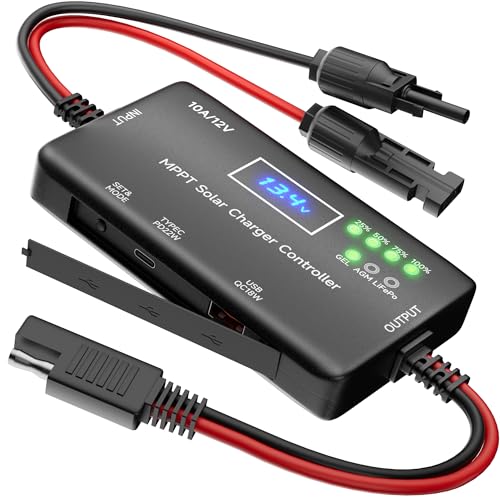
- Designed for 12V batteries only
- USB and Type-C device outputs
- Four-stage charging with multiple protections
Best For: Portable 12V systems and tight installation spaces
Large-System Value

- 150V maximum solar input
- Supports 12V to 48V systems
- LCD controls and two-year warranty
Best For: Larger DIY solar arrays and varied battery banks
Feature-Rich Alternative
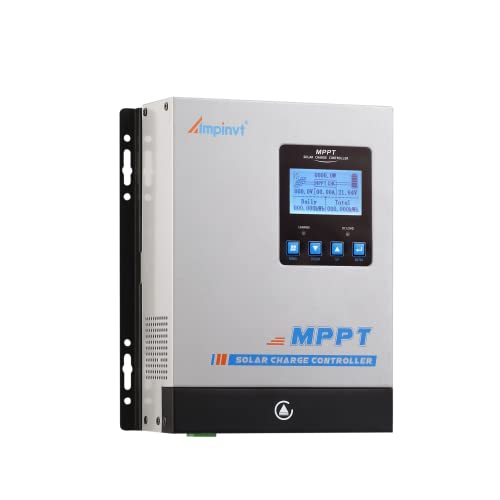
- LCD energy statistics and generation curves
- Multiple battery profiles, including lithium
- 150V PV input with extensive protections
Best For: Data-focused 60A solar installations
Best All-Weather Pick – Renogy Rover 40A MPPT Controller
For off-grid systems that need flexible battery support and dependable operation in changing conditions, the Renogy Rover is one of the more versatile mppt solar charge controllers. It supports automatic 12V/24V detection, multiple battery chemistries, and provides an LCD for local status checks.
Best For: RVs, cabins, and off-grid installations using lead-acid or lithium batteries in demanding climates.
Pros:
- Up to 98% conversion rate and 99% tracking efficiency according to the supplied specifications.
- Supports Gel, AGM, flooded, and lithium batteries with dedicated charging stages.
- Includes reverse-polarity, overcharge, overload, short-circuit, and reverse-current protection.
- Operates from -40°F to 149°F and includes an LCD plus remote temperature sensor.
Cons:
- Bluetooth connectivity requires the separately sold BT-2 accessory.
- Its 40A rating may be limiting for larger solar arrays.
The Rover 40A is a practical choice when battery compatibility, weather tolerance, and built-in protection matter more than high-current capacity. Its app support is useful, but requires additional hardware.
Best High-Voltage Smart Pick – Victron SmartSolar 150/45
The Victron SmartSolar 150/45 is a strong option for higher-voltage solar installations needing app-based monitoring and configuration. Among mppt solar charge controllers, its 150V input rating and support for 12V through 48V systems provide useful design flexibility.
Best For: Multi-controller systems and users who want Bluetooth monitoring, firmware updates, and adjustable settings.
Pros:
- Supports 12V, 24V, 36V, and 48V battery systems.
- Accepts up to 150V and provides a 45A charging rating.
- VictronConnect offers real-time data, 30-day history, presets, updates, and alarms.
- Multiple units can synchronize charging stages, and the load output can disconnect at a configured voltage.
Cons:
- There is no built-in display, so monitoring relies on connected devices.
- The supplied notes do not specify a bundled remote temperature sensor.
This model suits technically minded users building scalable systems. Its synchronization and intelligent load output are especially useful where several controllers or direct-load management are involved.
Best High-Capacity Pick – POWLAND 120A MPPT Controller
For unusually large or high-voltage battery banks, the POWLAND 120A controller stands out among mppt solar charge controllers. It automatically detects systems from 12V through 96V, accepts up to 230V solar input, and uses an LCD to show operating information.
Best For: Large off-grid homes, RV systems, and mobile power setups requiring high charging capacity and broad voltage compatibility.
Pros:
- Automatic compatibility with 12V, 24V, 36V, 48V, 60V, 72V, 84V, and 96V systems.
- 120A charging capacity and up to 230V solar input support.
- Claims up to 98% MPPT efficiency and includes real-time LCD monitoring.
- Supports LiFePO4, AGM, GEL, and flooded lead-acid batteries with multiple protections.
Cons:
- The supplied notes identify a plastic construction but do not provide operating-temperature or warranty details.
- A 120A controller may be excessive for small solar arrays.
- The notes do not mention app connectivity or remote monitoring.
The POWLAND is compelling when system voltage range and charging capacity are the priorities. Its LCD keeps key readings visible locally, while the broad compatibility makes it adaptable to larger installations.
Best 12/24V Smart Pick – Victron SmartSolar 100/50
The Victron SmartSolar 100/50 is a focused choice for 12V and 24V systems that benefit from efficient tracking and connected controls. It combines a 100V solar input rating with 50A charging capacity and the VictronConnect app.
Best For: 12V/24V solar systems where app access, synchronized charging, and intelligent load control are useful.
Pros:
- Designed for 12V and 24V battery systems with a 50A charging rating.
- 100V input rating provides room for compatible panel configurations.
- VictronConnect supports real-time data, 30-day history, settings, firmware updates, and alarms.
- Supports synchronized operation with other SmartSolar controllers and configurable load disconnect.
Cons:
- No built-in display is included.
- Its 100V input and 12/24V compatibility are less suited to higher-voltage systems.
This is a well-matched option for conventional 12V and 24V installations that prioritize connected monitoring over a local screen. The 50A rating gives it more charging headroom than smaller controllers in the same voltage class.
Best for Easy Setup – 100A LCD MPPT Controller
For larger 12V or 24V solar setups, this 100A MPPT solar charge controller focuses on simple installation and visible system control. Its automatic voltage recognition, LCD display, adjustable timer, and dual USB ports make it a practical option for home or commercial battery systems.
Best For: Users who want a high-capacity controller with automatic 12V/24V recognition and an onboard LCD.
Pros:
- Automatically recognizes 12V or 24V systems when the battery is connected first.
- LCD provides real-time performance information and adjustable settings.
- Claims charging efficiency of up to 99% and includes overcharge, short-circuit, and reverse-polarity protection.
- Includes dual USB ports, a 12-month warranty, and lifetime technical support.
Cons:
- Requires a base battery charge for automatic voltage detection.
- Installation sequence matters: connect the battery before the solar panels.
- The supplied notes do not specify the controller’s detailed operating limits beyond its 100A rating.
This is a feature-rich choice for buyers prioritizing capacity, simple monitoring, and broad 12V/24V compatibility. Confirm that the controller’s current rating and system specifications match your panels and batteries before purchase.
Best Smart-System Pick – Victron 75V 15A SmartSolar
The Victron Energy SmartSolar is a compact MPPT solar charge controller for 12V or 24V systems that puts monitoring and configuration in the VictronConnect app. It is designed to optimize output, coordinate multiple controllers, and manage connected loads as battery voltage changes.
Best For: Users who want app-based monitoring, firmware updates, and expandable multi-controller solar systems.
Pros:
- Bluetooth connectivity enables real-time data, 30-day history, configuration, firmware updates, and alarms through VictronConnect.
- Fast maximum-power-point tracking is designed to maintain output even with partial panel shade.
- Multiple SmartSolar controllers can synchronize their charging stages.
- Configurable load output can disconnect devices when battery voltage becomes too low.
Cons:
- Its 15A rating is more suited to smaller systems than high-current installations.
- The supplied specifications describe an LED or minimal display rather than a full onboard screen.
- It supports 12V/24V systems, so it is not presented as a universal higher-voltage controller.
This controller stands out when connected monitoring and coordinated system management matter more than a large current rating. Its compact dimensions also suit installations where space is limited.
Best Compact 12V Pick – SUNAPEX 10A MPPT Controller
This SUNAPEX MPPT solar charge controller is built specifically for 12V batteries and provides a compact, straightforward option for portable systems or tight installation spaces. It supports Lead-Acid, Gel, AGM, and LiFePO4 batteries, with LCD status information, USB and Type-C outputs, and multiple protection features.
Best For: Compact 12V solar systems using compatible standalone panels and rechargeable batteries.
Pros:
- Supports Lead-Acid, Gel, AGM, and LiFePO4 12V batteries.
- LCD and LED indicators show charging status, voltage, and temporarily displayed current.
- Includes USB and Type-C outputs for powering compatible devices.
- Four-stage charging and safeguards address overcharging, reverse current, polarity errors, short circuits, and overheating.
Cons:
- Limited to 12V batteries and must not be used with 24V or 36V packs.
- It is not compatible with solar panels that have integrated controllers.
- Correct polarity and the specified connection order are required; no polarity converter is included.
For a small 12V installation, this model combines useful device outputs with broad battery-type support in a compact enclosure. Check your panel type, battery voltage, polarity, and 10A charging requirements before connecting it.
Smart Control Pick – Victron Energy SmartSolar 100V 20A
For shoppers comparing mppt solar charge controllers, the Victron Energy SmartSolar 100V 20A stands out for app-based monitoring and intelligent charging. Its fast maximum power point tracking is designed to capture available solar energy efficiently, including when panels experience partial shade.
Best For: Users who want Bluetooth connectivity, synchronized charging, and configurable load control in a compact controller.
Pros:
- VictronConnect provides real-time data, 30-day performance history, settings, firmware updates, and alarms.
- Multiple SmartSolar controllers can synchronize their charging stages.
- Intelligent load output can disconnect loads when battery voltage becomes too low.
- Supports systems listed for 12V through 48V batteries.
Cons:
- The 20A rating is less suited to higher-current solar arrays than 60A alternatives.
- An optional LCD is listed rather than a built-in display.
This is a strong choice when monitoring, customization, and coordinated multi-controller operation matter more than maximum charging capacity.
Large-System Value – Renogy Rover Lite 60A
The Renogy Rover Lite 60A is a high-capacity option among mppt solar charge controllers, with a 150V maximum solar input and support for 12V, 24V, 36V, and 48V battery systems. Its design is aimed at larger DIY installations where series-connected panels can reduce wiring complexity.
Best For: Larger DIY solar setups needing 60A charging, broad battery-system compatibility, and operation across demanding temperatures.
Pros:
- 150V maximum solar input can support up to six Renogy 200W monocrystalline panels in series, according to the supplied specifications.
- Supports gel, sealed, flooded, and lithium batteries across 12V to 48V systems.
- Designed for full-load operation from -31°F to 113°F, with lithium low-temperature protection.
- Includes an LCD, battery temperature sensor, and a two-year material and workmanship warranty.
Cons:
- Bluetooth monitoring requires a separately purchased module.
- The product notes specify compatibility only with BT 2.0 Bluetooth modules, sold separately.
Choose this controller if your array and battery bank justify a 60A unit and you value high-voltage panel input without giving up on-device LCD controls.
Feature-Rich Alternative – Ampinvt MPPT 60A
The Ampinvt 60A combines high current capacity with an LCD that displays operating data, energy statistics, and daily generation and current curves. For buyers comparing mppt solar charge controllers, it also offers selectable battery profiles and optional remote monitoring through an additional Wi-Fi accessory.
Best For: Users who want detailed on-device statistics, multiple battery settings, and 60A charging across several system voltages.
Pros:
- Supports 12V, 24V, 36V, and 48V battery systems, with listed solar capacities up to 3,400W at 48V.
- Offers sealed, gel, AGM, flooded, lithium, and user-defined charging options.
- Claims a maximum power tracking rate of at least 99% and conversion efficiency above 98%.
- Includes protections for overcharge, over-discharge, overload, short circuit, reverse polarity, overheating, and low battery voltage.
Cons:
- Wi-Fi remote monitoring requires an additional purchase.
- 36V operation must be adjusted manually rather than selected through the listed automatic settings.
- The unit is relatively large at 7.9 × 3.3 × 11 inches.
This model makes sense for installations where clear energy data and extensive protection features are more important than built-in wireless connectivity.
How We Picked These Mppt Solar Charge Controllers
We focused on the specifications that matter most in real installations: maximum charging current, supported battery voltages, maximum PV voltage, battery chemistry compatibility, monitoring features, and installation flexibility. The lineup includes compact controllers for small battery banks as well as high-capacity models for larger cabins, RVs, workshops, and backup systems.
We also considered practical features such as automatic voltage detection, LCD displays, Bluetooth or app-based monitoring where available, and support for lithium, AGM, gel, sealed, and flooded batteries. Always verify the manufacturer’s wiring, fuse, grounding, and configuration requirements before installation.
Quick Comparison
| System need | What to prioritize | Best fit from this roundup |
|---|---|---|
| Small 12V battery setup | 10–20A output and simple configuration | SUNAPEX 10A or Victron 15A/20A models |
| Typical RV or cabin system | 40–60A capacity and broad battery support | Renogy Rover, Victron 45A/50A, or Ampinvt 60A |
| Large solar array | High current rating and adequate PV voltage headroom | Renogy 60A, POWLAND 120A, or 100A controller |
| Advanced monitoring | Bluetooth, app integration, or detailed system data | Victron SmartSolar models |
Key Buying Factors for Mppt Solar Charge Controllers
Match the Controller to Your Battery Bank
Confirm whether your system is 12V, 24V, 36V, 48V, or another supported voltage. A controller with automatic detection is convenient, but it should still be configured for the correct battery type. Lithium batteries often require different charging parameters than AGM, gel, or flooded lead-acid batteries.
Check Current and Solar Input Limits
The controller’s amp rating describes the maximum charging current, while its PV voltage rating limits the voltage coming from the solar array. Calculate the array’s open-circuit voltage in the coldest expected conditions, then stay below the controller’s maximum. Oversizing the array may also exceed the allowable input power even when voltage appears suitable.
Consider Monitoring and Installation
LCD screens provide local status information, while Bluetooth or app connectivity can make it easier to review charging history and adjust settings. Also check terminal size, enclosure ventilation, cable length, fuse requirements, and whether an external temperature sensor is supported.
Who Should Buy Which Mppt Solar Charge Controllers?
Choose a compact 10A or 15A controller for a small 12V battery, portable panel, shed, or modest lighting system. A 20A model suits small 48V or lightly loaded installations when its voltage requirements match the battery bank.
For most RV, boat, and cabin systems, a 40A–60A controller offers a useful balance of capacity and cost. Select a Victron SmartSolar model if detailed monitoring and established configuration tools are priorities. Choose a Renogy or Ampinvt unit when broad voltage support and straightforward system sizing are more important.
High-output 100A–120A controllers are intended for substantial battery banks and solar arrays. Before buying one, confirm that the wiring, fuses, battery bank, busbars, and ventilation can safely handle the current. If your array or battery chemistry is unusual, consult the manufacturer’s electrical specifications or a qualified installer.