Choosing the right battery is essential for turning solar energy into dependable power after sunset. The best deep cycle batteries for solar storage balance usable capacity, cycle life, safety, charging compatibility, and total cost.
This roundup compares 10 selected options across AGM, SLA, and LiFePO4 chemistries, including compact batteries, high-capacity systems, and specialized solar charging accessories.
Best 10 Deep Cycle Batteries for Solar Storage Picks for 2026
Trusted AGM Value

- Sealed 100Ah AGM construction
- Supports series and up to 4P configurations
- -4°F to 140°F discharge range
Best For: RVs, cabins, and straightforward solar storage systems
Compact SLA Pick
Power Sonic PS-12400NB 40Ah Battery

- 12V, 40Ah rechargeable capacity
- Sealed lead-acid construction
- Compact 30-pound form factor
Best For: Small backup systems and lower-demand solar projects
Smart Lithium Upgrade
12V 100Ah LiFePO4 Marine Battery

- 1280Wh capacity at about 24 pounds
- Bluetooth 5.0 app monitoring
- 4,000-plus cycles with a 100A BMS
Best For: Mobile, marine, RV, and off-grid solar systems
High-Capacity SLA
Mighty Max ML8D 12V 250Ah AGM Battery

- Large 250Ah 12V capacity
- Maintenance-free, spill-proof AGM design
- One-year manufacturer warranty
Best For: Stationary and high-capacity off-grid solar storage
Solar Light Backup
EBL 1100mAh AA Rechargeable Batteries
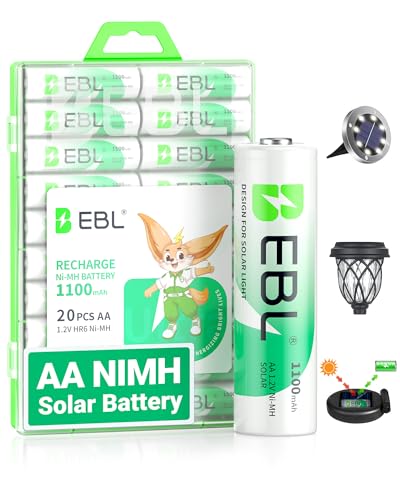
- 20-pack of 1.2V, 1100mAh NiMH AA cells
- Rated for up to 500 deep-charge cycles
- Designed for solar lights and other small devices
Best For: Replacing rechargeable batteries in garden and string lights
Off-Grid Power Upgrade
GOKWH 12V 100Ah LiFePO4 Battery

- 1,280Wh 12.8V LiFePO4 battery with 100A BMS
- Bluetooth app tracks SOC, voltage, and temperature
- Expandable up to 4S4P per supplied specifications
Best For: RV, off-grid, marine, and home-backup storage
Solar Charging Accessory
Voltset 20W 12V Battery Charger
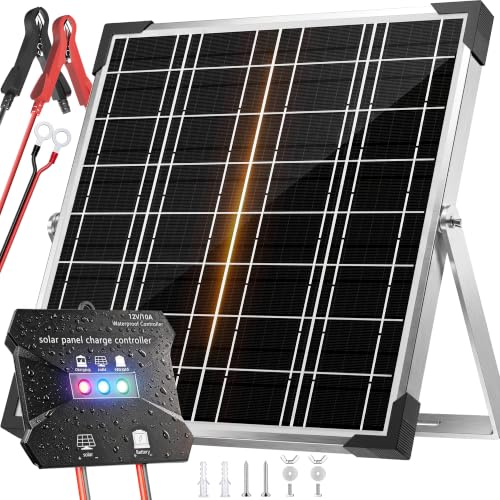
- 20W monocrystalline panel with MPPT controller
- Works with several 12V battery chemistries
- Includes protection features and mounting hardware
Best For: Trickle-charging and maintaining 12V batteries outdoors
Best Long-Life Option

- 15,000+ rated cycles
- 100A smart BMS
- Expandable to 20.48kWh
Best For: 24V solar, RV, backup, and off-grid systems
Best Connected High-Capacity Pick

- 3,584Wh of capacity
- Bluetooth 5.0 monitoring
- 200A smart BMS
Best For: 12V RV, backup, and off-grid solar storage
Best Expandable 12V Capacity

- 4,096Wh stated capacity
- App-based status monitoring
- Expandable to 24V or 48V systems
Best For: High-capacity 12V solar, RV, and off-grid systems
Trusted AGM Value – Renogy 12V 100Ah AGM Battery
If you want dependable deep cycle batteries for solar storage without moving to lithium, this Renogy AGM battery is a practical option. Its sealed lead-acid design is maintenance-free, supports series and parallel configurations, and provides stable power for common appliances.
Best For: RVs, cabins, and solar users seeking a proven 12V AGM battery with flexible system expansion.
Pros:
- 100Ah capacity with a sealed, maintenance-free AGM design
- Supports series connections and up to four batteries in parallel
- Rated for discharge performance from -4°F to 140°F
- Low stated monthly self-discharge rate below 3% at 77°F
Cons:
- At 63.9 pounds, it is substantially heavier than the listed LiFePO4 alternative
- Includes a two-year prorated warranty rather than a full replacement warranty
The Renogy is a sensible fit when simplicity, sealed construction, and broad temperature performance matter more than minimizing battery weight. Its 100Ah capacity and expansion support also make it adaptable for many small-to-medium solar setups.
Compact SLA Pick – Power Sonic PS-12400NB 40Ah Battery
The Power Sonic PS-12400NB is a compact sealed lead-acid battery for smaller power needs. With a 12V, 40Ah rating and a 30-pound listed weight, it can suit modest solar storage applications where a lower-capacity battery is preferable to a larger 100Ah model.
Best For: Compact backup systems and smaller solar projects that need rechargeable 12V storage.
Pros:
- Rechargeable 12V sealed lead-acid construction
- 40Ah capacity for smaller energy-storage requirements
- Compact dimensions of 7.76 x 6.5 x 6.69 inches
Cons:
- Lower capacity than the 100Ah and 250Ah batteries in this roundup
- The supplied details do not specify a warranty or additional connection features
This Power Sonic model makes the most sense when space and required capacity are limited. For higher-demand solar storage, its 40Ah rating may require more batteries or more frequent recharging than the larger options.
Smart Lithium Upgrade – 12V 100Ah LiFePO4 Marine Battery
For shoppers comparing deep cycle batteries for solar storage, this 12.8V 100Ah LiFePO4 battery offers a lighter, more feature-rich alternative to AGM. Bluetooth 5.0 monitoring, a built-in 100A BMS, and stated 4,000-plus cycle durability make it well suited to mobile and off-grid use.
Best For: RVs, boats, and off-grid solar systems where low weight, app monitoring, and long cycle life are priorities.
Pros:
- 1280Wh capacity in a 24-pound package
- Bluetooth monitoring for battery level, voltage, current, and temperature
- Built-in 100A BMS with multiple protections and low-temperature discharge cutoff
- Supports 4P4S expansion and is rated for 4,000-plus deep cycles
Cons:
- The supplied warranty information is unspecified
- Its marine-focused design may offer more features than basic stationary storage requires
This is the strongest choice here for users who value portability and detailed battery monitoring. Its expansion capability and long stated cycle life also make it a compelling foundation for larger mobile or off-grid systems.
High-Capacity SLA – Mighty Max ML8D 12V 250Ah AGM Battery
ML8D -12 Volt 250 AH, Internal Thread (INT) Terminal, Rechargeable SLA AGM Battery
Check Price On AmazonThe Mighty Max ML8D is a high-capacity sealed lead-acid AGM battery for solar storage users who need more amp-hours from a single 12V unit. Its maintenance-free, spill-proof construction can be mounted in different positions, though the 149-pound weight requires careful planning.
Best For: Stationary or robust off-grid systems that prioritize 250Ah capacity and maintenance-free AGM operation.
Pros:
- Large 250Ah capacity for extended storage needs
- Sealed, rechargeable, maintenance-free AGM design
- Spill-proof construction resists shocks and vibration
- Specified one-year manufacturer warranty
Cons:
- Very heavy at 149 pounds
- Large 20.47 x 10.59 x 8.86-inch dimensions require substantial installation space
- Battery and screws are included, but no wire harness or mounting accessories are supplied
The ML8D is best viewed as a capacity-first choice rather than a portable one. It can reduce the number of batteries needed in a 12V storage bank, but its size and weight make installation and future repositioning more demanding.
Solar Light Backup – EBL 1100mAh AA Rechargeable Batteries
If you need deep cycle batteries for solar storage in small outdoor lighting systems, these EBL AA NiMH cells are a practical replacement option. The 20-pack provides 1.2V, 1100mAh rechargeable batteries for garden lights, string lights, and other everyday devices.
Best For: Solar garden lights and other low-power AA devices.
Pros:
- Includes 20 rechargeable 1100mAh AA batteries.
- Rated for up to 500 deep charging and discharging cycles.
- Low-self-discharge design is specified to retain 80% capacity after three years.
- Designed for use from -4°F to 140°F and includes a storage case.
Cons:
- These are small 1.2V AA cells, not a substitute for a 12V home or RV storage battery.
- Performance depends on adequate sunlight or a compatible charger.
Choose this pack for replacing rechargeable cells in solar landscaping lights rather than for large-scale solar energy storage. Its cycle rating, temperature range, and 20-cell quantity make it convenient for maintaining multiple small fixtures.
Off-Grid Power Upgrade – GOKWH 12V 100Ah LiFePO4 Battery
For buyers comparing deep cycle batteries for solar storage, this 12V 100Ah LiFePO4 battery offers 1,280Wh of stated capacity, Bluetooth monitoring, and expansion potential. Its Group 24 format is suited to RV, marine, trolling-motor, home-backup, and off-grid applications.
Best For: RVs, off-grid systems, trolling motors, and compact home backup setups.
Pros:
- Bluetooth 5.0 app provides real-time SOC, voltage, and temperature monitoring.
- Built-in BMS includes more than 20 protection functions.
- Supports up to a 4S4P configuration, with expansion up to 51.2V 400Ah according to the supplied specifications.
- Low-temperature protection stops charging below 0°F and discharging below -4°F.
Cons:
- At 24 pounds, it may be heavier than some smaller battery options.
- Expansion requires compatible wiring, configuration, and installation knowledge.
- The supplied notes do not specify a manufacturer warranty duration.
This is the strongest match here for actual solar storage because it provides a 12.8V, 100Ah platform with monitoring and a stated 4,000-cycle rating. Verify charger and inverter compatibility before integrating it into a larger system.
Solar Charging Accessory – Voltset 20W 12V Battery Charger
The Voltset 20W kit is a maintenance charger rather than a standalone storage battery, but it can support deep cycle batteries for solar storage by replenishing compatible 12V systems. Its monocrystalline panel, charge controller, and included mounting hardware are designed for vehicles, RVs, boats, trailers, and small off-grid setups.
Best For: Maintaining 12V batteries in RVs, boats, trailers, and outdoor equipment.
Pros:
- MPPT controller is claimed to charge 20–30% faster than standard tracking technology.
- Compatible with LiFePO4, AGM, Gel, flooded, and lithium-ion 12V batteries.
- Built-in protection covers overcharge, over-discharge, short circuit, and reverse polarity.
- IP67 weather-resistant construction and a stated operating range from -40°F to 185°F.
Cons:
- Its 20W output is intended for trickle charging and maintenance, not rapid charging of large battery banks.
- The kit requires suitable sun exposure to deliver useful charging.
- It is a charger and panel kit, not a deep-cycle battery itself.
Use this kit to maintain a compatible 12V battery between uses or offset standby drain. The automatic stop-and-resume behavior, LED status indicators, and included bracket make it a convenient supplemental charging solution.
Best Long-Life Option – 24V 100Ah LiFePO4 Battery
For shoppers comparing deep cycle batteries for solar storage, this 24V 100Ah LiFePO4 model offers 2,560Wh of capacity, long cycle life, and built-in protection. Its 24V design can simplify larger solar, RV, backup-power, and off-grid setups.
Best For: Solar storage systems, RVs, marine applications, backup power, and off-grid users who want a long-lasting 24V battery.
Pros:
- Rated for 15,000+ cycles and backed by a listed 10-year warranty.
- 100A smart BMS protects against overcharge, over-discharge, overcurrent, short circuits, and temperature changes.
- Low-temperature charging cutoff and support for expansion up to eight batteries.
Cons:
- Its 24V configuration may not directly suit systems designed only for 12V batteries.
- Charging is disabled below 32°F (0°C), so cold-weather installations need appropriate planning.
Choose this model when cycle longevity and scalable 24V storage matter most. The IP65 rating and low-temperature protection add useful flexibility for outdoor installations.
Best Connected High-Capacity Pick – 12V 280Ah LiFePO4 Battery
This 12V 280Ah battery is a practical choice among deep cycle batteries for solar storage when you want substantial capacity in a 12V format. It provides 3,584Wh, Bluetooth monitoring, and expansion support for RV, backup, and off-grid applications.
Best For: RVs, trolling motors, home backup, and off-grid solar users who value app-based monitoring and expandable capacity.
Pros:
- Bluetooth 5.0 provides battery status, voltage, current, temperature, and fault information through a smartphone.
- 3,584Wh capacity and 200A BMS support demanding loads and system protection.
- Supports expansion up to 4P4S, with a stated 57.34kWh maximum system size.
Cons:
- At 58 pounds, it is not a lightweight battery for frequent repositioning.
- The supplied specifications do not list a manufacturer warranty duration.
Its combination of 12V compatibility, high capacity, and Bluetooth diagnostics makes it appealing for users who want visibility into their storage system without adding a separate monitor.
Best Expandable 12V Capacity – 12V 320Ah LiFePO4 Battery
With 4,096Wh of stated capacity, this 12V 320Ah model is designed for buyers seeking deep cycle batteries for solar storage with app monitoring and room to expand. Its smart BMS and outdoor-oriented casing also suit RV and marine installations.
Best For: Larger 12V solar, RV, home-backup, off-grid, and trolling-motor setups that may later expand to 24V or 48V.
Pros:
- Offers 4,096Wh of capacity in a 12V battery format.
- Smart app monitoring tracks voltage, capacity, temperature, and cycle information.
- Supports 4P4S expansion and includes a smart 200A BMS for key electrical protections.
Cons:
- Its listed 58-pound weight may make installation more demanding.
- The supplied specifications do not state a manufacturer warranty period.
This is a strong fit when maximizing capacity in a 12V starting system is more important than choosing a smaller battery. Expansion support gives it added value for growing solar or off-grid setups.
How We Picked the Best Deep Cycle Batteries for Solar Storage
We evaluated the selected products by battery chemistry, nominal voltage, stated capacity, cycle-life claims, protection features, connectivity, terminal design, and intended use. We also considered whether each model fits common applications such as solar lighting, backup power, RV systems, trolling motors, and small off-grid installations.
Capacity claims are typically measured in amp-hours (Ah) and should be interpreted alongside voltage. Watt-hours (Wh) provide a more useful comparison across different voltage systems: multiply volts by amp-hours to estimate nominal energy. Actual usable energy depends on discharge limits, inverter efficiency, temperature, and battery age.
Quick Comparison
| Battery type | Typical strengths | Best suited to |
|---|---|---|
| AGM or SLA | Lower upfront cost, simple charging, sealed construction | Small backup systems, solar lighting, occasional use |
| 12V LiFePO4 | Low weight, long cycle life, high usable capacity | RVs, boats, portable power, and frequent cycling |
| 24V LiFePO4 | Efficient higher-voltage storage and lower current draw | Larger solar banks and compatible inverters |
| Solar maintainer | Low-power battery maintenance rather than energy storage | Keeping compatible batteries topped up |
Key Buying Factors for Deep Cycle Batteries for Solar Storage
Choose the Right Chemistry
AGM and SLA batteries are familiar, sealed, and often affordable, but they are heavier and generally offer fewer cycles than lithium iron phosphate. LiFePO4 batteries usually provide more usable capacity, faster charging, and longer service life, though they cost more initially and require compatible charging equipment.
Match Voltage and Capacity
Confirm that the battery voltage matches your inverter, charge controller, solar panel arrangement, and wiring. Estimate daily energy use in watt-hours, then add reserve for cloudy weather and conversion losses. Do not assume a 100Ah battery provides the same energy at 12V and 24V.
Check Protection and Operating Conditions
A built-in battery management system can protect lithium batteries from overcharge, over-discharge, excessive current, and temperature problems. Low-temperature charging protection is particularly important for outdoor installations. Bluetooth or app monitoring is useful when you need to check voltage, state of charge, and alerts remotely.
Consider Installation and Maintenance
Verify dimensions, terminal type, cable requirements, ventilation needs, and allowable mounting position. AGM batteries may need more conservative discharge limits, while lithium models require a suitable charger and properly configured solar controller. Use manufacturer-approved series or parallel configurations only.
Who Should Buy Which Deep Cycle Batteries for Solar Storage?
Choose AGM or SLA for a budget-conscious, low-frequency backup system or simple solar lighting application. Choose a 12V LiFePO4 battery for regular cycling in an RV, boat, cabin, or portable solar setup. A 24V LiFePO4 model is a better fit for a larger bank when your inverter and charge controller support 24V operation. High-capacity 280Ah and 320Ah options suit demanding trolling-motor or extended off-grid applications, while a small solar maintainer is appropriate only for keeping a compatible battery charged—not for powering a full household system.