Choosing among 24 volt deep cycle batteries is easier when you match battery chemistry, capacity, discharge demands, and charging equipment to your application. The options in this roundup cover lithium, gel, marine, RV, solar, and off-grid use.
Below, compare the selected batteries by usable energy, cycle-life expectations, protection features, portability, and intended use before deciding which model best fits your system.
Best 10 24 Volt Deep Cycle Batteries Picks for 2026
High-Capacity Pick
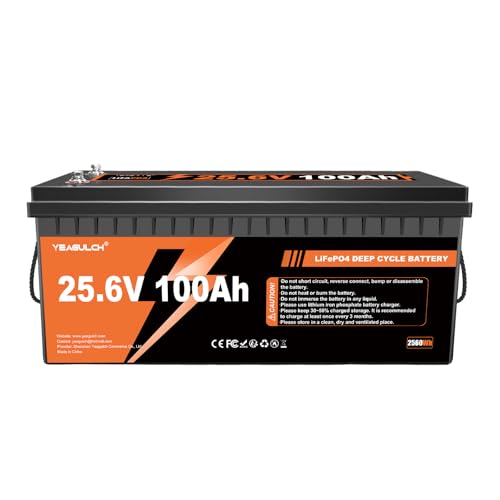
- Approximately 2.56kWh of usable energy
- 100A BMS with multiple safety protections
- Designed for solar, RV, marine, and off-grid use
Best For: High-capacity 24V energy storage
Compact Marine Pick
24V 50Ah Lithium Trolling Motor Battery

- Built for 70–100 lb thrust trolling motors
- Compact Group 24 design weighs 19 pounds
- IP65 rating and over 5,000 claimed deep cycles
Best For: Compact marine and trolling-motor setups
Sealed Lead-Acid Alternative
Mighty Max 12V 100Ah Gel Battery

- 12V 100Ah gel deep-cycle battery
- Maintenance-free and non-spillable design
- Can serve as a building block for compatible 24V systems
Best For: Gel-based solar and deep-cycle setups
Smart Monitoring Pick
LiTime 24V 50Ah Bluetooth Battery

- Bluetooth 5.0 monitors voltage and state of charge
- Low-temperature charge and discharge protection
- Compact Group 24 marine-ready design
Best For: Connected trolling-motor and cold-weather use
Best Overall Value
VEVOR 24V 100Ah LiFePO4 Battery
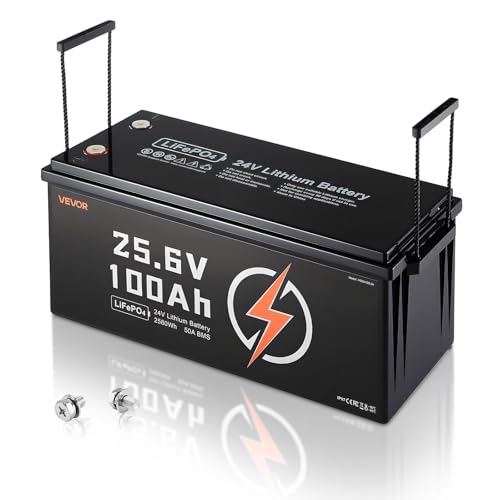
- 2,560Wh capacity with 4,000+ cycles
- 50A BMS with five-layer protection
- Expandable up to 20.48kWh
Best For: Portable RV, marine, and off-grid power
Best for Expandable Solar Banks
Dyness 24V 100Ah LiFePO4 Battery

- Smart 100A BMS with low-temperature cutoff
- Supports expansion up to a 20.48kWh bank
- Includes a five-year manufacturer warranty
Best For: Scalable solar, RV, and off-grid systems
Best for Trolling Motors
Elefast 24V 100Ah LiFePO4 Battery

- Handles a stated 300A one-second startup surge
- 100A BMS with low-temperature protection
- Supports 2S4P expansion up to 20,480Wh
Best For: 24V trolling motors and marine power systems
Long-Life Pick
LiTime 24V 100Ah LiFePO4 Battery
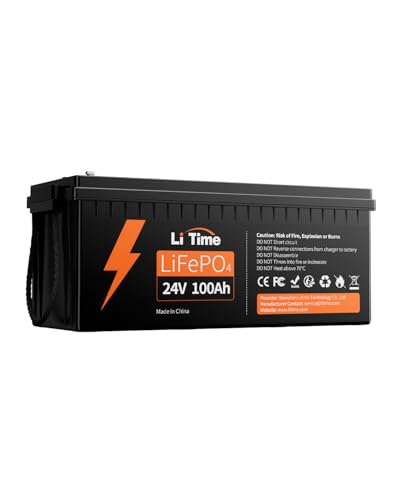
- 4,000+ rated cycles and 10+ year life
- 2.56kWh capacity with expandable configuration
- 100A BMS and IP65 protection
Best For: RVs, boats, trolling motors, and off-grid solar
Compact Value Option
24V 100Ah LiFePO4 Deep Cycle Battery

- Compact 13.38 x 7.48 x 9.84-inch housing
- 2,560Wh capacity and 42.42-pound weight
- 100A BMS with IP65 waterproof housing
Best For: Space-limited RV, boat, and solar installations
Cold-Weather Choice
SUPER EMPOWER 24V 100Ah LiFePO4

- Low-temperature charge and discharge protection
- 2,560Wh capacity with 100A smart BMS
- Five-year limited warranty and expandable design
Best For: Cold-weather RV, marine, solar, and off-grid storage
High-Capacity Pick – 24V 100Ah LiFePO4 Battery
For buyers comparing 24 volt deep cycle batteries for solar, RV, marine, or off-grid storage, this 24V 100Ah LiFePO4 model offers approximately 2.56kWh of usable energy. Its higher system voltage can help reduce current draw and wiring losses compared with similar 12V setups.
Best For: 24V solar storage, RV house power, marine auxiliary systems, home backup, and off-grid applications requiring substantial energy capacity.
Pros:
- Approximately 2.56kWh of usable energy in a 24V-class, 100Ah configuration
- LiFePO4 chemistry is designed for repeated deep-cycle use
- Built-in 100A BMS helps protect against overcharge, over-discharge, over-current, short circuits, and unsafe temperatures
- Up to about 15,000 cycles at 60% depth of discharge under normal conditions
Cons:
- Not intended for car starting, engine cranking, or standard golf cart drive use
- Requires periodic charging or cycling during storage, at least once every six months
- May require a system specifically configured for its 24V/25.6V operating range
This is the capacity-focused option in the group. It makes the most sense when long runtime and frequent cycling matter more than a compact trolling-motor form factor.
Compact Marine Pick – 24V 50Ah Lithium Trolling Motor Battery
This 24V 50Ah LiFePO4 battery is a practical choice among 24 volt deep cycle batteries for trolling motors and compact marine setups. Its Group 24 footprint, IP65 rating, and relatively light 19-pound weight make installation and transport easier than with an equivalent lead-acid battery.
Best For: 24V trolling motors rated for 70–100 pounds of thrust, as well as boats, kayaks, RVs, off-grid systems, and backup power.
Pros:
- Designed as a direct replacement for many 24V lead-acid or AGM batteries
- Grade A LiFePO4 cells are rated for over 5,000 deep cycles
- Built-in BMS protects against overcharge, over-discharge, over-current, short circuit, and overheating
- Compact Group 24 dimensions and IP65 water- and dust-resistance rating
Cons:
- 50Ah capacity provides less energy than a 100Ah battery
- Designed for 24V systems rather than general-purpose 12V replacement use
- Included components are limited to the battery and M8 terminal hardware
With its marine-oriented design and compact dimensions, this battery is a strong fit for boat owners who want lithium weight savings without moving to a larger energy-storage format.
Sealed Lead-Acid Alternative – Mighty Max 12V 100Ah Gel Battery
Mighty Max Battery 12V 100AH Gel Battery Replaces Solar Wind Deep Cycle VRLA 12V 24V 48V
Check Price On AmazonAlthough this Mighty Max model is a 12V battery, it can be relevant when assembling 24 volt deep cycle batteries in a series configuration. Its 100Ah gel design is maintenance-free, non-spillable, and intended for solar, wind, and other deep-cycle applications.
Best For: Buyers who specifically prefer sealed gel technology and need a 12V building block for a compatible 24V system.
Pros:
- 100Ah gel battery designed for rechargeable deep-cycle use
- Maintenance-free, non-spillable construction helps reduce spill and fume concerns
- Slower self-discharge than AGM is intended to help retain charge during periods of inactivity
- Designed to resist vibration and shocks in demanding environments
Cons:
- This is a 12V battery, not a standalone 24V battery
- At 60.9 pounds, it is substantially heavier than the listed lithium options
- A compatible series setup and additional battery may be required for 24V operation
This is the choice for shoppers committed to gel lead-acid technology. Confirm the system’s series requirements, available space, and weight limits before using it in a 24V configuration.
Smart Monitoring Pick – LiTime 24V 50Ah Bluetooth Battery
For buyers seeking 24 volt deep cycle batteries with app-based visibility, the LiTime 24V 50Ah model adds Bluetooth 5.0 monitoring to a marine-ready LiFePO4 platform. It is built for 24V trolling motors and also supports RV, off-grid, and other compact power systems.
Best For: Boat and trolling-motor users who want to monitor state of charge and voltage while benefiting from low-temperature protection.
Pros:
- Bluetooth 5.0 provides real-time data such as state of charge and voltage
- 50A BMS offers more than 20 protections, including marine-oriented TVS surge protection
- Low-temperature controls stop discharge below -4°F and charging below 32°F
- Compact Group 24 design, IP65 rating, and support for up to 4P2S configurations
Cons:
- 50Ah capacity is lower than larger 100Ah deep-cycle options
- Bluetooth monitoring may be unnecessary for buyers wanting a simpler battery
- Charging is automatically stopped below 32°F, which requires planning in freezing conditions
The LiTime stands out when monitoring and cold-weather safeguards are priorities. Its compact format keeps installation manageable, while the stated 4,000-plus cycles at 100% depth of discharge support regular use.
Best Overall Value – VEVOR 24V 100Ah LiFePO4 Battery
For shoppers comparing 24 volt deep cycle batteries, the VEVOR 24V 100Ah LiFePO4 battery offers a practical balance of capacity, portability, and everyday protection. Its 2,560Wh capacity, 50A maximum discharge current, and built-in BMS make it suitable for RV, marine, trolling motor, and backup-power setups.
Best For: RV owners, campers, marine users, and off-grid setups that need a lightweight 24V lithium battery.
Pros:
- LiFePO4 chemistry provides 4,000+ cycles and maintenance-free operation.
- Built-in 50A BMS protects against overcharge, over-discharge, overcurrent, high temperature, and short circuits.
- Supports expansion up to 20.48kWh and can fully charge in about five hours.
- Compact 41.2-pound design is easier to transport than comparable lead-acid batteries.
Cons:
- The 50A maximum discharge rating may be limiting for some higher-draw applications.
- No Bluetooth monitoring is listed.
Choose this VEVOR model when you want a portable 24V battery with useful solar-expansion potential and straightforward built-in safety features. Verify your system’s discharge requirements before purchase.
Best for Expandable Solar Banks – Dyness 24V 100Ah LiFePO4 Battery
The Dyness 24V 100Ah battery is a strong option among 24 volt deep cycle batteries for buyers planning a larger solar or backup-power bank. It combines A+ grade LiFePO4 cells, a smart 100A BMS, 2,560Wh of capacity, and support for series and parallel expansion.
Best For: Solar-storage, RV, marine, and off-grid users who want a scalable battery bank with cold-weather protection.
Pros:
- A+ grade cells and a claimed 4,000+ deep-cycle lifespan support long-term use.
- Smart 100A BMS includes low-temperature cutoff plus protection from overcharge, over-discharge, overcurrent, overheating, and short circuits.
- Can be configured in up to a 4P2S arrangement for a 20.48kWh battery bank.
- Includes a five-year manufacturer warranty and stated 24-hour customer-service response.
Cons:
- The manufacturer says it is not intended for engine starting or high-drain applications such as golf carts.
- Its roughly 9.9kg weight may be less convenient for highly portable setups.
Dyness stands out when expandability and cold-environment safeguards matter more than high-drain motor use. It is best matched with a planned solar, RV, marine, or backup system rather than engine-starting duty.
Best for Trolling Motors – Elefast 24V 100Ah LiFePO4 Battery
For trolling-motor users comparing 24 volt deep cycle batteries, the Elefast 24V 100Ah LiFePO4 battery emphasizes high startup-current handling and extended cycling. Its 100A BMS can handle a stated 300A one-second inrush and supports applications including 24V trolling motors, boats, RVs, and solar systems.
Best For: 24V trolling motors, marine systems, RVs, and buyers who need strong short-duration motor-start support.
Pros:
- Designed to handle a 300A/1-second inrush discharge for motor startup.
- Provides up to three minutes of 1.2C discharge capability, according to the supplied specifications.
- 100A BMS includes overload, overcharge, over-discharge, high-temperature, short-circuit, and low-temperature protection.
- Supports 2S4P expansion from 2,560Wh to 20,480Wh and includes a five-year service commitment.
Cons:
- The specifications list varying cycle-life figures, so buyers should confirm the current rating with the manufacturer.
- At 42.5 pounds, it is not the lightest option for portable use.
- No Bluetooth monitoring is listed.
Elefast is a compelling fit when a 24V system must tolerate brief motor-start surges. Its larger BMS rating and expansion support also give it flexibility for marine and solar installations, though the cycle-life claims warrant verification.
Long-Life Pick – LiTime 24V 100Ah LiFePO4 Battery
For shoppers comparing 24 volt deep cycle batteries, the LiTime 24V 100Ah LiFePO4 model stands out for its long rated cycle life, expandable capacity, and 100A protection system. Its 2.56kWh capacity suits trolling motors, RVs, marine systems, and off-grid solar, but check the relatively large 21 x 8.2 x 8.5-inch footprint before ordering.
Best For: RVs, boats, trolling motors, and off-grid solar users who prioritize long service life and lower weight.
Pros:
- Rated for 4,000+ cycles at 100% depth of discharge and a 10+ year life.
- 45.85-pound design is substantially lighter than comparable lead-acid batteries.
- Supports expansion up to a 48V 400Ah, 20.48kWh system.
- Includes a 100A BMS, IP65 protection, and low-temperature cutoff protection.
Cons:
- The 21-inch length may not fit smaller boat or RV compartments.
- Bluetooth monitoring is not included.
- Requires a compatible lithium charger and is not intended for golf carts or engine starting.
This is a strong choice when long-term value and expandable storage matter more than compact dimensions or app-based monitoring. Verify the compartment and charging setup before purchase.
Compact Value Option – 24V 100Ah LiFePO4 Deep Cycle Battery
This 24V 100Ah battery is a space-conscious option among 24 volt deep cycle batteries. It delivers 2,560Wh in a compact 13.38 x 7.48 x 9.84-inch housing, weighs 42.42 pounds, and is designed for trolling motors, RVs, boats, solar kits, and backup power systems.
Best For: RV and marine users who need a compact 24V battery with substantial capacity.
Pros:
- Compact dimensions can help conserve mounting space.
- Provides 2,560Wh of energy in a single 24V battery.
- Built-in 100A BMS protects against overcharge, over-discharge, short circuit, and overheating.
- Supports expansion up to 20.48kWh and is housed in an IP65 waterproof enclosure.
Cons:
- Warranty coverage is listed as 12 months.
- Supplied notes do not specify a cycle-life rating or low-temperature cutoff feature.
- Charging and application compatibility should be confirmed in the manual before installation.
The compact footprint makes this battery particularly appealing where conventional 24V battery dimensions are difficult to accommodate. Its shorter stated warranty makes it worth comparing carefully with longer-covered alternatives.
Cold-Weather Choice – SUPER EMPOWER 24V 100Ah LiFePO4
The SUPER EMPOWER 24V 100Ah model is one of the more versatile 24 volt deep cycle batteries for RV, marine, solar, and off-grid energy storage. It combines 2,560Wh of capacity with low-temperature charging and discharging protection, plus support for series and parallel expansion.
Best For: RV and marine energy storage users who expect cold-weather operation and want a five-year limited warranty.
Pros:
- Low-temperature protection pauses charging below 32°F and discharging below -4°F.
- Grade A LiFePO4 cells and a smart 100A BMS provide cell balancing and temperature protection.
- Supports up to two batteries in series and four in parallel, reaching 20.48kWh.
- Includes a five-year limited warranty for manufacturing defects under normal use.
Cons:
- It is intended for energy storage and is not suitable for engine starting or cranking.
- Requires a compatible 24V lithium charger or properly configured solar controller.
- Its 20.94 x 8.13 x 8.56-inch size still needs to be checked against the installation space.
With explicit cold-weather safeguards and flexible expansion, this battery is a practical fit for seasonal RV and marine systems. Plan around its lithium-specific charging requirements and energy-storage-only design.
How We Picked These 24 Volt Deep Cycle Batteries
We focused on batteries that provide a nominal 24-volt output and are designed for repeated discharge rather than short bursts of starting power. The selection includes lithium iron phosphate (LiFePO4) models, a gel VRLA option, and batteries aimed at trolling motors, RVs, solar storage, and off-grid systems.
We considered stated capacity, battery-management-system features, advertised cycle life, charging compatibility, physical practicality, and the manufacturer’s intended applications. Specifications can vary by seller and production batch, so confirm the current datasheet, dimensions, terminals, warranty, and charging limits before purchase.
Quick Comparison
| Battery type | Typical strengths | Best suited to |
|---|---|---|
| 24V 50Ah LiFePO4 | Lower weight and cost; easier to install | Smaller trolling motors and compact systems |
| 24V 100Ah LiFePO4 | Higher energy storage and long cycle life | RV, solar, marine, and off-grid loads |
| 24V lithium with Bluetooth | App-based monitoring and status visibility | Users who want remote battery data |
| 24V gel or VRLA | Sealed construction and simpler electronics | Budget-conscious, stationary installations |
Key Buying Factors for 24 Volt Deep Cycle Batteries
Capacity and Usable Energy
A 24V 100Ah battery stores about 2,400 watt-hours before accounting for reserve capacity, losses, and recommended depth of discharge. A 50Ah model stores roughly half as much. Compare the battery’s usable capacity with your expected load and runtime, not just its amp-hour rating.
Chemistry and Cycle Life
LiFePO4 batteries are generally lighter, support deeper regular discharge, and offer substantially more cycles than traditional lead-acid designs. Gel batteries can be useful in fixed installations, but they are heavier and usually require more conservative charging and discharge limits.
BMS, Current, and Compatibility
For lithium models, check the BMS continuous discharge rating against your motor’s or inverter’s demand. Confirm that the charger is made for the battery chemistry and voltage. A built-in BMS may protect against overcharge, over-discharge, excess current, and temperature problems, but it does not replace correct system setup.
Fit, Environment, and Charging Conditions
Measure the available compartment and verify terminal orientation, cables, and mounting requirements. Marine users should consider vibration, splash protection, and secure installation. Lithium batteries may need low-temperature charging protection or a manufacturer-approved heated design in cold climates.
Who Should Buy Which 24 Volt Deep Cycle Batteries?
- For compact trolling motors: Choose a 24V 50Ah LiFePO4 battery when weight, portability, and moderate runtime matter most.
- For longer marine or RV use: A 24V 100Ah LiFePO4 battery provides more reserve and is better suited to sustained loads.
- For solar and off-grid storage: Prioritize cycle life, inverter compatibility, parallel-series limits, and a clearly specified BMS.
- For monitoring-focused setups: Select a Bluetooth-equipped model if app access to voltage, state of charge, and fault information is useful.
- For stationary, lower-cost installations: A gel VRLA battery may fit, provided its weight, lower usable capacity, and charging requirements are acceptable.
Before ordering, verify the complete system voltage, charger profile, maximum load, battery dimensions, warranty, and return policy. These checks help ensure your chosen battery performs safely and delivers the runtime your equipment requires.