Reliable solar power can make overlanding more comfortable, especially when you need to recharge a power station, run lights, or keep small appliances operating away from hookups.
We compare 10 portable panels across output, efficiency, weather resistance, folding design, charging compatibility, and practical campsite usability.
Best 10 Portable Solar Panel for Overlanding Picks for 2026
Best All-Around 100W Pick
ZOUPW 100W Foldable Solar Panel

- 23.5% efficient monocrystalline cells
- Five connector types included
- IP67 waterproof and USB-equipped
Best For: Lightweight overlanding setups and smaller power stations
Best High-Output Blanket
RENOGY REGO 400W Portable Solar Panel

- 400W output with 25% N-type efficiency
- Compact foldable blanket design
- MC4 connections for compatible systems
Best For: Large power stations and higher-demand overlanding
Best 200W Value Option

- 200W output with up to 23.5% efficiency
- Four kickstands aid panel positioning
- Includes MC4-to-4-in-1 charging cable
Best For: Moderate power stations and value-focused overlanding
Best Lightweight Premium Panel

- 25% efficient N-type solar technology
- 12.3-pound foldable design
- IP68 protection and adjustable bracket
Best For: Mobile overlanding with frequent setup and repositioning
Rugged High-Efficiency Pick
BougeRV 200W N-Type Foldable Panel

- 25% N-Type cell efficiency
- Fiberglass construction with IP65 protection
- XT60/DC7909 connectors and 8.2-foot cable
Best For: Vehicle-based camping and repeated outdoor setups
Most Versatile Connectivity
Renogy 200W Portable Solar Panel

- 25% N-Type cell efficiency
- Built-in USB-C PD and dual USB-A ports
- Four kickstands with three angle settings
Best For: Overlanders charging power stations and USB devices
Lightest 12V Battery Kit
DOKIO 200W Foldable Solar Panel

- 9.7-pound lightweight design
- Separate PWM controller with safety protections
- 9.84-foot cable and dual USB ports
Best For: 12V battery systems in vans, RVs, and trailers
Lightweight Pick
GRECELL UB200 200W Flexible Panel

- 10.1-pound portable design
- Up to 23.5% conversion efficiency
- Four connector options included
Best For: Weight-conscious overlanders needing flexible power-station compatibility
Weather-Ready Choice
SOKIOVOLA N-Type 200W Folding Panel

- Up to 25% stated efficiency
- IP68 ETFE-coated construction
- Five-in-one connector cable
Best For: Overlanders seeking durable outdoor use and broad generator compatibility
Complete Kit
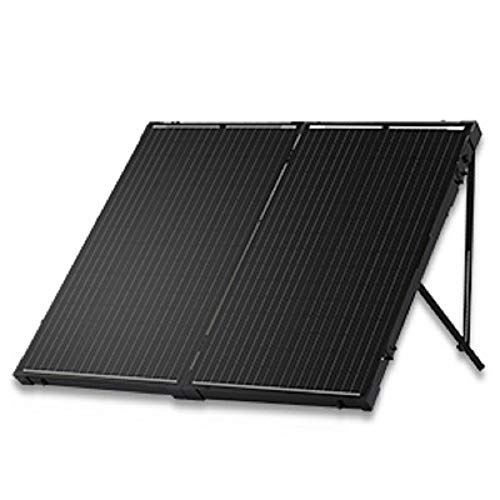
- Pre-installed 20A PWM controller
- Adjustable aluminum kickstand
- Tempered-glass suitcase construction
Best For: Overlanders wanting a ready-to-use 12V charging system
Best All-Around 100W Pick – ZOUPW 100W Foldable Solar Panel
For a versatile portable solar panel for overlanding, the ZOUPW 100W combines a manageable 9.5-pound weight with 23.5% monocrystalline-cell efficiency. Its adjustable kickstands, five connector options, and direct USB charging make it practical for smaller power stations and campsite electronics.
Best For: Overlanders who want a lightweight 100W panel with broad power-station compatibility.
Pros:
- 23.5% efficiency and adjustable 45-degree kickstands
- Includes five connector types for many Jackery, EcoFlow, Anker, and Bluetti models
- IP67 waterproof panel with ETFE coating
- Built-in USB-C and USB-A ports can charge small devices directly
Cons:
- Output is limited to 100W
- Actual charging can be restricted by a power station’s input limit
This is a well-rounded choice when portability, easy setup, and connector flexibility matter more than maximum wattage.
Best High-Output Blanket – RENOGY REGO 400W Portable Solar Panel
The RENOGY REGO 400W is a high-output portable solar panel for overlanding designed for larger energy needs. Its N-type cells offer 25% efficiency, while the blanket-style design folds into a compact package and can be laid on the ground, hung, or positioned across a vehicle’s front window.
Best For: Overlanders needing substantial solar input for compatible power stations or 12V/24V battery systems.
Pros:
- 400W maximum output with 25% N-type solar-cell efficiency
- Folds into a compact blanket-style package with carry handle and shoulder straps
- ETFE-laminated construction and operating range from -10°C to 65°C
- Compatible with several major power-station brands when voltage, current, and connectors match
Cons:
- Weighs 8.57 kg, making it heavier than smaller panels
- MC4 output cables only; the 4-in-1 adapter is sold separately
- Solar charge controller is not included for 12V/24V battery systems
The REGO is compelling for extended trips and higher-demand systems, but buyers should verify connector requirements and budget for any needed adapter or controller.
Best 200W Value Option – EBL 200W Foldable Solar Panel
The EBL 200W is a practical middle-ground portable solar panel for overlanding, offering twice the rated output of a 100W panel without moving into the largest blanket systems. It uses monocrystalline cells, four kickstands, and a bundled MC4-to-4-in-1 cable for broad generator compatibility.
Best For: Campers and overlanders seeking more charging capacity for a moderate-sized power station.
Pros:
- 200W maximum output with conversion efficiency up to 23.5%
- Includes XT60, Anderson, DC7909, and aviation connectors
- Foldable design with four kickstands for positioning
- 840D Oxford cloth outer material and PET lamination provide water and wear resistance
Cons:
- At about 18 pounds, it is relatively heavy for a portable panel
- IP65 protection is less robust than the IP67 and IP68 ratings on some alternatives
- Unfolded length exceeds 94 inches
Choose the EBL when 200W is a useful capacity target and a bundled multi-connector cable is more important than minimizing packed weight.
Best Lightweight Premium Panel – EF ECOFLOW 160W Solar Panel
The EF ECOFLOW 160W stands out as a lightweight portable solar panel for overlanding with 25% N-type conversion efficiency. Its 30-to-60-degree adjustable bracket, solar angle guide, 40-second setup, and IP68 rating suit travelers who regularly reposition their gear in changing outdoor conditions.
Best For: Overlanders prioritizing efficient charging, low carry weight, and strong weather protection.
Pros:
- 25% conversion efficiency using N-type solar technology
- 12.3-pound foldable design with quick setup
- Adjustable 30-to-60-degree bracket and angle guide
- IP68 water- and dust-resistant construction with ETFE coating
Cons:
- 160W output is lower than the 200W and 400W alternatives
- Uses an MC4 connector and includes a solar-to-XT60i cable, so compatibility should be checked
- Only a 12-month manufacturer warranty is listed
This panel is a strong fit for mobile setups where efficient use of limited space and easy handling matter more than maximum rated wattage.
Rugged High-Efficiency Pick – BougeRV 200W N-Type Foldable Panel
The BougeRV 200W is a practical portable solar panel for overlanding when you want strong output, durable construction, and flexible placement around camp. Its N-Type cells are rated for 25% conversion efficiency, while the fiberglass layer and IP65 protection help it handle repeated outdoor use.
Best For: Overlanders, RV travelers, and campers who need a rugged 200W panel with broad connector compatibility and a long extension cable.
Pros:
- 25% N-Type cell efficiency provides high output without increasing panel size.
- Fiberglass-reinforced construction helps resist cracking and surface abrasion.
- Includes XT60 and DC7909 connectors plus an 8.2-foot extension cable.
- Folds with built-in handles and carries an IP65 water- and dust-resistance rating.
Cons:
- At 13.8 pounds, it is heavier than some compact folding options.
- Compatibility depends on the power station or battery accepting the included connector types.
Choose this model if durability and connection flexibility matter more than minimizing carry weight. The fiberglass construction, weather resistance, and cable length suit vehicle-based camps and repeated setup.
Most Versatile Connectivity – Renogy 200W Portable Solar Panel
The Renogy 200W stands out as a versatile portable solar panel for overlanding, combining 25% N-Type cell efficiency with direct USB charging. Its magnetic folding design, multiple positioning angles, and included kickstands make it convenient for SUVs, RVs, and campsite use.
Best For: Overlanders who want to charge compatible power stations and smaller USB devices from one foldable panel.
Pros:
- 16BB N-Type cells provide a stated 25% efficiency rating.
- USB-C PD 45W and dual USB-A ports support phones, tablets, laptops, GPS units, and cameras.
- Four kickstands and 40°, 50°, and 60° positioning options help with setup.
- Folds to 23.72 by 22.99 by 1.97 inches and weighs 13.9 pounds.
Cons:
- The panel uses MC4 output, and the 4-in-1 adapter is sold separately.
- Its 13.9-pound weight may be less appealing for foot travel.
This is a strong fit when charging flexibility is a priority. The built-in USB outputs reduce dependence on extra adapters, while the magnetic closure and adjustable kickstands simplify vehicle and campsite storage.
Lightest 12V Battery Kit – DOKIO 200W Foldable Solar Panel
The DOKIO 200W is a lightweight portable solar panel for overlanding designed around 12V battery charging. It includes a separate PWM controller, a 9.84-foot cable, dual USB ports, and several connection options for RVs, vans, boats, trailers, and emergency power.
Best For: Overlanders who prioritize low carry weight and need a controller-based setup for a 12V battery system.
Pros:
- Weighs 9.7 pounds and folds to a slim 20 by 27 by 1.1 inches.
- Includes a standalone PWM controller with reverse-polarity, overcharge, overload, and short-circuit protection.
- Its 9.84-foot cable allows flexible panel placement in direct sunlight.
- Dual USB ports can power phones, lamps, and small gadgets when connected to a 12V battery.
Cons:
- The included PWM controller may be less efficient than an MPPT-based system.
- Some power stations may limit input to 100–150W, so the full panel rating may not be usable.
- USB output can vary when used without a battery in direct sunlight.
For vehicle builds using a 12V battery, the DOKIO offers a simple and relatively lightweight package. Check your power station’s input limit and connection requirements before buying, especially if you plan to pair it with a portable power station.
Lightweight Pick – GRECELL UB200 200W Flexible Panel
The GRECELL UB200 is a practical portable solar panel for overlanding when packability matters. Its 10.1-pound weight, slim folded profile, flexible ETFE surface, and multiple connector options make it easy to carry and pair with many portable power stations.
Best For: Overlanders who prioritize low weight, compact storage, and broad power-station compatibility.
Pros:
- 200W monocrystalline panel with up to 23.5% conversion efficiency.
- Lightweight 10.1-pound design with four adjustable kickstands.
- Includes XT60, Anderson, DC, and aviation connector options.
- Flexible, scratch-resistant ETFE surface with IP65 water resistance.
Cons:
- Controller and alligator clips are not included.
- IP65 water resistance is intended for splashes, not submersion or placement in rain.
Choose this model if moving gear between campsites or storing equipment in a crowded vehicle is a priority. The lighter construction is appealing for overlanding, though users needing a complete battery-charging kit may need to add compatible accessories.
Weather-Ready Choice – SOKIOVOLA N-Type 200W Folding Panel
The SOKIOVOLA N-Type panel is a versatile portable solar panel for overlanding, with a foldable 200W design and a five-in-one cable for common power stations. Its ETFE coating and IP68 rating suit travelers who expect dust and changing outdoor conditions, while the magnetic handle simplifies transport.
Best For: Overlanders wanting high stated efficiency, strong weather protection, and multiple connection choices.
Pros:
- N-type monocrystalline cells rated for up to 25% conversion efficiency.
- IP68 waterproof and dustproof ETFE-coated construction.
- Includes a five-in-one cable for XT60, Anderson, DC5521, DC7909, and DC8020 connections.
- Folded size is approximately 21 by 23 inches and includes a carrying handle.
Cons:
- At 16.3 pounds, it is heavier than some portable 200W alternatives.
- Actual charging output can be limited by a power station’s maximum solar-input rating.
This is a strong middle-ground option for vehicle-based trips where durability and compatibility matter more than minimum carry weight. Before buying, confirm that your power station can accept the panel’s potential input.
Complete Kit – Renogy 200W Solar Suitcase
The Renogy 200W suitcase is a portable solar panel for overlanding aimed at users who want a more complete 12V charging setup. It includes a pre-installed 20A PWM charge controller, alligator-clip cable, adjustable kickstand, and a rugged glass-and-aluminum build for campsite or vehicle use.
Best For: Overlanders charging 12V batteries or compatible power stations who prefer an out-of-the-box kit.
Pros:
- N-type cells provide up to 25% conversion efficiency.
- Includes a pre-installed waterproof 20A PWM charge controller and charging cable.
- Adjustable aluminum kickstand helps aim the panel toward the sun.
- Tempered glass, aluminum framing, and an IP65 junction box support outdoor use.
Cons:
- At 28.5 pounds, it is substantially heavier than the other listed panels.
- Its PWM controller may be less efficient than an MPPT setup.
- The suitcase-style construction is less flexible for tight storage spaces.
Pick the Renogy when plug-and-play 12V charging is more important than minimizing weight. It is well suited to vehicle-based overlanding, but its heavier glass construction is best carried and stored in a dedicated cargo area.
How We Picked the Best Portable Solar Panel for Overlanding
We selected panels suited to real overlanding setups, including compact power stations, 12V batteries, and larger off-grid systems. The shortlist covers 100W to 400W models, with both standalone panels and suitcase-style kits that include a charge controller.
Our comparison focuses on rated wattage, cell efficiency, connector and power-station compatibility, portability, weather protection, setup hardware, and the trade-off between charging speed and packed size. Published output is a best-case rating, so actual performance will vary with sunlight, panel angle, temperature, shading, and cable losses.
Quick Comparison
| What to Compare | Best Fit | Why It Matters |
|---|---|---|
| 100W–160W | Solo travelers and compact power stations | Easy to carry and adequate for phones, lights, cameras, and modest daily loads |
| 200W | Most overlanding setups | A useful balance of charging speed, portability, and broad power-station compatibility |
| 400W | High-consumption camps | Faster replenishment for larger batteries, refrigerators, and frequent device charging |
| Suitcase kit | 12V battery users | Often includes a charge controller, kickstand, and a simpler direct-to-battery setup |
Key Buying Factors for a Portable Solar Panel for Overlanding
Wattage and Real-World Output
Choose wattage based on your daily energy use and battery capacity. A 200W panel is a practical starting point for many vehicles, while 100W or 160W models are easier to store. If you run a compressor refrigerator, induction cooking equipment, or other high-draw devices, a 400W option may reduce recharge time. Expect lower output in morning, evening, cloudy, or partially shaded conditions.
Compatibility and Charging Hardware
Check the panel’s connector, voltage range, and maximum input supported by your power station. A panel may be electrically capable yet incompatible without the correct adapter. For 12V batteries, confirm whether a charge controller is included; a controller is essential for safe battery charging unless your system already has one.
Portability and Campsite Setup
Foldable panels pack more easily, but larger models can be heavy and need a stable surface. Look for integrated handles, kickstands, manageable folded dimensions, and cable storage. Adjustable positioning is valuable because aiming the panel at the sun often matters more than small efficiency differences.
Weather Resistance and Durability
Water-resistant or waterproof construction helps with unexpected weather, but it does not make every connector or power station suitable for rain. Protect connections, avoid standing water, and follow the manufacturer’s storage and cleaning instructions. Fiberglass or reinforced construction can be useful for frequent vehicle travel.
Who Should Buy Which Portable Solar Panel for Overlanding?
Choose a 100W or 160W panel if space is limited or you mainly charge electronics and a compact power station. Choose a 200W model if you want the best all-around balance for weekend trips, refrigeration, lighting, and general campsite power. Choose a 400W panel if rapid recovery and higher daily energy use matter more than packed size. Choose a suitcase panel with a controller if you charge a conventional 12V battery and want a more complete out-of-the-box kit.
Before buying, compare the panel’s folded dimensions with your vehicle storage area and verify the exact input limits of your battery or power station. Those checks will usually matter more than headline efficiency alone.