High-capacity portable solar panels make it easier to recharge a power station without relying on wall outlets or a fuel generator. The right model can provide useful backup power for camping, travel, job sites, and emergencies.
This roundup compares 10 portable panels ranging from compact 200W designs to larger 480W systems, with attention to output, efficiency, portability, weather resistance, and power-station compatibility.
Best 10 High Capacity Portable Solar Panels Picks for 2026
Lightweight High-Capacity Pick
HQST 200W N-Type Portable Panel

- Up to 25% N-Type cell efficiency
- About 11 pounds with a compact fold
- Includes a versatile 3-in-1 adapter cable
Best For: Portable 200W charging for camping, RV trips, and backup power
Maximum Output Value

- 400W maximum power rating
- 23.5% stated conversion efficiency
- Folds six ways with multiple cable adapters
Best For: Higher-output charging for compatible large power stations
Direct-Device Convenience
Renogy 200W EFLEX Portable Panel

- Up to 25% N-Type cell efficiency
- USB-C PD and dual USB-A outputs
- Four kickstands with three angle settings
Best For: Camping and backup use with direct phone, tablet, and camera charging
Large-Power-Station Specialist
ZOUPW 450W N-Type Portable Panel

- 450W output with 25% efficiency
- 45.9V Voc for 40–60V input systems
- Includes four connector types and ground stakes
Best For: Compatible 2kWh-plus power stations and high-voltage solar generators
Most Compact High-Capacity Pick
Renogy 400W Portable Solar Panel
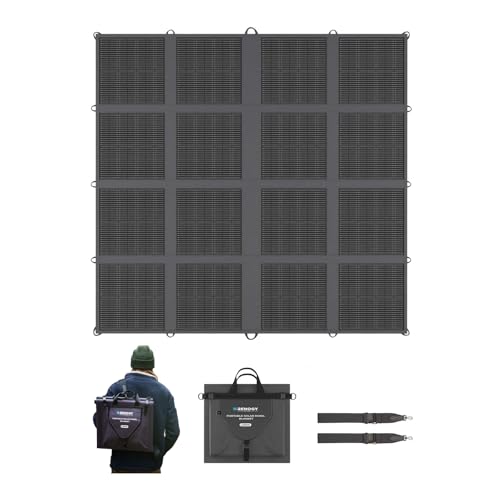
- 400W output with claimed 25% efficiency
- 16-fold design weighs about 16.1 pounds
- MC4 output; adapter sold separately
Best For: Campers and RV travelers needing high output in a compact package
Highest Rated Output
ZOUPW 480W Bifacial Solar Panel

- 480W output with 25% claimed conversion
- Bifacial design may add up to 30% on reflective surfaces
- Includes connector cable, extension cable, bag, and stakes
Best For: Large power stations and off-grid users seeking the highest rated capacity
Best Setup Convenience
Greenmagic 400W Foldable Solar Panel

- 400W output with claimed 21.5%–23.5% efficiency
- Four adjustable kickstands simplify positioning
- MC4 cable and broad power-station compatibility
Best For: Campers and RV users wanting quick setup and flexible positioning
High-Output All-Rounder
SOKIOVOLA 200W Foldable Solar Panel

- 200W output with up to 25% efficiency
- Foldable design with magnetic handle
- IP68 protection and multi-connector cable
Best For: Camping, RV travel, and off-grid backup charging
Maximum Wattage Pick
Renogy 400W Foldable Solar Blanket

- 400W maximum output at 36V
- 23.7% SunPower cell efficiency
- Foldable blanket with ETFE protection
Best For: Large power stations, RVs, and high-demand off-grid charging
Device-Charging Favorite
Twelseavan 200W Solar Panel with USB-C

- 200W output with 24% efficiency
- 60W USB-C and QC3.0 charging ports
- Four kickstands and broad adapter support
Best For: Campsites and emergency use with direct device charging
Lightweight High-Capacity Pick – HQST 200W N-Type Portable Panel
If you want high capacity portable solar panels without carrying a bulky setup, the HQST 200W panel is a practical middle ground. Its N-Type cells offer up to 25% efficiency, while the folding design, adjustable kickstands, and included 3-in-1 adapter cable simplify off-grid charging.
Best For: Campers, RV users, and emergency-backup buyers who need a portable 200W panel compatible with many popular power stations.
Pros:
- Up to 25% efficiency from 16BB N-Type cells.
- Relatively lightweight at about 11 pounds and folds to 1.97 inches thick.
- Includes XT60, DC7909, and DC5521 connections for broad power-station compatibility.
- IP67 waterproof construction and adjustable 40°–60° kickstands.
Cons:
- The 200W output is lower than the larger panels in this roundup.
- Series or parallel connections require careful attention to compatible voltage and power limits.
The HQST stands out when portability matters as much as capacity. It offers useful weather protection and easy setup, making it a balanced choice for mobile charging rather than maximum possible solar output.
Maximum Output Value – 400W Foldable Solar Charger
For shoppers comparing high capacity portable solar panels, this 400W foldable solar charger emphasizes higher rated output while remaining transportable. Its six-fold design, 23.5% conversion rate, adjustable kickstand, and multiple included cable options are suited to larger power-station setups.
Best For: Buyers who want a high-output portable panel for compatible EcoFlow, Jackery, Bluetti, Anker, and similar power stations.
Pros:
- 400W maximum power with a stated 23.5% conversion rate.
- Six-fold design packs down to roughly 26 × 22 × 3 inches.
- Includes MC4, XT60, Anderson, and DC8020 connection options.
- Six-angle kickstand and auto-restart technology support easier operation.
Cons:
- Weighs about 20–23 pounds, so it is less convenient than 200W alternatives.
- Its 40V output requires checking power-station input compatibility before purchase.
- Rated IP65 rather than the higher waterproof ratings listed by some competitors.
This panel makes sense when charging speed and rated capacity take priority over minimum carry weight. Confirm your power station accepts the panel’s voltage and connectors, then use the adjustable stand to optimize sunlight exposure.
Direct-Device Convenience – Renogy 200W EFLEX Portable Panel
The Renogy EFLEX combines the portability expected from high capacity portable solar panels with direct USB charging for smaller electronics. Its 200W N-Type design provides up to 25% efficiency, while the magnetic closure and built-in ports make it convenient for campsites, RVs, and outage preparation.
Best For: Users who want to charge a power station while also running phones, tablets, laptops, GPS units, or cameras directly from the panel.
Pros:
- 16BB N-Type cells provide up to 25% efficiency.
- USB-C PD up to 45W plus two USB-A ports support direct device charging.
- Folds to about 23.72 × 22.99 × 1.97 inches and weighs 13.89 pounds.
- Includes four kickstands and adjustable 40°, 50°, and 60° angles.
Cons:
- The 4-in-1 power-station adapter is sold separately.
- MC4 output and device compatibility should be checked against the intended power station.
- At 200W, it cannot match the rated capacity of the 400W and 450W options.
Renogy’s strongest advantage is flexibility: it can feed compatible power stations or charge everyday USB devices directly. It is a good fit for organized, lightweight setups where convenience matters more than maximum panel wattage.
Large-Power-Station Specialist – ZOUPW 450W N-Type Portable Panel
Among these high capacity portable solar panels, the ZOUPW 450W model is aimed squarely at large solar generators. Its 45.9V open-circuit voltage, 25% efficiency, N-Type 16BB cells, and included multi-connector cable support fast charging for compatible 2kWh-plus power stations.
Best For: Owners of high-voltage EcoFlow DELTA, Anker SOLIX, Bluetti, and other large power stations that accept roughly 40–60V solar input.
Pros:
- 450W rated output with 25% efficiency and N-Type 16BB cells.
- Designed for high-capacity power stations with 40–60V input.
- Includes XT60, Anderson, DC7909, and DC8020 adapter connections.
- IP68-rated panel construction, four kickstands, ground stakes, and a storage bag.
Cons:
- Not compatible with low-voltage units such as Jackery 300/500/1000 or Bluetti EB70S.
- At about 29.5 pounds, it is heavier than the 200W alternatives.
- The manufacturer does not recommend long-term fixed, series, or parallel connections.
The ZOUPW offers the highest rated capacity here, but compatibility is the deciding factor. Verify your power station’s solar-input range before buying; for the right large generator, this panel is built for faster, higher-volume charging.
Most Compact High-Capacity Pick – Renogy 400W Portable Solar Panel
For shoppers comparing high capacity portable solar panels, the Renogy 400W model stands out for combining high output with an unusually compact 16-fold design. Its 25% efficiency rating, 16.1-pound weight, and MC4 output make it practical for camping, RV travel, blackout backup, and other portable power setups.
Best For: Campers, van travelers, and RV owners who prioritize high wattage with minimal storage space.
Pros:
- 400W output and claimed 25% efficiency using N-Type 16BB cells
- Folds to a backpack-size 16.54 x 15.83 x 4.13 inches and weighs about 16.1 pounds
- Can be placed on a windshield, ground, between trees, or on racks
- UL 61730 certified and backed by a two-year material and workmanship warranty
Cons:
- MC4 output only; the 4-in-1 adapter is sold separately
- Actual output depends on sunlight, shade, temperature, cable length, and power-station input limits
The Renogy is an appealing option when portability matters as much as capacity. Confirm your power station’s voltage, amperage, and connector requirements before buying, since real-world charging performance will vary.
Highest Rated Output – ZOUPW 480W Bifacial Solar Panel
The ZOUPW 480W is a high capacity portable solar panel designed for larger power stations and demanding off-grid use. Its N-Type 16BB cells, bifacial construction, 42.5V architecture, and included cables make it a feature-rich choice for RV travel, emergency backup, and wilderness setups.
Best For: Users with large-capacity power stations who want maximum rated output and potential gains from reflective surfaces.
Pros:
- 480W rated output with a claimed 25% conversion rate
- Bifacial design may provide up to 30% extra power on high-albedo surfaces such as snow or sand
- Includes a 4-in-1 connector cable, 13-foot extension cable, storage bag, and ground stakes
- IP68-rated panel with a 36-month warranty
Cons:
- At 22.5 pounds, it is heavier than the Renogy option in this roundup
- Bifacial gains depend on reflective ground conditions and suitable placement
- The manufacturer does not recommend long-term fixed, series, or parallel connections
This is the strongest capacity choice on paper, especially where a large power station and reflective ground are available. Its higher voltage and included accessories are useful, but verify compatibility and follow the manufacturer’s connection and shading guidance.
Best Setup Convenience – Greenmagic 400W Foldable Solar Panel
The Greenmagic 400W panel is a practical high capacity portable solar panel for users who want broad power-station compatibility and quick positioning. Four adjustable kickstands, hanging loops, an MC4 cable, and a foldable design make it suited to camping, RV use, and home backup.
Best For: Buyers who want an easy-to-position 400W panel with built-in stands and wide compatibility.
Pros:
- 400W output with claimed 21.5%–23.5% conversion efficiency
- Four adjustable kickstands help angle the panel toward the sun
- Built-in MC4 cable and compatibility with many Jackery, Goal Zero, EcoFlow, Bluetti, and Anker stations
- 840D Oxford cloth exterior and IP65 panel water resistance
Cons:
- Weighs 21.5 pounds and folds to about 32.09 x 31.30 x 1.97 inches
- The junction box is not waterproof, and the panel should not be left in rain or submerged
- Its claimed efficiency range is lower than the Renogy and ZOUPW claims
Greenmagic is a sensible middle-ground option for straightforward outdoor setup. The integrated stands reduce the need for extra supports, while the included MC4 connection simplifies pairing with compatible 40V-class power stations.
High-Output All-Rounder – SOKIOVOLA 200W Foldable Solar Panel
For shoppers comparing high capacity portable solar panels, the SOKIOVOLA 200W model offers a strong mix of output, portability, and broad power-station compatibility. Its 25% efficiency rating, foldable design, and included multi-connector cable make it practical for camping, RV use, and backup charging.
Best For: Campers, RV owners, and off-grid users who want a durable 200W panel with flexible connector options.
Pros:
- 200W maximum output with up to 25% conversion efficiency.
- Foldable 21-by-23-inch design with a magnetic carrying handle.
- Includes a 5-in-1 cable supporting XT60, DC5521, DC7909, DC8020, and Anderson connections.
- ETFE coating and an IP68 waterproof rating support outdoor durability.
Cons:
- At 16.3 pounds, it may be heavy for extended backpacking or hiking.
- Actual charging output can be limited by the connected power station’s maximum solar-input rating.
Overall, this is a versatile high capacity portable solar panel for vehicle-based adventures and emergency preparedness. Its weight is more manageable for camping and RV travel than for carrying long distances, but the high efficiency and connector range add useful flexibility.
Maximum Wattage Pick – Renogy 400W Foldable Solar Blanket
If your priority is raw charging capacity, the Renogy 400W solar blanket stands out among high capacity portable solar panels. It delivers up to 400W at 36V and uses SunPower solar cells rated at 23.7% efficiency, making it suited to larger portable power stations and demanding off-grid use.
Best For: RV travelers, campers, and users with large power stations who want the highest stated wattage in this lineup.
Pros:
- 400W maximum output can help shorten charging times for compatible generators.
- SunPower cells provide a stated 23.7% conversion efficiency.
- Foldable blanket format weighs 26.5 pounds and stores compactly.
- ETFE covering helps improve impact resistance for outdoor use.
Cons:
- At 26.5 pounds, it is substantially heavier than the 200W alternatives.
- Its 36V output requires a compatible power station or solar input.
The Renogy is the clear capacity-focused choice, especially when charging a large generator or camper battery. Its higher output comes with more carrying weight, so it makes the most sense for setups where maximum generation matters more than backpacking portability.
Device-Charging Favorite – Twelseavan 200W Solar Panel with USB-C
The Twelseavan 200W panel is a practical option among high capacity portable solar panels when you also want direct charging for smaller electronics. Alongside its 200W solar output, it provides USB-C, QC3.0, and USB ports, plus adjustable kickstands and a multi-adapter MC4 cable for flexible field setup.
Best For: Campers and emergency-kit users who need to charge a power station and personal devices from one foldable panel.
Pros:
- 200W maximum output with 24% conversion efficiency.
- Includes USB-C PD up to 60W, QC3.0 up to 18W, and a standard USB port.
- Four adjustable kickstands and a magnetic handle simplify positioning and transport.
- Includes an 8-in-1 connection solution for many portable power stations.
Cons:
- Its IP65 rating is lower than the SOKIOVOLA model’s IP68 rating.
- At 15.7 pounds, it is portable but not especially light for long hikes.
This model is especially appealing if direct phone, camera, tablet, or power-bank charging matters alongside generator charging. It offers slightly less stated efficiency than the SOKIOVOLA, but its built-in device ports and adjustable supports make it convenient for campsite use.
How We Picked the Best High Capacity Portable Solar Panels
We focused on panels rated from 200W to 480W and prioritized models with practical features for real-world portable power. Those features include high-efficiency N-type or monocrystalline cells, foldable construction, MC4 connectivity, weather-resistant materials, and compatibility with popular power stations from brands such as EcoFlow, Jackery, Bluetti, Anker, and EF.
Published wattage is a best-case rating, not a guaranteed everyday output. Actual performance depends on sunlight angle, cloud cover, temperature, shading, cable losses, and the input limits of your power station.
Quick Comparison
| Panel class | Best suited to | Main advantage | Trade-off |
|---|---|---|---|
| 200W | Weekend camping and smaller power stations | Lower weight and easier setup | Slower charging for large batteries |
| 400W | Extended trips and home backup | Strong charging speed | More bulk and higher input demands |
| 450W–480W | Maximum portable generation | Highest potential output | Requires more space and careful compatibility checks |
Key Buying Factors for High-Capacity Portable Solar Panels
Rated Wattage and Real-World Output
Choose wattage according to your battery capacity and charging needs. A 200W panel is easier to carry, while a 400W or larger panel can reduce recharge time when conditions are favorable. Do not assume a larger panel will charge faster if your power station has a low solar-input ceiling.
Voltage, Connectors, and Compatibility
Check the panel’s operating voltage, open-circuit voltage, current, and connector type against your power station’s solar-input specifications. MC4 connectors are common, but an adapter may still be required. Series or parallel connections can increase output, but only when the manufacturer permits them and the voltage remains within limits.
Efficiency and Cell Design
Higher efficiency can produce more power from a smaller footprint, which matters when campsite or balcony space is limited. N-type and bifacial designs may improve performance in suitable conditions, but installation angle and reflective ground surfaces still matter more than headline specifications alone.
Portability and Durability
Consider folded dimensions, carrying handles, kickstands, cable storage, and total weight. IP65, IP67, and IP68 ratings indicate increasing levels of protection against dust and water, but portable panels should still be folded and stored dry rather than left exposed indefinitely.
Who Should Buy Which High Capacity Portable Solar Panels?
Choose a 200W Panel If Portability Matters Most
200W options are a sensible fit for occasional campers, travelers, and owners of smaller power stations. They offer a useful balance of charging ability, manageable size, and simpler setup.
Choose 400W for Everyday Versatility
A 400W model is the strongest all-purpose choice for users who regularly recharge medium or large power stations. It is better suited to extended outdoor stays, emergency preparedness, and heavier loads, provided you have enough setup space.
Choose 450W or 480W for Maximum Solar Input
The largest panels make sense for users who want the shortest possible solar recharge times and can handle additional weight and bulk. Confirm your power station accepts the panel’s voltage and maximum current before buying.