A narrow sump pit can rule out many standard pumps before performance even becomes a consideration. The right model must fit the basin, manage incoming water effectively, and leave enough room for a reliable float switch or sensor.
We compared 10 sump pumps and related basin options across flow rate, motor power, construction, discharge compatibility, controls, and installation practicality to help you choose with fewer surprises.
Best 10 Sump Pumps for Narrow Pits Picks for 2026
High-Output Utility Pick

- Narrow 6.18-inch square footprint
- 79.25 GPM flow and 36-foot lift
- Includes hose, adapters, and long cord
Best For: High-volume drainage in narrow-footprint spaces
Space-Saving Basin Pick

- Compact 13-by-10.2-inch footprint
- Perforated walls collect surrounding water
- Includes fitted lid and routing openings
Best For: Compact installations needing a separate sump basin
Automatic Basement Pick

- Compact 9-by-6.5-inch footprint
- Top suction helps reduce clogging
- Automatic float switch and 4,600 GPH flow
Best For: Indoor basement pits needing automatic operation
Balanced Basement Coverage

- 3,450 GPH flow and 25-foot lift
- Adjustable automatic float switch
- Specified for 18-inch-plus basins
Best For: Larger sump basins needing automatic basement water removal
Narrow-Pit Specialist

- Vertical float switch fits narrow pits
- 5,490 GPH capacity
- Five-year manufacturer warranty
Best For: Indoor basement pits where compact float operation matters
High-Flow Pick

- 4,500 GPH rated flow at a 5-foot lift
- Bottom suction reaches about 1/5 inch
- Includes adapters and 10-foot power cord
Best For: Fast water removal from wells, basements, pools, and hot tubs
Automatic-Drain Option
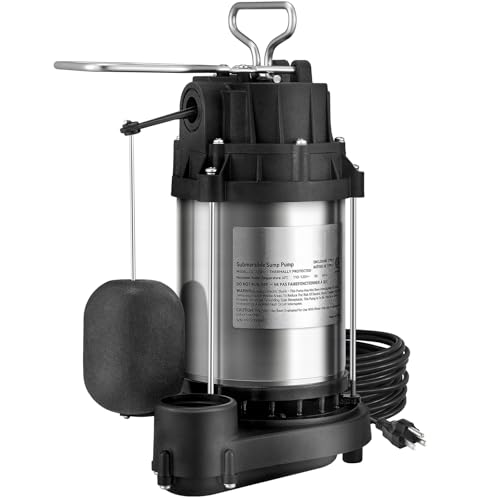
- Tethered float switch enables automatic operation
- 4,320 GPH rating with 28-foot lift
- IPX8-rated stainless steel and cast iron construction
Best For: Basins with enough room for the pump and float switch
Best Simple Pick

- 6-inch cylindrical body fits tight pits
- 4,000 GPH oil-free 1 HP drainage power
- Includes lifting rope and multiple adapters
Best For: Narrow pits and supervised emergency drainage
Compact Crawl Space Pick – Liberty Pumps CSP-237
For sump pumps for narrow pits, the Liberty Pumps CSP-237 is a purpose-built option with a compact 10-by-10-inch footprint. Its included perforated pit and cover make it suited to collecting and removing water beneath homes, in crawl spaces, and in basements.
Best For: Crawl spaces and other compact areas where an included sump pit is useful.
Pros:
- Compact 10″ L x 10″ W x 13″ H dimensions
- Includes a perforated polyethylene sump pit and cover
- 1/3 HP motor delivers up to 18 GPM with a 24-foot maximum lift
- Designed for dewatering crawl spaces, basements, and areas beneath homes
Cons:
- Lower flow rate than the larger utility pump options listed here
- Included components are limited to the product
The CSP-237 stands out when installation space is tight and a matched basin-and-cover setup is preferable. Its 18 GPM rating is better suited to focused drainage than high-volume flood removal.
High-Output Utility Pick – SEESII 1HP Submersible Pump
Among sump pumps for narrow pits, the SEESII 1HP pump offers substantial capacity in a 6.18-by-6.18-inch footprint. It is a versatile choice for fast water removal, though its 12.24-inch height and utility-pump design should be checked against the pit dimensions.
Best For: Narrow-footprint applications requiring high flow, extended lift, and included hose accessories.
Pros:
- Compact 6.18″ L x 6.18″ W footprint
- High 79.25 GPM flow rate and 36-foot maximum lift
- Includes a 23-foot hose, adapters, and a 25-foot power cord
- Built-in filter helps reduce clogging from small debris
Cons:
- 12.24-inch height may not suit especially shallow pits
- Designed for clean and lightly dirty water rather than heavy debris
- Higher 1 HP output may be more than needed for routine sump duty
This SEESII is the strongest performer here for rapid drainage and elevated discharge. Confirm the pit’s available height and ensure the water conditions match its clean-to-lightly-dirty-water design.
Space-Saving Basin Pick – Perforated Sump Basin and Lid
For sump pumps for narrow pits, this 13-by-10.2-by-15-inch basin provides a compact collection point rather than a pump itself. Its perforated walls are designed to collect surrounding water, while the included lid provides openings for discharge piping and the power cord.
Best For: Limited-space installations that need a basin and lid for a separate utility pump.
Pros:
- Space-saving 13″ x 10.2″ x 15″ dimensions
- Perforated design supports 360-degree water intake
- Reinforced plastic construction helps resist lateral soil pressure
- Includes a fitted lid with pre-cut routing openings
Cons:
- Does not include a sump pump
- Its 15-inch height may not fit shallow installations
- Rectangular dimensions require careful pit-space planning
This combo is useful when the main challenge is creating a compact, protected sump location. Pair it with a compatible pump after checking the basin’s dimensions and the pump’s operating requirements.
Automatic Basement Pick – WAYNE CDU790
The WAYNE CDU790 is a practical choice among sump pumps for narrow pits, with a 9-by-6.5-inch footprint and an 11.5-inch height. Its top-suction design helps limit clogging at the bottom of the pit, while the integrated vertical float switch provides automatic operation.
Best For: Basement pits needing automatic operation, quiet performance, and a compact pump footprint.
Pros:
- Compact 9″ L x 6.5″ W x 11.5″ H dimensions
- Top suction helps minimize bottom-debris clogging and air lock
- Delivers up to 4,600 GPH with a 20-foot maximum lift
- Integrated float switch is tested to 1 million cycles
Cons:
- Intended for indoor use only
- Lower maximum lift than the SEESII utility pump
- At 16.4 pounds, it is heavier than the compact Liberty pump
The CDU790 balances a narrow footprint with automatic basement protection and durable construction. It is a particularly sensible fit for indoor sump pits where dependable float-switch operation matters more than maximum flow.
Balanced Basement Coverage – 1/2 HP AQUASTRONG
For sump pumps for narrow pits, the AQUASTRONG is best suited to larger basins rather than especially tight pits: the manufacturer specifies installation in an 18-inch-diameter-or-larger sump basin. Its 3,450 GPH output, adjustable float switch, and top-suction design make it a practical choice for routine basement water removal.
Best For: Homeowners with an 18-inch-or-larger sump basin who want automatic basement, wastewater, or rainwater removal.
Pros:
- Moves up to 3,450 gallons per hour and lifts water up to 25 feet.
- Adjustable float switch with piggy-back plug supports automatic operation.
- Top suction helps reduce airlock and bottom-of-pit debris clogging.
- Includes thermal overload protection, a 20-foot UL power cable, and a one-year warranty.
Cons:
- Specified for sump basins 18 inches in diameter or larger, so it may not fit very narrow pits.
- The 1-1/2-inch NPT discharge may require compatible plumbing fittings.
The AQUASTRONG offers a useful balance of automatic operation, solid construction, and moderate lifting capacity. Confirm your basin diameter and discharge setup before choosing it for a narrow-pit installation.
High-Flow Utility Pick – 1.5 HP SUB 6500SS
Among sump pumps for narrow pits, this high-output model requires careful fit checking because its housing measures 7.4 by 7.4 inches and its automatic starting level is 17.7 inches. It delivers up to 6,500 GPH, includes three hose adapters, and can handle water removal from sump pits, basements, pools, and other areas.
Best For: Users who need very high flow and have enough pit clearance for the pump and its adjustable float operation.
Pros:
- 1.5 HP motor pumps up to 6,500 GPH and lifts water 26 feet.
- 304 stainless steel housing, corrosion-resistant plastic, and thermal overload protection support durability.
- Three hose adapters accommodate different hose sizes.
- Can operate in automatic or manual mode.
Cons:
- The 15.3-inch height and 17.7-inch automatic starting level may not suit shallow or very tight pits.
- Manual mode does not shut off automatically, so it requires closer monitoring.
- Not intended for corrosive or flammable liquids.
This is the strongest-flow option in the group, but its float requirements make pit dimensions especially important. Measure both the available footprint and water depth before using it in a narrow sump pit.
Narrow-Pit Specialist – WAYNE CDU980E 3/4 HP
The WAYNE CDU980E is the most directly targeted choice for sump pumps for narrow pits, thanks to its integrated vertical float switch. Its 10.5-by-9-by-11-inch dimensions, top-suction design, and 5,490 GPH capacity combine practical fit with strong basement water-removal performance.
Best For: Narrow sump pits where a vertical float switch and automatic operation are priorities.
Pros:
- Vertical float switch is designed to fit narrow sump pits.
- Moves up to 5,490 gallons per hour with a 3/4 HP motor.
- Top suction helps prevent clogging and eliminates the need for a weep hole.
- Cast iron and stainless steel construction is backed by a five-year warranty.
Cons:
- Listed for indoor use only.
- Its 92 GPM flow rate is lower than the 1.5 HP utility pump in this roundup.
- The vertical float design may provide less adjustment flexibility than a cable-style float.
For a genuinely narrow pit, the CDU980E is the clearest fit-focused option here. It pairs a space-conscious vertical float with substantial capacity and a notably long five-year warranty.
High-Flow Pick – Aquastrong 1 HP Sump Pump
For sump pumps for narrow pits, the Aquastrong offers strong water-removal capacity in a relatively compact package. Its 1 HP motor is rated for up to 4,500 GPH at a 5-foot lift, while the bottom-suction design can draw water down to about 1/5 inch from the surface.
Best For: Homeowners who need a high-flow pump for basement wells, window wells, hot tubs, pools, or other water-removal jobs.
Pros:
- High 4,500 GPH flow rating and up to 30 feet of lift.
- Bottom-suction design removes water close to the surface and handles solids up to 1/5 inch.
- Includes multiple adapters, a 10-foot UL power cord, and thermal overload protection.
Cons:
- Its listed dimensions are 6.3 by 9.85 by 11.03 inches, so buyers should verify pit clearance.
- Plug-in operation is manual rather than float-switch automatic.
The Aquastrong is a practical choice when fast drainage and low residual water matter more than automatic cycling. Check the pit opening and discharge setup before buying, especially for very confined installations.
Automatic-Drain Option – VEVOR 1/2 HP Sump Pump
Among sump pumps for narrow pits, the VEVOR stands out for hands-free operation through its tethered float switch. The 1/2 HP motor moves up to 4,320 GPH and lifts water as high as 28 feet, but its recommended pit size is larger than many narrow-pit setups.
Best For: Indoor basement basins and outdoor drainage applications where automatic start-and-stop operation is a priority.
Pros:
- Tethered float switch starts and stops the pump according to water level.
- Rated for up to 4,320 GPH and a 28-foot maximum lift.
- Stainless steel surface, cast iron frame, IPX8 waterproof rating, and thermal overload protection.
Cons:
- The manufacturer specifies a sump pit larger than 22 inches high by 15 inches in diameter.
- At 15.6 by 11.2 by 10 inches and 15.7 pounds, it is comparatively bulky for tight pits.
- Passes solids only up to 0.1 inch in diameter.
The VEVOR is better suited to a generously sized basin than a truly narrow pit. Confirm the pit dimensions and float-switch clearance before choosing it for a confined installation.
Best Simple Pick – Green Expert 1 HP Sump Pump
For sump pumps for narrow pits, the Green Expert is purpose-built around a 6-inch cylindrical body, top discharge, and top-routed power lead. Its manual 1 HP pump is rated for 4,000 GPH and includes a lifting rope and adapters for temporary drainage work.
Best For: Narrow sump pits, drainage pits, basements, hot tubs, pools, and supervised emergency water removal.
Pros:
- Compact 6-inch cylindrical body is designed for tight wells and pits.
- 304 stainless steel body resists rust and corrosion, while the oil-free 1 HP motor provides high-volume drainage.
- Double-layer intake helps reduce blockage from leaves, pebbles, and debris.
- Includes a 16.5-foot lifting rope and several hose and pipe adapters.
Cons:
- Manual activation requires supervised plug-in operation.
- It stops at about 1 inch of water, or 0.8 inch under ideal conditions, rather than removing every last bit.
- Its 4,000 GPH rating is lower than the Aquastrong’s listed flow.
The Green Expert is the most directly aligned with narrow-pit installations in this group. Its compact body and top-discharge layout simplify placement, while the manual design makes it best for monitored, temporary, or emergency pumping.
How We Picked the Best Sump Pumps for Narrow Pits
We focused on the specifications that matter most when space is limited: pump footprint, switch design, discharge size, power, construction materials, and expected water-removal capacity. We also considered whether each option is better suited to a permanent sump installation, a crawl space, or occasional utility pumping.
Flow-rate claims are typically measured with little or no lift, so real performance will be lower once the pump pushes water vertically through pipe, fittings, and a check valve. Models with stronger motors can help with demanding installations, but excessive capacity is not automatically better if the pit, outlet, or drainage system cannot handle it.
Quick Comparison
- Compact crawl-space option: Liberty Pumps CSP-237 is designed for restricted spaces and low-profile applications.
- Permanent basement installations: WAYNE CDU790 and CDU980E offer durable construction and automatic operation.
- Higher-flow water removal: The SEESII, 1.5HP utility pump, and AQUASTRONG models target faster water movement.
- Stainless-steel construction: VEVOR, Green Expert, and several AQUASTRONG options emphasize corrosion-resistant housings.
- Basin replacement or expansion: The perforated basin and lid combo may be useful when the existing pit is undersized or poorly configured.
Key Buying Factors for Sump Pumps for Narrow Pits
Physical Fit and Float Clearance
Measure the pit’s inside diameter and depth, then compare those dimensions with the pump body and float’s movement—not just the motor housing. A tethered float may need more open space than a vertical float, while a narrow pit may favor a compact sensor or crawl-space design.
Head Height and Actual Flow
Check the pump’s performance at your required vertical lift. Measure from the pump outlet to the discharge point, then account for horizontal pipe runs and bends. A pump advertised at several thousand gallons per hour may deliver substantially less at working height.
Discharge Compatibility
Match the pump’s NPT outlet to the discharge pipe using the correct adapter, check valve, and sealant. Avoid reducing the pipe unnecessarily, since restrictions can reduce flow and increase strain. Confirm that your existing plumbing can accept the listed outlet size.
Automatic Controls and Backup Planning
Automatic float switches are convenient, but they need room to move freely and can be affected by debris or nearby cables. Vertical switches may suit narrow pits better. For flood-prone homes, consider an alarm, battery backup, or secondary pump rather than relying on one unit.
Materials, Cord Length, and Maintenance
Cast iron, aluminum, and stainless steel can provide useful durability, while thermoplastic bodies may reduce weight and cost. Verify cord length, outlet requirements, intake accessibility, and whether the pump is intended for continuous sump duty or intermittent utility use.
Who Should Buy Which Sump Pumps for Narrow Pits?
Choose the Liberty Pumps model when restricted crawl-space dimensions are the main challenge. The WAYNE CDU790 is a practical choice for a conventional basement pit, while the CDU980E is better for buyers who want more capacity and a longer warranty. Select an AQUASTRONG, SEESII, or high-powered utility pump when rapid water removal is more important than minimal energy use, but verify head-height performance first.
For corrosion resistance or occasional pumping, the VEVOR and Green Expert models are worth considering. If the pit itself is the problem, the basin-and-lid combo may be the more useful purchase. Before ordering any of these Sump Pumps for Narrow Pits, confirm dimensions, switch clearance, outlet size, electrical requirements, and local installation rules.