Reliable battery information can make RV travel easier, especially when boondocking or managing solar power. A quality monitor shows more than voltage alone, helping you track current draw and estimated state of charge.
We compared 10 battery monitors for RVs across shunt capacity, display options, wiring reach, alarms, water resistance, and compatibility with lithium and lead-acid systems. Use the guide below to narrow the list to the right fit for your power setup.
Best 10 Battery Monitors for Rvs Picks for 2026
Best Budget Shunt Monitor

- Tracks SOC, voltage, current, and capacity
- Supports 8V–120V systems and multiple chemistries
- Includes 100A shunt and 2-meter cable
Best For: Smaller RVs, camper vans, and compact solar systems
Best Long-Cable Monitor

- Includes a 13-foot custom cable
- Tracks up to 350A and 999Ah
- Backlit LCD with retained settings
Best For: Larger RVs and installations needing remote display placement
Best Alarm Display

- Displays voltage, power, capacity, and charge time
- Includes configurable visual and buzzer alarms
- Supports 8V–120V and battery banks up to 9,999Ah
Best For: Dry RV and off-grid installations needing battery alerts
Rugged Voltage Monitor
IPX7 Multi-Voltage Battery Tester

- Supports 7–100V battery systems
- IPX7 housing with temperature and buzzer alarms
- Displays voltage and remaining capacity percentage
Best For: Moisture-exposed RV and marine installations needing broad voltage compatibility
Shunt-Based Power Tracking

- Measures voltage, current, state of charge, and capacity
- Supports 8–120V batteries and up to 350A continuous
- Backlit display with memory and included shielded cables
Best For: RV owners who want detailed battery-use and capacity information
Easy-Read Capacity Display

- Displays voltage, capacity, and percentage together
- Supports 8–100V lithium and lead-acid systems
- Waterproof panel with alarms and power-outage memory
Best For: RV users wanting a straightforward, easy-to-read capacity display
Proven Shunt Monitor
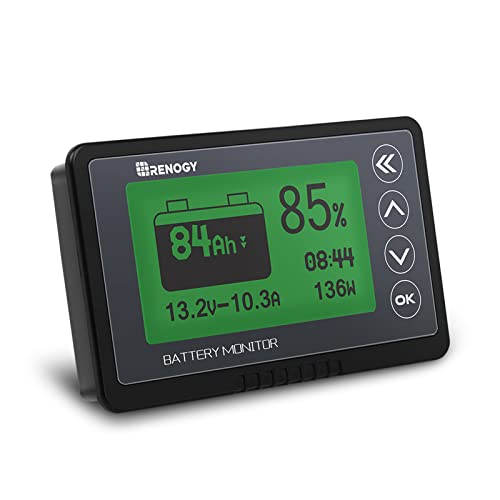
- 1% accuracy with 10–120V and up to 500A support
- Programmable high and low capacity alarms
- 20-foot cable and transparent shunt holder included
Best For: RV systems using 12V, 24V, or 48V battery banks
Color-Screen Value Pick

- 2.4-inch color screen with adjustable brightness
- Stores the latest readings after system shutdown
- 8–100V support with programmable capacity alarms
Best For: RV owners wanting an easy-to-read display and retained data
Best Budget Shunt Monitor – AILI 100A Battery Monitor
For RV owners seeking practical battery monitors for RVs, the AILI provides a straightforward wired display of state of charge, voltage, current, and remaining capacity. Its 100A shunt and support for systems from 8V to 120V make it a sensible fit for smaller battery banks.
Best For: Camper vans, caravans, smaller RV electrical systems, and compact solar setups under 100A.
Pros:
- Displays state of charge, voltage, current, and capacity up to 999Ah.
- Supports 12V, 24V, 36V, and 48V systems and several battery chemistries.
- Includes a 2-meter cable, 100A shunt, bracket, and manual.
- Low standby power, backlight, sleep mode, and memory retention.
Cons:
- The 100A shunt is intended for smaller systems rather than high-current installations.
- Monitoring uses a wired LCD rather than Bluetooth or a phone app.
The AILI is a compact, self-powered choice when you want essential battery information without app setup. Its capacity range and broad voltage compatibility add flexibility, while the 100A rating limits it primarily to modest RV and off-grid systems.
Best Smart App Monitor – ANCEL BM1000 Bluetooth Battery Monitor
The ANCEL BM1000 brings phone-based monitoring to battery monitors for RVs, showing state of charge, voltage, current, power, and capacity in real time. Its 400A smart shunt and 30-day history are useful for tracking consumption in RV, marine, solar, and off-grid battery banks.
Best For: RV owners who want Bluetooth access, usage history, and monitoring for typical 100–300A peak-load systems.
Pros:
- Provides live battery data through a Bluetooth phone app.
- Stores up to 30 days of voltage, current, and temperature history.
- Supports 10V–120V systems and lithium, LiFePO4, AGM, and lead-acid batteries.
- Includes reverse-polarity and overload protection plus QR installation guidance.
Cons:
- Bluetooth range is about 10 meters in open areas and can be reduced by walls or metal compartments.
- It is not intended for starter-battery load testing, CCA testing, or OBD diagnostics.
The BM1000 is a strong choice if you prefer checking battery status from a phone instead of installing a dedicated interior display. Its history tools add useful context, but nearby Bluetooth access and the intended battery-bank use should fit your RV layout and system.
Best Long-Cable Monitor – QWORK 350A Battery Monitor
The QWORK monitor is a practical wired option among battery monitors for RVs, combining a backlit LCD with a 13-foot custom cable. It tracks voltage, current, state of charge, and capacity, while its reinforced 350A shunt is suited to more demanding RV and off-grid installations.
Best For: RVs, motorhomes, caravans, and solar storage systems where the display needs to be installed away from the battery compartment.
Pros:
- Includes a long 13-foot cable for flexible display placement.
- Tracks voltage, current up to 350A, state of charge, and capacity up to 999Ah.
- Backlit LCD is designed for visibility in low light.
- Memory retains testing parameters after a power disconnect.
Cons:
- The supplied notes list an 8V–80V maximum in the details, while the feature copy states up to 100V.
- It uses a wired display and does not offer app-based monitoring.
- The notes do not specify supported battery chemistries.
The QWORK stands out for installations where cable length matters. Its higher-current shunt and long lead can simplify placement in a larger RV, though buyers should verify the applicable voltage limit and battery compatibility before installation.
Best Alarm Display – LiTime 500A Battery Monitor
The LiTime 500A monitor adds visual and audible alerts to battery monitors for RVs, displaying voltage, current, power, capacity, charge time, and battery percentage directly on its LCD. Its 8V–120V range and support for battery banks up to 9,999Ah make it suitable for larger RV and off-grid setups.
Best For: RV and solar users who want a dedicated screen with configurable low-voltage or low-capacity warnings.
Pros:
- Displays extensive information, including power, capacity, percentage, and remaining charge or discharge time.
- Offers a 500A shunt and supports 8V–120V battery systems.
- Provides configurable flashing-screen and buzzer alarms.
- Works with Li-ion, LiFePO4, Gel, AGM, and other listed battery types.
Cons:
- The monitor is not waterproof and is unsuitable for marine environments.
- Setup requires following the manual after the display powers on.
- The supplied unit is relatively larger and heavier than some compact monitors.
The LiTime is appealing when an audible warning is more useful than checking an app or screen regularly. Its broad voltage and capacity ranges offer room for expansion, but it should be installed in a dry location and configured carefully according to the manual.
Rugged Voltage Monitor – IPX7 Multi-Voltage Battery Tester
For RV owners seeking battery monitors for RVs that can handle varied electrical setups and outdoor use, this meter covers 7–100V systems and displays voltage, temperature, and remaining capacity percentage. Its sealed housing, alarm settings, and included mounting hardware make it practical for installations exposed to moisture.
Best For: RVs, boats, and other vehicles using lead-acid, AGM, LiFePO4, or lithium-ion batteries across multiple voltage ranges.
Pros:
- Supports 7–100V systems, including 12V, 24V, 36V, 48V, 60V, and 72V setups.
- IPX7 waterproof housing with reverse-connection protection.
- Displays voltage, capacity percentage, and temperature, with configurable high- and low-voltage buzzer alarms.
- Includes a mounting bracket, adhesive, screws, and 23.62-inch wires.
Cons:
- Requires an initial setup following the instructions or the percentage may remain at 100%.
- It does not provide the current and amp-hour tracking of a shunt-based monitor.
This is a flexible choice when waterproof construction and broad voltage compatibility matter most. It is best suited to buyers who want a straightforward panel display rather than detailed current-flow data.
Shunt-Based Power Tracking – BINTA 500A Battery Monitor
Among battery monitors for RVs, this BINTA model stands out for measuring more than voltage. Its included shunt tracks current, state of charge, and remaining capacity, giving RV users a more complete view of battery usage and available power.
Best For: RVs and other 8–120V systems where current draw, capacity tracking, and state-of-charge information are more useful than voltage-only readings.
Pros:
- Tracks voltage, current, state of charge, and remaining capacity up to 999Ah.
- Supports lead-acid, LiFePO4, and lithium-ion batteries from 8–120V.
- Handles up to 500A peak and 350A continuous current.
- Includes shielded cables, a positive wire, backlit display, auto-sleep, and data memory.
Cons:
- Shunt-based installation is more involved than installing a basic voltage display.
- The listed upper temperature rating is 50°C.
Choose this monitor when accurate, multi-metric battery information is a priority. Its shunt and capacity tracking are particularly useful for managing demanding RV electrical systems, though installation takes more planning than a simple panel meter.
Easy-Read Capacity Display – DROK Waterproof Battery Meter
This DROK meter is a practical option for shoppers comparing battery monitors for RVs that show key information at once. Its larger color LCD displays voltage, capacity, and remaining percentage without requiring users to switch interfaces, while the waterproof panel is designed for vehicle and marine applications.
Best For: RV, marine, golf-cart, and solar-generator users who want a simple voltage and capacity display for 8–100V battery systems.
Pros:
- Shows voltage, capacity, and remaining percentage on an upgraded larger screen.
- Supports 8–100V systems and multiple lithium and lead-acid battery types.
- Waterproof panel with reverse-polarity protection and low-voltage alarm.
- Includes automatic power-outage saving and rear voltage calibration adjustment.
Cons:
- It is a voltage and capacity meter rather than a shunt-based current monitor.
- The supplied notes do not specify an included mounting bracket or wiring accessories.
This model makes sense for buyers who value a clear, uncomplicated display and broad battery compatibility. The calibration adjustment adds flexibility, while the waterproof design suits RV and marine installations.
Wide-Range Alarm Pick – LiTime 500A Battery Monitor
For RV owners comparing battery monitors for RVs, the LiTime 500A offers broad battery-bank compatibility, detailed readings, and an audible warning system. Its shunt-based design tracks voltage, current, power, capacity, remaining charge or discharge time, and state of charge with stated ±1% accuracy.
Best For: RV and off-grid users who need a wide 8–120V operating range, nighttime visibility, and preset voltage or capacity alerts.
Pros:
- Supports 8–120V battery banks and capacities up to 9,999Ah.
- Displays multiple battery metrics, including SOC and remaining time.
- Adjustable backlit LCD, buzzer alarm, and included 20-foot shielded cable.
- Works with Li-ion, LiFePO4, AGM, Gel, and other battery types.
Cons:
- The monitor is not waterproof and requires installation in a dry location.
- The alarm sounds every 10 seconds when a preset threshold is reached, which may be noticeable in a quiet RV.
Choose this LiTime model when compatibility and alert features matter most. The broad voltage range is especially useful for varied RV and off-grid setups, while the dry-location requirement should be planned for during installation.
Proven Shunt Monitor – Renogy 500A Battery Monitor
The Renogy 500A is a practical choice among battery monitors for RVs when accurate voltage and current readings are the priority. Its shunt design measures battery activity with stated 1% accuracy and adds programmable alarms to help flag high or low capacity conditions.
Best For: RV users with 12V, 24V, or 48V systems who want a readable display, battery-type flexibility, and a remote installation option.
Pros:
- Supports 10–120V systems and up to 500A.
- Compatible with AGM, Gel, lead-acid, LiFePO4, lithium-ion, and nickel-metal hydride batteries.
- Displays voltage, current, consumed power, capacity, and battery degradation rate.
- Includes a transparent shunt holder and 20-foot shielded cable.
Cons:
- Its stated minimum operating voltage is 10V, so it is less suited to lower-voltage setups than some alternatives.
- The supplied notes do not specify a waterproof enclosure.
Renogy’s monitor is a balanced option for conventional RV electrical systems, particularly where 12V, 24V, or 48V compatibility covers the installation. Its alarms and remote cable make it useful for keeping an eye on battery condition from a convenient panel location.
Color-Screen Value Pick – LNEX 500A RV Battery Monitor
The LNEX 500A stands out among battery monitors for RVs with its 2.4-inch color screen and data-retention feature. It measures voltage and current across a range of battery types, while programmable high and low capacity alarms help draw attention to potentially problematic conditions.
Best For: RV owners who prefer a large color display, adjustable brightness, and a monitor that retains its latest testing data after shutdown.
Pros:
- 2.4-inch color screen presents readings clearly at a glance.
- Supports 8–100V batteries and multiple chemistries, including LiFePO4, lithium-ion, lead-acid, and Gel.
- Stores the latest testing data when the system shuts down.
- Includes programmable high and low capacity alarms, a transparent shunt holder, and a 16-foot shielded wire.
Cons:
- The included shielded wire is shorter than the 20-foot cables supplied with the other listed models.
- Its listed operating range is described inconsistently in the supplied details, so verify the intended voltage range before installation.
LNEX is a good fit when display readability and saved data are more important than maximum cable length. The adjustable brightness is useful for nighttime viewing, and the broad battery compatibility suits many RV, boat, and recreational power systems.
How We Picked the Best Battery Monitors for Rvs
We focused on monitors that measure battery voltage and current through an external shunt, since shunt-based systems generally provide a more useful picture of energy flowing into and out of the battery bank than voltage-only gauges. The selected models cover common RV requirements, including 12V and 24V systems, lithium and lead-acid compatibility, capacities from roughly 100A to 500A, and installations with either a built-in screen or wireless access.
We also considered practical installation details: cable length, terminal size, display readability, programmable alarms, waterproofing, backlighting, and whether the monitor can track larger battery capacities. Product specifications should still be checked against your exact battery bank and charging equipment before purchase.
Quick Comparison
- Best for basic monitoring: AILI offers a straightforward display and broad voltage range for common RV installations.
- Best for Bluetooth access: ANCEL BM1000 is suited to users who want to view readings from a phone.
- Best for long cable runs: QWORK and LNEX models include extended wiring options for flexible placement.
- Best for larger current loads: The 500A models from LiTime, BINTA, Renogy, and LNEX suit many higher-demand RV banks.
- Best for wet or exposed locations: Waterproof options from the IPX7 and DROK listings add protection where installation conditions are less controlled.
Key Buying Factors for Battery Monitors for Rvs
Shunt Rating and System Size
Choose a shunt with enough capacity for the maximum continuous and peak current your inverter, appliances, chargers, and solar equipment may draw. A 500A model provides more headroom than a 100A unit, but it does not automatically improve accuracy if the installation is poorly sized or wired.
Battery Chemistry and Voltage Range
Confirm support for your battery type, especially if you use LiFePO4. Lithium batteries have different voltage behavior and charging characteristics from lead-acid batteries, so a monitor should allow appropriate capacity settings and calibration. Also verify that its input range covers your nominal system voltage.
Display, Bluetooth, and Alarms
LCD screens are convenient for a fixed interior mounting location, while Bluetooth can reduce the need to install a display in a visible area. High- and low-voltage alarms are useful for protecting batteries and identifying charging or load problems before they become inconvenient.
Installation and Environmental Protection
The shunt should normally be installed on the battery-bank negative side so the monitor can measure all relevant loads and charging sources. Check terminal size, included cable length, backlighting, enclosure protection, and access to the display before ordering.
Who Should Buy Which Battery Monitors for Rvs?
Choose a simple AILI, QWORK, or BINTA monitor if you want an affordable wall-mounted readout and have straightforward wiring needs. Consider ANCEL if phone-based access is more useful than a dedicated screen. LiTime or Renogy are sensible candidates for established RV battery systems that need a conventional 500A shunt and clear readings.
For exposed compartments, outdoor utility areas, or boats and trailers that may encounter moisture, prioritize the waterproof listings and still follow their installation limitations. LNEX is worth considering when you need a larger color display, a long shielded cable, or programmable alarms. Regardless of model, calibrate the monitor after installation and enter the correct battery capacity for meaningful state-of-charge estimates.