A reliable battery monitor can help you spot low voltage, charging problems, and declining battery performance before they leave you stranded. The best digital battery monitors make readings easier to see and interpret across vehicles, boats, RVs, and off-grid projects.
This roundup compares ten options with different voltage ranges, display styles, weather-resistance ratings, Bluetooth features, and measurement capabilities. Use the guide below to match the monitor to your battery chemistry, installation space, and preferred level of detail.
Best 10 Digital Battery Monitors Picks for 2026
Best Waterproof Panel Meter

- Measures DC 8–48V with 0.1V stated accuracy
- Waterproof blue LED display for low-light viewing
- Includes panel, wiring, screws, and nylon nut
Best For: Built-in voltage monitoring for vehicles and marine systems
Best Multi-Voltage Alarm Gauge
Golf Cart Battery Meter with Alarm

- Supports systems from 12V to 84V
- Shows voltage and estimated battery percentage
- Offers selectable battery types and low-battery alarm
Best For: Golf carts and lithium or lead-acid recreational systems
Best App-Based Monitor
ANCEL BM300 Pro Bluetooth Battery Monitor
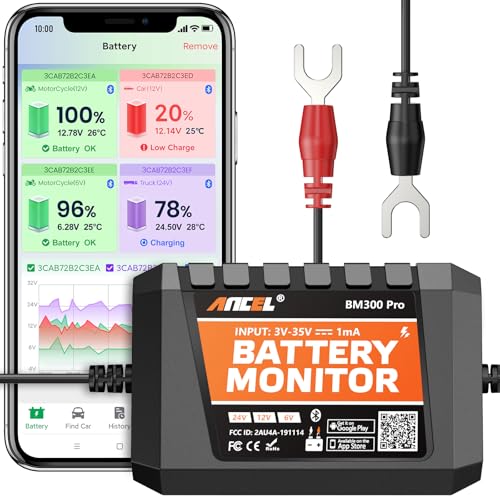
- Monitors 6V, 12V, and 24V systems in an app
- Stores and syncs up to 72 days of history
- Adds temperature, SOC, and supported test data
Best For: Bluetooth-based vehicle and battery-bank monitoring
Best High-Voltage LCD Gauge

- Covers 10–100V battery systems
- Supports lithium, lead-acid, LiFePO4, and NiMH batteries
- Displays capacity percentage and internal meter temperature
Best For: Golf carts, RVs, marine equipment, and DIY high-voltage projects
Smart Bluetooth Pick

- Bluetooth app monitoring for 12V batteries
- Cranking and charging-system tests
- 70-day history, alerts, and IP67 protection
Best For: Drivers wanting remote monitoring and battery alerts
Wide-Range Panel Pick
Multi-Voltage LCD Battery Meter

- Supports 7V-100V DC battery systems
- Backlit LCD shows voltage and remaining power
- IP67 rating with low-voltage warning
Best For: Multi-voltage vehicle and solar battery installations
Detailed Shunt Monitor
CGELE Multifunction Battery Meter

- Nine readings include voltage, current, power, and SOC
- Measures up to 200V and 100A
- Backlit LCD with included shunt
Best For: RV and solar users needing detailed battery data
Rugged Wide-Range Monitor

- 7-100V compatibility for many battery systems
- IPX7 housing with voltage and temperature alarms
- Displays voltage and remaining capacity percentage
Best For: Outdoor vehicles, boats, RVs, and golf carts
Easy-Read Capacity Meter
DROK 8-100V Waterproof Battery Monitor

- Large screen shows voltage and capacity together
- 8-100V support for lithium and lead-acid batteries
- Includes calibration, memory, and low-voltage alarm features
Best For: Vehicle, marine, RV, and solar-generator monitoring
Compact Green-Backlit Gauge
12-84V Battery Capacity Indicator
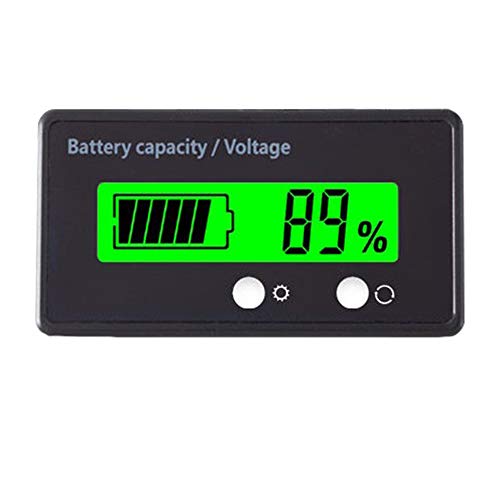
- Supports lead-acid and 3S-26S lithium batteries
- Switches between voltage and percentage displays
- Compact waterproof design with reverse protection
Best For: Space-constrained golf cart and electric-vehicle installations
Best Waterproof Panel Meter – Blue LED 12/24/36V Voltmeter
For straightforward vehicle and marine monitoring, this digital battery monitor provides a bright blue voltage display and a broad 8–48V measuring range. Its waterproof design and flexible mounting options make it a practical choice for installations where quick voltage checks matter.
Best For: Cars, motorcycles, boats, RVs, trucks, ATVs, and other 12V or 24V systems needing a built-in panel voltmeter.
Pros:
- Measures DC 8–48V with stated 0.1V accuracy.
- Blue three-digit LED display is easy to view, including in dark environments.
- Waterproof design suits moist marine and vehicle applications.
- Includes mounting panel, nylon nut, screws, and wires.
Cons:
- Displays voltage rather than battery percentage or temperature.
- Installation requires a 29mm mounting hole or the included panel.
This is a focused, easy-to-read option for users who want a permanently installed voltage readout rather than app-based diagnostics or advanced battery-health data.
Best Multi-Voltage Alarm Gauge – Golf Cart Battery Meter with Alarm
This digital battery monitor is designed for users who want both voltage and an estimated battery percentage. It supports systems from 12V through 84V, offers selectable battery types, and adds a low-capacity alarm to help identify a critically depleted battery before complete discharge.
Best For: Golf carts, e-bikes, scooters, motorcycles, RVs, trolling motors, and solar setups using compatible lead-acid or lithium batteries.
Pros:
- Compatible with 12V, 24V, 36V, 48V, 60V, 72V, and 84V systems.
- Cycles between voltage and battery-percentage readings.
- Supports several battery types, including lead-acid, AGM, and lithium configurations.
- Flashing low-battery alarm provides an early warning of critically low capacity.
Cons:
- Correct battery-code selection is required for accurate readings.
- Minimum operating voltage is 12V, so it is not intended for 6V systems.
Compared with a basic voltmeter, this gauge offers more useful battery-status context and a warning function, making it a strong fit for multi-voltage recreational and utility equipment.
Best App-Based Monitor – ANCEL BM300 Pro Bluetooth Battery Monitor
The ANCEL BM300 Pro takes digital battery monitors beyond a local display by sending voltage, estimated state of charge, and temperature data to a smartphone app. It supports 6V, 12V, and 24V systems, stores up to 72 days of history, and can be used with additional units to monitor multiple batteries.
Best For: Vehicle owners and battery-bank users who want app-based history, alerts, and diagnostic readings within Bluetooth range.
Pros:
- Monitors 6V, 12V, and 24V systems through a smartphone app.
- Provides voltage, estimated SOC, temperature, and supported cranking and charging tests.
- Stores up to 72 days of data while disconnected and syncs after reconnection.
- IP67 housing and approximately 1mA average current draw support long-term installation.
Cons:
- Bluetooth range is required; it does not provide Wi-Fi, cellular, or unlimited-distance monitoring.
- One monitor connects to one battery, and additional batteries require additional units.
- Cranking and charging tests are not supported on 6V systems.
This is the most information-rich choice here for users comfortable with smartphone monitoring, especially when historical graphs and vehicle-starting or charging data are more valuable than a simple dashboard readout.
Best High-Voltage LCD Gauge – DROK 10–100V Battery Monitor
This DROK digital battery monitor combines voltage, battery-capacity testing, and an internal temperature readout in an LCD gauge. Its 10–100V range covers common 12V, 24V, 36V, 48V, and 60V setups, while programmable voltage-to-percentage settings accommodate different battery systems.
Best For: Golf carts, marine and RV equipment, vehicles, and DIY projects using lithium, lead-acid, LiFePO4, or NiMH batteries.
Pros:
- Wide 10–100V operating range supports many battery configurations.
- Works with lithium, lead-acid, lithium iron phosphate, and NiMH batteries.
- Combines voltage monitoring with a battery-capacity percentage display.
- Allows the percentage reading to be programmed for the corresponding voltage.
Cons:
- The temperature display reports the meter’s internal temperature, not ambient air temperature.
- The default setting is for a 48V lead-acid battery and may require programming for other setups.
- The supplied notes do not specify a waterproof rating.
With its unusually broad voltage range and configurable capacity display, this gauge is a versatile option for higher-voltage projects, provided the user calibrates the percentage setting and understands the temperature limitation.
Smart Bluetooth Pick – ANCEL BM200 Battery Monitor
For drivers seeking digital battery monitors with remote access, the ANCEL BM200 combines Bluetooth monitoring with battery, cranking, and charging-system tests. It supports 12V lead-acid and lithium batteries and records battery data for later review.
Best For: Car, motorcycle, truck, RV, and boat owners who want app-based monitoring and alerts.
Pros:
- Tests voltage, cranking performance, and charging-system operation.
- Works with iOS and Android and can monitor up to four devices.
- Stores readings every two minutes for up to 70 days.
- IP67 housing with reverse-polarity and short-circuit protection.
Cons:
- Requires Bluetooth, a compatible app, and GPS permission for vehicle-location features.
- Designed for 12V systems rather than the broader voltage range supported by some panel meters.
- Installation is intended to be permanent rather than simply plug-in testing.
The BM200 is a strong choice when convenience and ongoing battery history matter more than a built-in display. Its alerts and system tests provide useful warning signs before a battery-related problem becomes a breakdown.
Wide-Range Panel Pick – Multi-Voltage LCD Battery Meter
This digital battery monitor is a practical panel-mounted option for systems ranging from 12V to 84V. Its backlit LCD shows voltage and remaining power, while the IP67 rating helps it handle water and dust in everyday vehicle use.
Best For: Golf carts, cars, motorcycles, trucks, boats, RVs, and solar setups using varied battery voltages.
Pros:
- Supports DC inputs from 7V to 100V and multiple battery chemistries.
- Displays voltage and remaining power on a readable backlit screen.
- Includes a low-voltage warning when battery level drops below 10%.
- Uses low power and retains settings with power-off memory.
Cons:
- Requires panel or mounting-surface installation and wiring.
- Provides basic voltage and power readings rather than detailed diagnostic tests.
- The supplied package lists the voltage meter as the included component.
Choose this meter when you need an always-visible reading across a wide range of battery systems. It is especially useful for installations where a weather-resistant, low-consumption display is preferable to app connectivity.
Detailed Shunt Monitor – CGELE Multifunction Battery Meter
Among digital battery monitors, this shunt-based meter stands out for displaying nine electrical measurements on one LCD screen. It measures voltage, current, power, capacity, state of charge, energy, impedance, internal resistance, and running time for battery systems from 12V to 48V.
Best For: RV, car, and solar-system users who need detailed electrical data rather than voltage alone.
Pros:
- Displays nine parameters, including voltage, current, power, SOC, and capacity.
- Measures up to 200V and 100A, with stated accuracy reaching 1%.
- Backlit full-view LCD supports daytime and nighttime viewing.
- Pressing-terminal design simplifies wire installation and removal.
Cons:
- Installation requires wiring the included shunt into the system.
- Its stated application range centers on 12V, 24V, and 48V systems.
- More measurement functions may mean a steeper setup than a simple voltage display.
This is the better fit for users who want a fuller picture of battery performance and energy use. The shunt and broad measurement set make it more informative than a basic panel voltmeter, particularly in RV or solar applications.
Rugged Wide-Range Monitor – IPX7 7-100V Battery Monitor
For buyers comparing digital battery monitors for vehicles, boats, or outdoor equipment, this model stands out with a 7-100V operating range, capacity percentage display, temperature readout, and configurable alarms. Its sealed IPX7 housing is suited to installations where water and dust exposure are concerns.
Best For: Electric motorcycles, golf carts, cars, RVs, boats, and other indoor or outdoor applications using compatible lithium or lead-acid batteries.
Pros:
- Supports a broad 7-100V range, including 12V, 24V, 36V, 48V, 60V, and 72V systems.
- IPX7 waterproof, dustproof housing with reverse-connection protection.
- Displays voltage, remaining capacity percentage, and temperature.
- Includes high- and low-voltage buzzer alarms, mounting bracket, adhesive, and screws.
Cons:
- Requires an initial setup from the instructions or the percentage may remain at 100%.
- Temperature display switches to the Celsius setting.
This is a strong choice when durability and broad voltage compatibility matter. The included mounting hardware simplifies installation, while power-off memory preserves settings after power is removed.
Easy-Read Capacity Meter – DROK 8-100V Waterproof Battery Monitor
This DROK model is one of the more convenient digital battery monitors for users who want voltage, capacity, and remaining percentage visible on a larger color LCD screen without switching interfaces. It also adds low-voltage warning, power-outage memory, and rear voltage calibration.
Best For: Cars, golf carts, motorcycles, RVs, marine equipment, and solar generators using compatible 8-100V lithium or lead-acid batteries.
Pros:
- Shows voltage, capacity, and remaining percentage on the upgraded larger screen.
- Works with 8-100V systems, including common 12V, 24V, 36V, 48V, and 72V setups.
- Waterproof design, reverse-polarity protection, and low-voltage alarm improve installation and monitoring convenience.
- Rear calibration potentiometer allows voltage adjustment for greater accuracy.
Cons:
- The supplied notes do not specify an included mounting bracket or installation hardware.
- Its corded-electric design requires a wired installation.
Choose this monitor if an always-visible, information-dense display is more important than a compact readout. The calibration feature is useful for fine-tuning voltage readings after installation.
Compact Green-Backlit Gauge – 12-84V Battery Capacity Indicator
For compact installations, this battery capacity indicator combines a green-backlit LCD with selectable voltage and percentage views. These digital battery monitors support 12-84V lead-acid systems and 3S-26S lithium batteries, making the unit suitable for many golf cart and electric-vehicle setups.
Best For: Golf carts, electric cars, vehicles, and compact battery installations that need a small waterproof monitor.
Pros:
- Supports 12-84V lead-acid batteries and 3S-26S lithium batteries.
- Offers voltage, battery percentage, battery-symbol, backlight, and sleep-mode functions.
- Compact, lightweight design with green backlight and low power consumption.
- Includes reverse-polarity protection and a built-in 30 cm power cable.
Cons:
- Its 12V minimum input excludes lower-voltage battery systems.
- The display is smaller than the larger-screen alternatives.
- Temperature operation is listed as 10°C to 50°C.
This is a practical pick when installation space is limited and basic battery status is the priority. Its selectable display modes provide flexibility, while the waterproof surface and reverse protection add reassurance for vehicle use.
How We Picked These Digital Battery Monitors
We focused on monitors that cover common 12V, 24V, 36V, 48V, and higher-voltage systems while offering useful differences in installation and measurement style. The selection includes simple panel voltmeters, waterproof gauges, golf-cart meters, Bluetooth-connected testers, and shunt-based monitors that measure voltage, current, and capacity.
We also considered display readability, stated operating range, alarm or temperature functions, compatibility with lead-acid and lithium batteries, and suitability for cars, RVs, marine equipment, and DIY power systems. Always verify the product’s specifications and wiring requirements before installation.
Quick Comparison
- Simple voltage display: Choose a panel meter when you mainly need an at-a-glance voltage reading.
- Golf carts and utility vehicles: Look for broad voltage compatibility, a clear display, waterproofing, and an easy-to-mount design.
- Connected monitoring: Bluetooth models are useful when you want to review readings from a phone rather than install a large display.
- Detailed power tracking: A shunt-based monitor is the better choice for measuring current flow and estimating remaining capacity.
- Wet or exposed locations: Prioritize an IP-rated waterproof monitor and protect wiring connections from moisture.
Key Buying Factors for Digital Battery Monitors
Voltage Range and System Compatibility
Confirm the monitor supports your battery bank’s nominal and charging voltage. A model advertised for 12V systems may not work safely with a 36V, 48V, or 72V setup. Wide-range meters offer more flexibility, but they still need correct wiring and configuration.
Display and Installation
LED displays are typically simple and easy to read, while LCD screens may show voltage, percentage, temperature, or other information. Check the cutout size, mounting depth, connection method, and whether the display is suitable for indoor or outdoor use.
Battery Chemistry and Capacity Accuracy
Voltage alone is only an estimate of remaining charge, especially under load. If accurate state-of-charge information matters, choose a compatible shunt monitor and configure it for your battery type. Lithium and lead-acid batteries have different voltage behavior, so compatibility claims matter.
Extra Features
Alarms can warn about low voltage, Bluetooth can support remote viewing, and temperature readings may help identify charging or environmental problems. Select only the features that support your actual use; a basic meter can be more dependable for simple installations.
Who Should Buy Which Digital Battery Monitors?
Choose a basic waterproof panel meter for a straightforward reading on a boat, vehicle, trailer, or outdoor project. Choose a golf-cart battery gauge if you need broad compatibility and a visible dashboard-style display. Choose a Bluetooth monitor when remote checks and historical information are more useful than a permanently mounted screen. Choose a shunt-based multifunction monitor for RVs, solar systems, and battery banks where current draw and remaining capacity are important.
Before buying, match the monitor’s voltage range to the complete battery system, confirm polarity and wiring instructions, and check whether an external shunt or fuse is required. Correct installation is essential for accurate readings and safe operation.