Solar charge controllers with temperature sensors help adjust charging behavior as battery temperature changes, improving safety, efficiency, and battery-care performance. The right setup depends on your battery chemistry, system voltage, solar-array limits, and controller compatibility.
We selected 10 controller and sensor options for different off-grid applications, from compact 12V systems to higher-voltage, expandable installations. Use the guide below to compare compatibility, essential specifications, and the best fit for your setup.
Best 10 Solar Charge Controllers with Temperature Sensors Picks for 2026
High-Capacity MPPT Pick
EPEVER 50A MPPT Controller with RTS

- 99.5%+ MPPT tracking efficiency
- Automatic 12V–48V system recognition
- Includes RTS, MT50, and RS485 cable
Best For: Larger systems needing remote monitoring and temperature sensing
Accessory-Only Choice
MidNite MNBTS Remote Temperature Sensor

- 15-foot remote temperature sensor
- For inverters or charge controllers
- Lightweight 4.9-ounce accessory
Best For: Compatible systems needing remote battery temperature measurement
High-Input MPPT Value
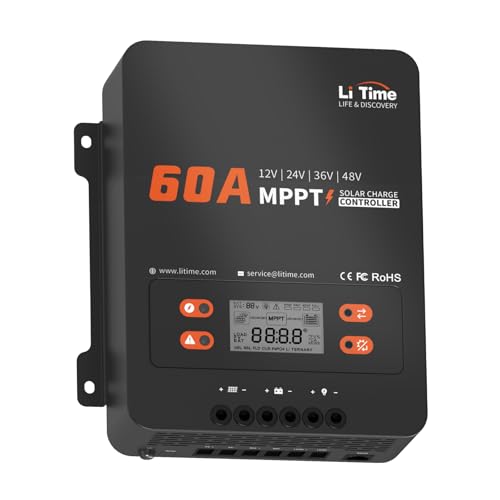
- Up to 200V PV input
- 99%+ tracking efficiency
- Supports LiFePO4 and lead-acid batteries
Best For: High-input systems needing broad voltage and battery support
Precision Temperature Add-On

- Measures temperature at the battery
- Fits several Morningstar controller families
- Epoxy-encapsulated and surge protected
Best For: Morningstar systems needing accurate remote temperature compensation
Smart MPPT Performance
Victron Energy SmartSolar 100V, 50A

- MPPT tracking helps maximize solar harvest
- Bluetooth app supports monitoring and configuration
- Synchronizes charging across multiple controllers
Best For: Systems needing efficient charging and app-based control
Voyager Temperature Monitoring
Renogy Battery Temperature Sensor

- Fits New Edition Voyager 10A and 20A models
- Measures from -4°F to 176°F
- Insulated wiring is rated for outdoor use
Best For: Compatible Voyager systems needing temperature compensation
EPEVER Controller Compatibility
EPEVER RTS Temperature Sensor Cable

- Activates temperature compensation on compatible MPPT controllers
- Fits several listed EPEVER and EPsolar families
- Uses a 3.81/2P connector
Best For: EPEVER systems needing a remote temperature sensor cable
Best Replacement Sensor

- Supports several EPEVER controller series
- Enables temperature compensation
- Plug-and-play 3-meter cable
Best For: Adding or replacing a sensor on compatible EPEVER controllers
Best Complete MPPT Kit
- Supports four system voltages
- Includes MT50, RTS, and RS485 cable
- Offers multiple charging profiles
Best For: Higher-capacity RV, household, and field-monitoring systems
Best Monitoring Bundle

- Includes 3-meter temperature sensor
- Adds USB-to-RS485 PC monitoring
- Uses separate RTS and RS485 connections
Best For: EPEVER owners needing temperature sensing and wired monitoring
High-Capacity MPPT Pick – EPEVER 50A MPPT Controller with RTS
For larger off-grid systems comparing solar charge controllers with temperature sensors, the EPEVER Tracer AN combines 50A MPPT charging with an included remote temperature sensor, MT50 meter, and RS485 communication cable. Its automatic 12V/24V/36V/48V system recognition and broad battery support make it a flexible choice for RVs, household systems, and field applications.
Best For: Larger multi-voltage solar systems that need remote monitoring and battery temperature information.
Pros:
- 99.5% or better MPPT tracking efficiency with fast tracking.
- Supports 12V, 24V, 36V, and 48V systems with automatic identification.
- Includes RTS, MT50 remote meter, PC communication cable, and dual RS485 ports.
- Supports sealed, gel, flooded, and user-defined charging options.
Cons:
- The 50A controller and included accessories may be more equipment than smaller systems require.
- Its listed weight is 4.46 kg, so installation planning matters.
This is a feature-rich option for buyers who want temperature-aware charging plus several monitoring and expansion paths. The automatic voltage recognition and parallel-capable RS485 design add versatility for evolving systems.
Accessory-Only Choice – MidNite MNBTS Remote Temperature Sensor
If you already have a compatible inverter or charge controller, the MidNite Solar MNBTS is a straightforward add-on for solar charge controllers with temperature sensors. Its 15-foot lead lets the sensor monitor battery temperature away from the controller, helping compatible equipment account for changing battery conditions.
Best For: Existing MidNite-compatible inverter or controller installations that need a remote battery temperature sensor.
Pros:
- Designed for use with an inverter or charge controller.
- Provides a 15-foot reach for remote battery temperature measurement.
- Lightweight accessory at 4.9 ounces.
Cons:
- This is a sensor accessory, not a complete solar charge controller.
- The supplied notes do not specify compatibility with particular controller models.
The MNBTS makes sense when the main controller or inverter already supports an external temperature sensor. Confirm connector and system compatibility before ordering, since the listing provides limited model-specific information.
High-Input MPPT Value – LiTime 60A 12V–48V Controller
The LiTime 60A is worth considering among solar charge controllers with temperature sensors when you need high PV input capacity and support for several battery voltages. It accepts up to 200V PV input, provides an LCD interface, and supports LiFePO4 and lead-acid battery settings, though the supplied notes do not identify a built-in or included temperature sensor.
Best For: High-input systems using LiFePO4 or lead-acid batteries across 12V, 24V, 36V, or 48V configurations.
Pros:
- 99% or better tracking efficiency and up to 96% peak conversion efficiency.
- Supports up to 200V PV input and substantial panel wattages by system voltage.
- Offers LiFePO4 and adjustable lead-acid charging modes.
- LCD screen, LED indicators, cooling hardware, and multiple protection features simplify operation.
Cons:
- The supplied notes specify no built-in Bluetooth.
- A temperature sensor is not listed among the included components.
- Its operating-temperature specification is listed as 50°C.
This controller offers strong voltage flexibility and high PV capacity, but it should not be treated as a complete temperature-sensing package based on the supplied information. Verify sensor compatibility separately if temperature-compensated charging is essential.
Precision Temperature Add-On – Morningstar RTS Sensor
The Morningstar RTS is a focused accessory for solar charge controllers with temperature sensors, measuring temperature at the battery so a compatible controller can apply more accurate compensation. It is especially useful when the battery and controller experience different temperatures, and it fits several Morningstar controller families.
Best For: Morningstar SunSaver MPPT, TriStar MPPT, SunKeeper, SunSaver Duo, ProStar, and other listed compatible controllers.
Pros:
- Improves temperature compensation when battery and controller temperatures differ.
- Compatible with multiple Morningstar controller families, including TriStar and ProStar models.
- Epoxy-encapsulated construction and power-lug housing protect against harsh conditions.
- Includes protection from lightning surges and short circuits, with a five-year warranty.
Cons:
- It is a standalone sensor, not a charge controller.
- Its benefits depend on using a compatible Morningstar controller or inverter.
For an existing Morningstar installation, this is a practical way to move temperature measurement closer to the battery. Its durable housing and broad stated compatibility make it a compelling upgrade when ambient conditions vary across the system.
Smart MPPT Performance – Victron Energy SmartSolar 100V, 50A
For shoppers comparing solar charge controllers with temperature sensors, the Victron Energy SmartSolar MPPT 100/50 stands out as a feature-rich controller focused on efficient charging, monitoring, and battery protection. Its MPPT tracking, Bluetooth connectivity, and configurable load output make it a strong choice for systems where performance data and control matter.
Best For: Solar power systems needing MPPT efficiency, app-based monitoring, and synchronized charging.
Pros:
- MPPT tracking is designed to maximize available solar power, including during partial shading.
- VictronConnect provides real-time data, 30-day performance history, configuration, firmware updates, and alarms.
- Supports synchronized charging across multiple SmartSolar MPPT controllers.
- Configurable load output can disconnect loads when battery voltage becomes too low.
Cons:
- No built-in display is included.
- The supplied notes do not identify a temperature sensor as included, so sensor compatibility should be confirmed separately.
- Its 100V, 50A specification may be more capability than smaller installations require.
This is a compelling controller for users who value app connectivity, charging optimization, and system-level coordination. If temperature-based battery compensation is essential, verify the required sensor and connection before purchasing.
Voyager Temperature Monitoring – Renogy Battery Temperature Sensor
Renogy Battery Temperature Sensor Solar Panel for New Edition Voyager Charge Controllers, Black
Check Price On AmazonFor buyers seeking solar charge controllers with temperature sensors, this Renogy battery temperature sensor is an accessory for New Edition Voyager 10A and 20A controllers. It provides analog temperature readings across a broad outdoor range to support temperature compensation in changing conditions.
Best For: Renogy New Edition Voyager 10A and 20A installations operating in variable outdoor temperatures.
Pros:
- Designed for compatibility with New Edition Voyager 10A and 20A models.
- Measures temperatures from -4°F to 176°F (-20°C to 80°C).
- Non-polarized, insulated wiring is intended to withstand harsh outdoor environments.
- Rated for outdoor use and listed as RoHS compliant.
Cons:
- This is a temperature sensor accessory, not a standalone charge controller.
- Compatibility is specifically stated for New Edition Voyager 10A and 20A models, so other controllers require verification.
- The supplied notes do not describe a digital display or advanced monitoring features.
This sensor is a practical add-on when a compatible Voyager controller needs temperature information for changing conditions. Confirm the exact Voyager edition and controller amperage before ordering.
EPEVER Controller Compatibility – EPEVER RTS Temperature Sensor Cable
Among solar charge controllers with temperature sensors, this EPEVER temperature sensor cable is a focused accessory for activating temperature compensation on compatible MPPT controllers. Its 3.81/2P connector is intended for a range of EPEVER and EPsolar controller families, making model matching the key buying consideration.
Best For: EPEVER MPPT systems that need remote battery temperature compensation.
Pros:
- Activates the temperature compensation function on compatible solar charge controllers.
- Supports multiple EPEVER/EPsolar families, including Tracer-A, Tracer-AN, Tracer-BN, Triron-N, XTRA-N, VS-BN, VS-AU, and LS-B.
- Uses a 3.81/2P connector and weighs approximately 0.09 kg.
Cons:
- It is a sensor cable rather than a complete charge controller.
- Compatibility depends on the controller model and connector configuration.
- The supplied notes do not specify the sensor’s temperature measurement range.
This cable makes sense for an existing compatible EPEVER MPPT installation where temperature compensation is needed. Check the exact controller series and connector before purchase, since the supplied compatibility list is model-specific.
Best Replacement Sensor – 3M Remote Temperature Sensor
For shoppers looking for solar charge controllers with temperature sensors, this plug-and-play remote sensor is a straightforward way to add temperature compensation to compatible EPEVER systems. Its 3-meter cable provides useful placement flexibility between the battery and controller.
Best For: EPEVER users who need a replacement or add-on remote temperature sensor for compatible Tracer-AN, Tracer-BN, VS-BN, VS-AU, or Triron-N controllers.
Pros:
- Supports multiple EPEVER solar charge controller series.
- Activates temperature compensation for the charge controller.
- Plug-and-play installation with a cable up to 3 meters long.
Cons:
- Compatibility is focused on EPEVER controllers and should be verified before purchase.
- It is a sensor only, not a complete charge controller.
This is a practical accessory when your compatible controller lacks a sensor or needs a replacement. Confirm the controller series and connector requirements before ordering.
Best Complete MPPT Kit – 60A MPPT Controller with RTS
Among solar charge controllers with temperature sensors, this EPEVER kit stands out as a complete monitoring-oriented package. It combines a 60A MPPT controller with an MT50 remote meter, remote temperature sensor, and RS485 communication cable for flexible system setup.
Best For: RV, household, and field-monitoring solar systems needing automatic 12V, 24V, 36V, or 48V recognition and expanded monitoring options.
Pros:
- Supports 12V, 24V, 36V, and 48V systems with automatic identification.
- Uses MPPT technology with stated tracking efficiency of at least 99.5%.
- Includes MT50 meter, remote temperature sensor, and RS485 communication cable.
- Offers sealed, gel, flooded, and user-defined charging options.
Cons:
- The 60A unit is a larger, heavier option at 6.55 kg.
- Its advanced communication and configuration features may be more than basic systems require.
This is the strongest all-in-one choice here for buyers building a higher-capacity system with remote monitoring. Check system wiring, PV input limits, and battery requirements before installation.
Best Monitoring Bundle – RTS Sensor and RS485 Adapter
This accessory bundle suits shoppers comparing solar charge controllers with temperature sensors who also want computer-based monitoring. It pairs a 3-meter RTS battery-temperature sensor with a USB-to-RS485 adapter for connecting a compatible controller to Solar Station PC software.
Best For: EPEVER MPPT controller owners who need temperature compensation and a wired PC monitoring connection.
Pros:
- Measures battery temperature for temperature-compensated control parameters.
- Includes a standard 3-meter sensor cable.
- USB-to-RS485 adapter supports monitoring through Solar Station PC software.
- Provides two useful accessories in one package.
Cons:
- It is an accessory bundle rather than a charge controller.
- Compatibility and port placement should be checked before ordering.
- If the sensor is short-circuited or damaged, the controller defaults to 25°C.
Choose this bundle when remote temperature measurement and PC-based controller access are both important. Verify that your controller has the required RTS and RS485 ports and supports the stated software connection.
How We Picked the Best Solar Charge Controllers with Temperature Sensors
We focused on products that support temperature-aware charging or provide a compatible remote temperature sensor for a solar charge controller. The selection includes MPPT controllers, standalone sensors, replacement cables, and monitoring accessories from established brands such as Victron Energy, Morningstar, EPEVER, Renogy, MidNite Solar, and LiTime.
Our comparison emphasizes battery-voltage support, maximum charging current, photovoltaic input limits, connector and communication compatibility, monitoring features, and suitability for common off-grid applications. Because a sensor is only useful when it works with the correct controller, matching the model and connector is a key part of the buying decision.
Quick Comparison
- Best for flexible system sizing: EPEVER 50A and 60A MPPT controllers support multiple nominal battery voltages and up to 150V PV input.
- Best for smart monitoring: Victron Energy SmartSolar adds app-based system visibility through its connected monitoring ecosystem.
- Best for higher PV input: LiTime’s 60A controller accepts up to 200V PV input, subject to the manufacturer’s wiring and configuration limits.
- Best for replacement sensors: Morningstar, MidNite Solar, Renogy, and EPEVER sensor options are useful when the controller is already installed.
Key Buying Factors for Solar Charge Controllers with Temperature Sensors
Controller and Sensor Compatibility
Check the exact controller model, connector type, pin arrangement, supported resistance range, and cable length before buying a sensor. A sensor made for one brand or product family may not function correctly with another, even when the plug appears similar.
Battery Voltage and Chemistry
Confirm that the controller supports your system voltage, such as 12V, 24V, 36V, or 48V. Then verify charging profiles for your battery chemistry. Lithium batteries often require different temperature protections than lead-acid batteries, and some lithium systems should not be charged below a specified temperature.
PV Input and Charging Capacity
Compare maximum PV voltage, allowable solar wattage, and charging current with the array and battery bank. Leave appropriate safety margin for cold-weather voltage increases and avoid exceeding the controller’s rated limits.
Monitoring and Installation
Remote sensors should be mounted directly on or near the battery in a location that reflects battery temperature rather than ambient air or a hot controller enclosure. If you want remote diagnostics, look for Bluetooth, an optional display, RS485, USB, or another supported communication method.
Who Should Buy Which Solar Charge Controllers with Temperature Sensors?
Choose a multi-voltage EPEVER controller if you want broad system compatibility and a conventional remote display. The LiTime 60A model is better suited to installations that need higher PV input capacity, provided its limits match your array. Victron Energy is a strong choice for buyers who prioritize connected monitoring and a polished ecosystem.
Buy a Morningstar or MidNite Solar sensor when you already use the corresponding controller and need a dependable replacement or add-on. Renogy’s sensor is most appropriate for compatible Voyager models, while the EPEVER sensor cables and RS485 adapter make sense for owners of supported EPEVER equipment. Before ordering, match the sensor part number, connector, and controller manual rather than relying on appearance alone.