Choosing among step-down isolation transformers means matching voltage, wattage, phase, and protection features to the equipment you need to power. The right transformer can reduce voltage safely while providing valuable electrical isolation.
This roundup compares ten options ranging from compact consumer converters to industrial control, HVAC, buck/boost, and high-capacity transformer designs.
Best 10 Step Down Isolation Transformers Picks for 2026
Industrial Isolation Choice
ABB 0.5kVA Step-Down Transformer

- 1-phase isolation for industrial applications
- 240x480V primary and 120/240V secondary
- Encapsulated, quiet, UL-listed construction
Best For: HVAC, control panels, lighting, and circuit isolation
HVAC Control Transformer
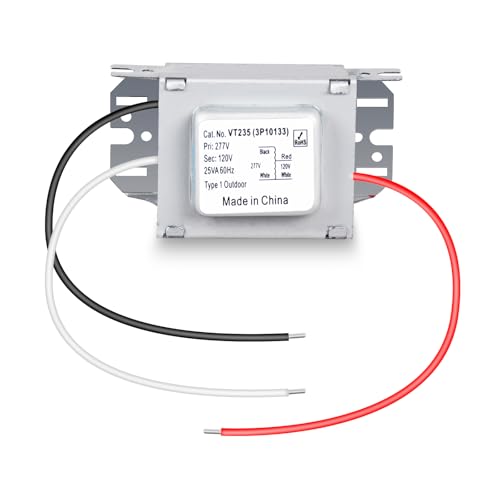
- Steps 277V down to isolated 120V
- 25VA output for control devices
- Compact enclosed design for retrofits
Best For: Lighting controls, HVAC systems, thermostats, and relays
Versatile HVAC Choice
TR50VA008 50VA Step-Down Transformer

- 480/277/240/208VAC input to 120VAC output
- Built-in circuit breaker
- Foot and dual-threaded hub mounting
Best For: HVAC controls and industrial equipment
Industrial Voltage Matching
245V to 220V Buck/Boost Transformer

- 245V primary and 220V secondary
- Multiple current options
- 50/60Hz operation with wall mount
Best For: Commercial and industrial voltage adjustment
High-Capacity Rack Solution
CyberPower OL5KSTF 5000VA Transformer

- Converts 200–240V AC to 120V output
- 5000VA/5000W with 12 outlets
- 2U rack/tower design with protective breakers
Best For: High-density equipment racks and towers
Heavy-Duty Choice
10,000W Voltage Converter Transformer

- Converts between 110V and 220V
- Includes overload and over-temperature protection
- Offers four standard sockets and a power switch
Best For: High-power 110V/220V conversion with multiple outlets
Compact Chassis Pick
Bogen T725 Step Down Transformer

- Compact chassis-mount form factor
- Weighs just 7.2 ounces
- Meets ANSI, CSA, and UL specifications
Best For: Space-constrained equipment assemblies
Commercial Voltage Match
240V-to-208V Buck/Boost Transformer
- Converts 240V primary to 208V secondary
- Offers 35.4, 60, or 130A options
- Supports floor or wall mounting
Best For: Permanent single-phase commercial installations
Compact Voltage Conversion Pick – LVYUAN 500W Step Up/Down Converter
If you need step down isolation transformers, note that this LVYUAN unit is a voltage converter—not an isolation transformer. It can step 220–240V down to 110–120V or step 110–120V up to 220–240V, with a 500W capacity suited to lower-power electronics and household devices.
Best For: Low-power chargers, routers, lamps, small speakers, and similar devices requiring 110–120V or 220–240V conversion.
Pros:
- Supports both step-up and step-down voltage conversion.
- Provides simultaneous 110–120V and 220–240V outlet options.
- Includes metal housing, fuse protection, and over-current protection.
- Compact, odorless, and designed for quiet operation.
Cons:
- It is explicitly not an isolation transformer.
- The 500W rating is unsuitable for high-power appliances such as microwaves, hair dryers, and coffee makers.
Choose this model when flexible voltage conversion matters more than electrical isolation. Stay within its 500W limit and use a larger transformer for demanding appliances.
Industrial Isolation Choice – ABB 0.5kVA Step-Down Transformer
For industrial applications involving step down isolation transformers, the ABB 9T58K2810 offers a purpose-built 1-phase isolation design. Its 240x480V primary and 120/240V secondary support control panels, HVAC systems, lighting, alarms, and circuit-isolation tasks.
Best For: Industrial control panels, HVAC equipment, lighting, signal and alarm panels, and machine-tool installations.
Pros:
- Provides 1-phase isolation with flexible 240x480V input and 120/240V output.
- Encapsulated construction helps resist moisture and corrosion.
- Welded core supports quiet operation, while the unit is seismic qualified.
- Compact surface-mount design uses terminal-block connections and brass screws.
Cons:
- Its 0.5kVA capacity is intended for light industrial loads rather than high-power applications.
- Installation requires appropriate electrical wiring and terminal connections.
This is the strongest match here for buyers specifically seeking a step-down isolation transformer for fixed industrial equipment. Its certifications, construction, and voltage flexibility make it better suited to professional installations than portable consumer use.
Japanese Voltage Adapter – LiteFuze JP-1000 1000W Transformer
The LiteFuze JP-1000 is a practical option for step down isolation transformers alternatives when the main requirement is converting between Japanese 100V and US 120V power. It supports appliances up to 1000W and combines dual sockets with overload protection for straightforward plug-and-play use.
Best For: Japanese and US appliances rated up to 1000W that need 100V-to-120V or 120V-to-100V conversion.
Pros:
- Supports conversion between Japanese 100V and US 120V equipment.
- 1000W capacity accommodates a wider range of devices than a 500W converter.
- Dual sockets and plug-and-play operation simplify setup.
- Features a resettable circuit breaker, automatic fuse protection, and a 3-year warranty.
Cons:
- The supplied notes describe voltage conversion, not isolation-transformer operation.
- Its specialized voltage range is less suitable for applications requiring 220–240V conversion.
Consider this LiteFuze when appliance compatibility between Japanese and US voltage systems is the priority. Its 1000W rating and resettable protection add convenience, but it should not be treated as a substitute for a true isolation transformer.
HVAC Control Transformer – 277V to 120V 25VA Transformer
This compact magnetic transformer is designed for specialized step down isolation transformer applications in control circuits. It converts 277V primary power to isolated 120V secondary power at up to 25VA, making it suitable for thermostats, relays, timers, sensors, lighting controls, and HVAC equipment.
Best For: Low-voltage control circuits in lighting systems, HVAC installations, thermostats, relays, timers, and sensors.
Pros:
- Provides a precise 277V-to-120V step-down ratio.
- Offers isolated power up to 25VA for control equipment.
- Compact enclosed design suits installations and retrofit projects.
- Includes a 2-year warranty.
Cons:
- The 25VA maximum load limits it to control and low-power applications.
- It is not intended for general-purpose appliance power conversion.
This transformer is a focused solution rather than a versatile household converter. Its defined voltage ratio, isolated 25VA output, and compact enclosure make it appropriate for low-power lighting and HVAC controls where the load requirements match.
Versatile HVAC Choice – TR50VA008 50VA Step-Down Transformer
For HVAC controls and similar equipment, this option is one of the more adaptable step down isolation transformers to consider. It converts 480/277/240/208VAC input to 120VAC output and includes multiple taps for compatibility with common industrial voltages.
Best For: HVAC control circuits, rooftop air-conditioning units, heating equipment, and installations needing flexible mounting.
Pros:
- Supports 480, 277, 240, and 208VAC input to 120VAC output.
- Built-in circuit breaker helps protect against overloads.
- Foot mount and dual-threaded hub installation options improve placement flexibility.
Cons:
- Limited to 50VA capacity.
- Designed primarily for HVAC and industrial control applications rather than high-power loads.
The TR50VA008 is a practical replacement-oriented transformer when you need a compact 120VAC control supply and compatibility with several input voltages. Confirm the required VA rating, wiring, and mounting arrangement before installation.
Industrial Voltage Matching – 245V to 220V Buck/Boost Transformer
This wall-mounted buck/boost model is suited to applications that need a modest voltage reduction from 245V primary to 220V secondary. Among step down isolation transformers, it stands out for offering multiple current options and 50/60Hz frequency support.
Best For: Industrial or commercial installations requiring 245V-to-220V voltage adjustment with a wall-mounted configuration.
Pros:
- Provides a 245V primary and 220V secondary configuration.
- Available current options include 22.89, 34.33, or 68.67 amps.
- Supports both 50Hz and 60Hz operation.
Cons:
- It does not provide a standard 120V output.
- Wall mounting may not suit every installation.
- Transformers cannot be returned for safety reasons after leaving the factory.
This transformer is best evaluated as a purpose-specific voltage-matching solution rather than a general-purpose control transformer. Verify the required current configuration, voltage, phase, and mounting needs carefully before ordering.
High-Capacity Rack Solution – CyberPower OL5KSTF 5000VA Transformer
The CyberPower OL5KSTF combines step-down conversion with isolation for larger electronics installations. It accepts 200V to 240V AC input and supplies 120V output at up to 5000VA/5000W, making it a strong option when multiple standard-voltage devices need centralized protection and connectivity.
Best For: Rack or tower installations supporting multiple 120V devices, including UPS, utility, or generator-fed equipment.
Pros:
- 5000VA/5000W capacity with 120V output.
- Twelve NEMA 5-20R outlets support NEMA 5-15P and 5-20P plugs.
- Includes over-temperature protection, resettable input/output breakers, and 50/60Hz support.
- Convertible 2U rack/tower design and a three-year warranty add installation flexibility.
Cons:
- At 83.8 pounds, it is substantially heavier than smaller transformers.
- Requires a 208V-class input connection with an included NEMA L6-30P power cord.
- Its rack/tower form factor may be excessive for small loads.
For data rooms and other equipment environments, the OL5KSTF offers high capacity, multiple outlets, and protective features in one enclosure. Check rack space, input power, outlet requirements, and total connected load before installation.
Heavy-Duty Choice – 10,000W Voltage Converter Transformer
For demanding step down isolation transformers applications involving 110V and 220V equipment, this heavy-duty voltage converter offers high capacity and practical built-in protections. It can convert between 110V and 220V and includes four standard sockets for connecting multiple appliances.
Best For: High-power household or workshop equipment requiring 110V/220V conversion and multiple outlets.
Pros:
- Supports up to 10,000W, with an 8,000W high-power converter rating noted in the features.
- Provides overload and over-temperature protection.
- Includes four standard sockets, a power indicator, and a one-click power switch.
- Iron construction and multiple surface treatments are designed for durability.
Cons:
- Its corded, foot-mounted design may require dedicated floor space.
- The listed 13A current rating may limit some high-demand applications.
- This is a voltage converter rather than a clearly specified galvanically isolated transformer.
Choose this model when capacity, outlet access, and operating protections matter most. Confirm the appliance load, current requirements, and whether true electrical isolation is required before buying.
Compact Chassis Pick – Bogen T725 Step Down Transformer
The Bogen T725 is a compact option for step down isolation transformers installations where a chassis-mounted component is preferable. Its small dimensions and low weight make it practical for equipment assemblies with limited available space.
Best For: Compact equipment builds needing a chassis-mounted step-down transformer.
Pros:
- Compact 1.37 by 2.5 by 1.25-inch dimensions.
- Lightweight design at 7.2 ounces.
- Chassis mounting suits integration into compatible equipment.
- Listed as meeting ANSI, CSA, and UL specifications.
Cons:
- The supplied information does not state input voltage, output voltage, or power capacity.
- Its compact format may not suit high-power applications.
- It is a component-style transformer rather than a ready-to-use outlet converter.
This transformer is most compelling when installation space and recognized specifications are priorities. Verify voltage, wattage, and compatibility with the intended equipment before selecting it for a step-down application.
Commercial Voltage Match – 240V-to-208V Buck/Boost Transformer
For commercial or industrial systems that need a defined voltage reduction, this single-phase buck/boost transformer changes 240V primary power to 208V secondary power. Its floor- or wall-mount flexibility and NEMA specification make it a candidate for more permanent step down isolation transformers installations.
Best For: Fixed single-phase installations requiring 240V-to-208V conversion at substantial current.
Pros:
- Specifies a 240V primary and 208V secondary.
- Available with current options of 35.4, 60, or 130 amps.
- Supports floor or wall mounting.
- Designed for 50/60Hz electrical systems and listed to NEMA specifications.
Cons:
- At 35 pounds, it is not a portable transformer.
- Custom options require contacting the seller.
- Transformers cannot be returned according to the supplied product information.
This is the strongest fit for a planned installation with clearly defined 240V-to-208V requirements. Carefully confirm phase, current option, mounting method, and system compatibility because the product is non-returnable.
How We Picked the Best Step Down Isolation Transformers
We selected products across the main use cases buyers face: international voltage conversion, electronic equipment, HVAC controls, industrial machinery, audio systems, and high-load applications. We considered primary and secondary voltage ranges, rated capacity, phase configuration, isolation design, protection features, installation style, and the type of equipment each transformer is intended to serve.
Because these products cover very different electrical requirements, a small plug-in converter should not be compared directly with a hardwired industrial transformer. Always verify the nameplate specifications and have fixed-wiring installations completed by a qualified electrician.
Quick Comparison
| Best For | Product Type to Consider | What to Check First |
|---|---|---|
| Travel and household electronics | Compact step-up/step-down converter | Continuous wattage, sockets, fuse or breaker |
| Control panels | Industrial isolation control transformer | VA rating, input taps, enclosure and mounting |
| HVAC equipment | Dedicated control transformer | Primary voltage, 120V output, 50VA requirement |
| Large machinery | Industrial buck/boost transformer | Amperage, phase, frequency and wiring method |
| Servers and sensitive loads | Online transformer or UPS-compatible model | Isolation, regulation, runtime and bypass features |
Key Buying Factors for Step-Down Isolation Transformers
Input and Output Voltage
Confirm the available supply voltage and the equipment’s required voltage before comparing models. A transformer designed for 240V-to-208V service is not a substitute for one converting 480V or 277V to 120V. Check whether the listed input is single-voltage, multi-tap, or adjustable.
Power Capacity and Load Type
Choose a VA or watt rating above the equipment’s normal demand, allowing extra capacity for startup surges from motors, compressors, and other inductive loads. For electronic devices, distinguish continuous output from short-term peak claims. Do not size a transformer only by the appliance’s running wattage when inrush current is significant.
Isolation, Protection, and Installation
Verify that the product is genuinely rated as an isolation transformer if galvanic separation is required. Circuit breakers, fuses, thermal protection, noise reduction, and surge protection can improve safety, but they do not replace proper grounding and overcurrent protection. Also check whether the unit is cord-and-plug, wall-mounted, foot-mounted, or intended for panel installation.
Phase, Frequency, and Environment
Match single-phase or three-phase requirements and confirm 50Hz or 60Hz compatibility. Industrial units may require ventilation, a suitable enclosure, dedicated disconnects, and professional installation. Keep ambient temperature, duty cycle, and local electrical codes in mind.
Who Should Buy Which Step Down Isolation Transformers?
Choose a compact converter such as the LVYUAN or LiteFuze style for occasional household or international-voltage use when the connected load is modest and portability matters. For control cabinets and low-voltage controls, an ABB-style industrial control transformer is a more appropriate choice.
HVAC technicians should focus on a dedicated 50VA control transformer with compatible mounting and circuit protection. Buyers converting 240V to 208V or 245V to 220V for larger equipment should look at buck/boost models and compare their available amp ratings carefully. For high-demand 110V/220V conversion, use a heavy-duty transformer sized for the full load rather than a consumer converter.
Finally, businesses powering sensitive servers or network equipment may prefer an online UPS or transformer system with monitoring and conditioned output. When voltage, amperage, or wiring is uncertain, consult the equipment manual and a licensed electrician before purchase.