Choosing the right DC circuit breaker for a battery bank is about more than matching an amp rating. The breaker must suit your system voltage, available fault current, cable size, terminals, and installation environment.
We selected 10 options spanning compact DIN-rail breakers, surface-mount battery protection, and higher-capacity molded-case designs for solar, RV, marine, and off-grid applications.
Best 10 Dc Circuit Breakers for Battery Banks Picks for 2026
Heavy-Duty Battery Isolation

- 300A two-pole design for high-current DC systems
- Thermal-magnetic overload and short-circuit protection
- Suitable for batteries, PV, UPS, and data centers
Best For: High-current battery banks and DC power installations
High-Voltage Battery Protection

- Two-pole MCCB for 500V/550V DC applications
- M8 terminals support 2/0 AWG copper cable lugs
- Arc chute and interphase barriers support DC interruption
Best For: Solar PV and ESS systems with heavy battery cabling
Compact Modular Protection

- 40A single-pole breakers in a two-pack
- Non-polarized design supports reversible current flow
- Includes DIN rail, screws, and crimp terminals
Best For: Low-current battery, RV, and solar branch circuits
Arc-Controlled ESS Protection

- 250A two-pole breaker for 500VDC systems
- Arc chutes support DC fault interruption
- Includes mounting hardware and installation accessories
Best For: High-power ESS, solar, and industrial battery banks
Compact 150A Protection
LiTime 150A Manual-Reset Breaker

- 12–48V DC compatibility
- Reusable manual reset
- Surface-mount design
Best For: LiFePO4, automotive, marine, RV, and solar circuits
Heavy-Duty 250A Disconnect
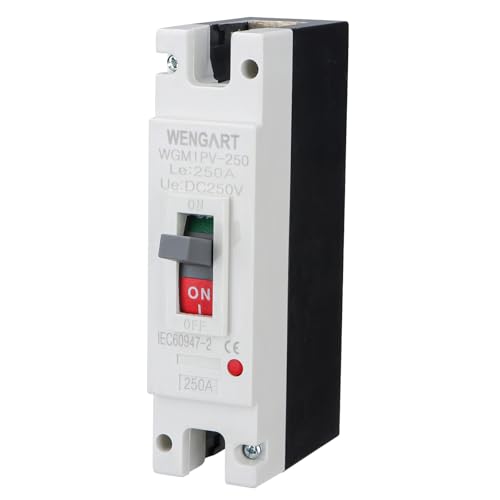
- 250A, 250V-rated breaker
- Magnetic arc-quenching system
- Large-conductor terminal support
Best For: High-capacity solar, battery-bank, and off-grid inverter systems
Two-Pole DC Isolation

- 12–125V DC range
- Two-pole protection
- 80A–250A options
Best For: Solar, RV, yacht, and dual-line DC installations
High-Voltage DIN Protection

- Two-pole DIN-rail design for 12V–1000V DC circuits
- Thermal-magnetic overload and short-circuit protection
- Includes rail, screws, and copper crimp terminals
Best For: High-voltage battery banks and solar or UPS installations
Marine-Ready Manual Reset

- 50A protection for 12V–48V DC systems
- Manual reset doubles as a battery disconnect
- Water-resistant housing for mobile applications
Best For: Marine, RV, vehicle, winch, and accessory battery circuits
Non-Polarized System Isolation

- Non-polarized two-pole design for reversible current
- Supports stated DC protection up to 500V
- Includes DIN rail and copper crimp terminals
Best For: Bidirectional battery, PV, EV, and reversible-motor circuits
Heavy-Duty Battery Isolation – 300A DC Circuit Breaker
For high-current battery banks, this 300A two-pole breaker combines thermal-magnetic overload protection with short-circuit protection and manual circuit isolation. It supports DC applications including batteries, photovoltaic systems, UPS equipment, and data centers, with front-accessible installation.
Best For: High-current battery banks, solar systems, UPS installations, and data-center DC distribution.
Pros:
- 300A rating with two poles for high-current DC applications.
- Provides overload, short-circuit, and isolation functions.
- Supports voltage ranges from 12–30V without short-circuit protection and 32–400V with short-circuit protection.
- Front-accessible installation and screw mounting simplify installation in equipment compartments.
Cons:
- At approximately 1.52 kg, it is heavier than miniature DIN-rail breakers.
- Short-circuit protection depends on operating within the specified voltage range.
This DIHOOL model is a practical choice when your battery-bank protection setup needs substantial current capacity and a dedicated isolation function. Verify the system voltage and cable sizing before installation.
High-Voltage Battery Protection – 200A 500V DC MCCB
This Wengart MCCB is built for high-voltage solar and energy-storage applications, pairing a two-pole DC design with a 500V/550V rating, arc-quenching hardware, and M8 terminals. Its handle-reset operation and included hex wrench are useful details for battery-bank installations.
Best For: Solar PV arrays, ESS battery systems, and high-voltage battery distribution using large cable lugs.
Pros:
- Two-pole DC MCCB design rated for 200A and 500V/550V applications.
- Arc-quenching chute and snap-in interphase barriers help address DC arcing during interruption.
- M8 bolt terminals are compatible with 2/0 AWG copper cable lugs.
- Corrosion-resistant housing is specified for harsh environments, +45°C thermal stability, and 2,000m altitude.
Cons:
- Panel mounting requires more installation planning than a DIN-rail breaker.
- The supplied details list a 200A model while also specifying a 250A current rating, so the exact rating should be confirmed before purchase.
With its high-voltage rating, large terminals, and arc-control features, this breaker targets substantial solar and ESS wiring rather than compact RV circuits. Confirm the model rating, cable lugs, and enclosure clearance during system design.
Compact Modular Protection – 40A DIN-Rail DC Breakers
These 40A miniature breakers suit lower-current battery-bank branches and solar circuits where compact DIN-rail mounting matters. The non-polarized single-pole design supports flexible wiring, while thermal-magnetic protection covers overloads and specified short-circuit applications.
Best For: RV batteries, solar charge controllers, PV arrays, inverters, and smaller DC branch circuits.
Pros:
- 40A single-pole format fits standard 35mm DIN rails.
- Non-polarized design simplifies installation where current direction may reverse.
- Supports 12–48VDC overload protection and 48–500VDC short-circuit protection.
- Pack includes two breakers, a DIN rail, screws, and copper crimp terminals.
Cons:
- 40A capacity is intended for branch circuits rather than high-current battery-bank mains.
- The supplied short-circuit protection range does not cover every low-voltage DC condition.
This is a convenient modular option for distributed protection in a battery or solar setup. Its compact form and included mounting hardware are particularly useful when adding protection to an existing DIN-rail enclosure.
Arc-Controlled ESS Protection – 250A 500V DC Battery Breaker
This two-pole 250A molded-case breaker is designed specifically for battery banks, ESS, solar PV systems, UPS equipment, and industrial DC distribution. Its 500VDC rating, silver-alloy contacts, arc chutes, and flame-retardant housing provide a robust combination of interruption and manual isolation features.
Best For: High-power battery banks, ESS installations, solar PV disconnects, and industrial DC distribution.
Pros:
- 250A two-pole design rated for 500VDC systems.
- Provides overload protection, short-circuit protection, and manual isolation.
- Arc chutes and silver-alloy contacts are designed to support DC arc interruption and conductivity.
- Package includes spacers, mounting screws, a hex wrench, electrical tape, and a manual.
Cons:
- Screw mounting may require a dedicated enclosure or mounting panel.
- Its high-current capacity is excessive for small battery or branch circuits.
For larger battery-bank protection systems, this breaker offers the current and voltage capacity needed for serious DC distribution. Its included mounting accessories add convenience, but installation should still account for conductor sizing, clearances, and system fault requirements.
Compact 150A Protection – LiTime 150A Manual-Reset Breaker
For shoppers comparing dc circuit breakers for battery banks, the LiTime 150A model is a compact surface-mount option for 12–48V DC systems. It is designed to help protect LiFePO4 batteries and connected circuits from overloads and short circuits while providing a reusable manual disconnect.
Best For: Automotive, marine, RV, and solar setups using compatible 12–48V DC batteries and circuits.
Pros:
- Supports 12–48V DC systems with a 150A current rating.
- Manual button and reset bar allow reusable operation.
- Surface-mount design and included one-year warranty support straightforward installation and ownership.
Cons:
- Its 150A rating may not suit higher-current battery banks.
- Single-pole construction may be less suitable when both DC conductors require switching.
The LiTime is a practical choice when you want a resettable breaker with a relatively compact footprint and broad vehicle, boat, and solar compatibility. Confirm the system voltage, current requirements, terminal fit, and pole configuration before buying.
Heavy-Duty 250A Disconnect – Wengart 250A DC MCCB
Among dc circuit breakers for battery banks, the Wengart 250A MCCB is built for high-capacity solar PV systems, large battery banks, and off-grid inverter installations. Its molded-case construction and magnetic arc-quenching system are intended for demanding DC protection and master-disconnect duties.
Best For: High-power battery-bank and solar installations that need a panel-mounted 250A disconnect.
Pros:
- 250A current rating and 250V application rating support high-capacity systems.
- Arc-chute and permanent-magnet design assist with DC arc interruption.
- Heavy-duty terminals accommodate conductors up to 250kcmil or 4/0 AWG, according to the supplied notes.
- High-leverage toggle provides a clear manual disconnect function.
Cons:
- Its larger molded-case format is less compact than a small surface-mount breaker.
- Panel mounting may require more installation space and planning.
The Wengart stands out for users moving beyond standard miniature breakers and needing a substantial manual disconnect for a powerful DC installation. Verify enclosure space, conductor size, voltage, and the stated pole configuration before installation.
Two-Pole DC Isolation – 250A Solar and RV Breaker
This two-pole model is a flexible option for buyers comparing dc circuit breakers for battery banks, solar arrays, RVs, and yachts. It supports 12–125V DC systems, offers selectable ratings from 80A to 250A, and is designed to provide overload, short-circuit, control, and isolation functions.
Best For: Solar, RV, yacht, and other DC installations where two-pole protection and multiple amperage choices are useful.
Pros:
- Two-pole design can protect and isolate both positive and negative lines.
- Wide 12–125V DC range and several current-rating options increase application flexibility.
- Electromagnetic fast trip and magnetic arc-extinguishing systems support fault interruption.
- Push-button ON/OFF control provides straightforward operation.
Cons:
- Correct terminal tightening is essential; the supplied notes warn that loose screws can cause burning.
- Buyers must select the appropriate amperage version rather than assuming the listed 250A option fits every system.
- The plastic construction may be less rugged than a molded-case MCCB.
The FORYON breaker offers broad voltage and amperage flexibility in a two-pole format, making it appealing for varied low- and mid-voltage DC applications. Match the selected rating to the wiring and equipment, and follow the installation requirements carefully.
High-Voltage DIN Protection – 20A 1000V DC Breaker
For buyers comparing dc circuit breakers for battery banks, this DIHOOL model offers a two-pole DIN-rail design rated for 12V–1000V DC circuits. Its thermal-magnetic C-curve trip, arc-squelching magnet, and visible status window suit battery, inverter, solar, and UPS installations.
Best For: High-voltage battery banks, PV arrays, solar charge controllers, UPS systems, and power inverters that use DIN-rail mounting.
Pros:
- Wide stated DC voltage range up to 1000V and 20A current rating.
- Provides isolation, short-circuit protection, and overload protection.
- Includes a DIN rail, mounting screws, and copper crimp terminals.
- Mechanical window shows ON and OFF status clearly.
Cons:
- Its 20A rating may not suit higher-current battery-bank circuits.
- DIN-rail installation may be less convenient than a surface-mounted breaker.
This is a strong fit when high DC voltage capability and compact rail mounting matter most. Confirm the system’s operating voltage, continuous current, and wiring requirements before installation.
Marine-Ready Manual Reset – 50A Surface-Mount Breaker
This RED WOLF breaker is a practical choice among dc circuit breakers for battery banks when you need a 50A, 12V–48V solution with a manual reset. Its surface-mount housing and push-button operation work well for accessible battery disconnect and accessory-circuit protection.
Best For: Boat, RV, trailer, truck, ATV, winch, audio, and auxiliary battery systems requiring a surface-mounted 50A breaker.
Pros:
- 50A rating supports higher-current accessory and battery circuits.
- Rated for DC systems up to 48V.
- Manual ON/OFF reset button can also serve as a battery disconnect or kill switch.
- Water-resistant housing and included tubular wire-end cable lugs add installation convenience.
Cons:
- Single-pole design is less suited to installations requiring two-pole isolation.
- Surface mounting requires an appropriate panel or firewall location.
- Its 48V maximum rating excludes higher-voltage battery systems.
Choose this model for low-voltage mobile and marine setups where straightforward manual resetting is valuable. Verify that the 50A rating matches the protected wiring and connected equipment.
Non-Polarized System Isolation – 30A DIN-Rail DC Breaker
For dc circuit breakers for battery banks with changing current direction, this DIHOOL 30A two-pole breaker offers non-polarized installation and DIN-rail mounting. It is designed for stated DC protection from 48V–500V, while also supporting selected lower-voltage overload applications and AC circuits.
Best For: Battery charge/discharge systems, PV arrays, reversible motors, EV charging or discharging circuits, and RV or home panels using 35mm DIN rail.
Pros:
- Non-polarized design simplifies wiring where current direction may reverse.
- Two-pole construction supports isolation and circuit control.
- Provides fast electromagnetic short-circuit tripping and thermal-magnetic protection.
- Includes a DIN rail, screws, and copper crimp terminals.
Cons:
- 30A capacity may be insufficient for larger battery-bank loads.
- Its detailed voltage capability varies by application, so system compatibility should be checked carefully.
- DIN-rail mounting requires a suitable enclosure or panel.
This is the most flexible option of the three for bidirectional battery current and mixed system layouts. Confirm the applicable DC voltage range and current rating for the exact circuit before selecting it.
How We Picked the Best Dc Circuit Breakers for Battery Banks
We compared the selected breakers across the specifications that most affect battery-bank safety and usability: continuous current rating, maximum DC voltage, number of poles, mounting method, terminal size, enclosure compatibility, and suitability for common solar, RV, marine, and backup-power installations. We also considered whether each design is intended for branch-circuit protection, battery isolation, or both.
Ratings should always be verified against the manufacturer’s documentation. A product’s advertised amperage or voltage does not automatically make it appropriate for every lithium, AGM, lead-acid, or high-voltage battery system.
Quick Comparison
| Best For | Look For | Common Styles |
|---|---|---|
| Small 12V–48V systems | Correct amp rating, compact mounting, suitable terminals | Surface-mount or miniature breaker |
| Solar arrays and ESS | Higher DC voltage rating and adequate interrupt capacity | DIN-rail breaker or MCCB |
| Large battery banks | High continuous current, heavy cable compatibility, secure lugs | High-amperage MCCB or surface-mount breaker |
| Service isolation | Accessible manual disconnect and clear ON/OFF position | Breaker with integrated handle |
Key Buying Factors for Dc Circuit Breakers for Battery Banks
Voltage and Polarity
Choose a breaker rated for the system’s maximum operating voltage, not merely its nominal voltage. A 12V, 24V, or 48V bank can produce dangerous DC arcs, while higher-voltage PV and energy-storage systems require components specifically rated for those levels. Confirm whether the breaker is polarized and follow the stated line/load orientation.
Amperage and Interrupt Capacity
The continuous rating should protect the cable and equipment without nuisance trips during normal loads or inverter startup. The interrupt rating must also exceed the prospective short-circuit current of the battery bank. Lithium batteries and parallel banks can deliver especially high fault current, so do not select solely by the expected load.
Connections and Installation
Match the breaker’s studs, bolts, terminal openings, and cable range to your wiring. M6 and M8 posts, DIN-rail clips, and surface-mount bases are not interchangeable installation methods. Use properly sized lugs, torque connections to the manufacturer’s specification, and provide a covered enclosure where accidental contact is possible.
Poles, Environment, and Code
Two-pole designs may be useful when both conductors must be isolated, but system grounding and disconnect requirements vary. For boats, vehicles, and outdoor solar equipment, consider vibration, moisture, temperature, and corrosion resistance. Follow applicable electrical codes and have high-energy or high-voltage installations checked by a qualified professional.
Who Should Buy Which Dc Circuit Breakers for Battery Banks?
- Small RV, marine, or 12V battery users: Choose a compact surface-mount breaker or manual disconnect matched to the cable and load.
- DIN-rail solar and control-panel builders: Look for a miniature or two-pole breaker with the required DC voltage rating and rail compatibility.
- Off-grid inverter and large battery-bank owners: Favor a high-current MCCB or heavy-duty breaker with suitable interrupt capacity and cable terminals.
- PV and energy-storage installers: Prioritize verified high-voltage DC ratings, correct pole configuration, enclosure fit, and documented compliance.
Before ordering, confirm the exact voltage, current, pole count, terminal size, mounting method, and required protection scheme. When in doubt, size the protection around the wiring and fault current—not just the appliance’s advertised wattage.