The best battery boxes do more than keep loose cells and heavy batteries organized. They can protect against accidental contact, moisture, impact, and—in some designs—fire-related hazards while making batteries easier to carry and access.
This roundup covers compact household organizers, tester-equipped cases, marine power centers, and rugged boxes for RV and automotive batteries. Use the buying guide below to match capacity, battery type, ventilation, portability, and safety features to your setup.
Best 10 Battery Boxes Picks for 2026
Best High-Capacity Organizer
Ontel Battery Daddy 180-Battery Case

- Stores up to 180 batteries across six types
- Clear double-sided case with secure latches
- Includes a tester and carrying handle
Best For: Large household collections and emergency battery storage
Best Marine Power Center
Newport Trolling Motor Battery Box
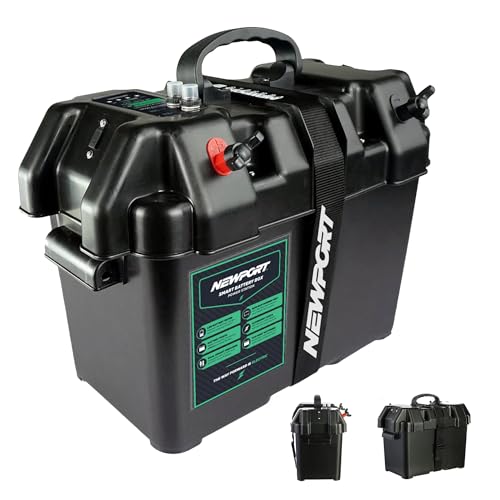
- External terminals simplify marine connections
- USB and 12V DC ports power accessories
- Circuit breakers and battery meter add control
Best For: Small boats using 12V lead-acid batteries
Best Wall-Mountable Storage
Amazon Basics 110-Battery Case

- Holds up to 110 common household batteries
- Includes a 1.5V and 9V battery tester
- Transparent, portable, and wall mountable
Best For: Medium-size household or workshop storage
Best RV and Off-Grid Power Case

- Fits Group 24, 27, and 31 batteries
- Includes voltmeter, outlets, USB, and Type-C ports
- Works with lithium, lead-acid, and gel batteries
Best For: RV, trailer, marine, and off-grid power setups
Best Large-Capacity Organizer
Fireproof Battery Vault with Tester
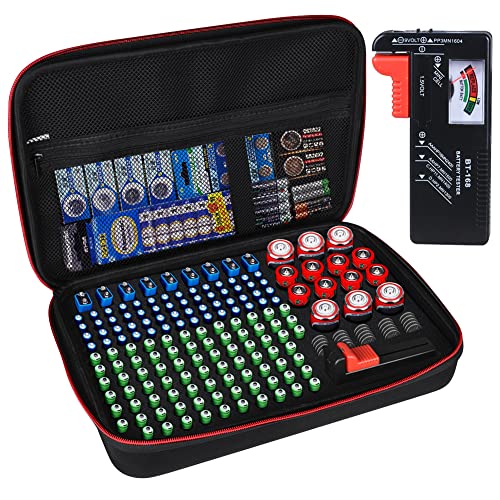
- Stores over 200 mixed-size batteries
- Includes a BT-168 battery tester
- Fire-resistant, waterproof, portable case
Best For: Large household battery collections
Best Portable Fireproof Option
DocSafe Battery Organizer with Tester

- Holds over 200 mixed batteries
- Includes a BT-168 tester and two pockets
- Passed UL94-V0/5VA flame-retardant testing
Best For: Portable home, car, and travel storage
Marine-Ready Protection
Attwood 9067-1 Group 27 Battery Box

- Vented design helps release battery gases
- 350-lb-rated hold-down strap included
- Acid-resistant polypropylene construction
Best For: Boat and RV owners with Group 27 batteries
Versatile RV Storage
Camco Large Group 27-31 Battery Box
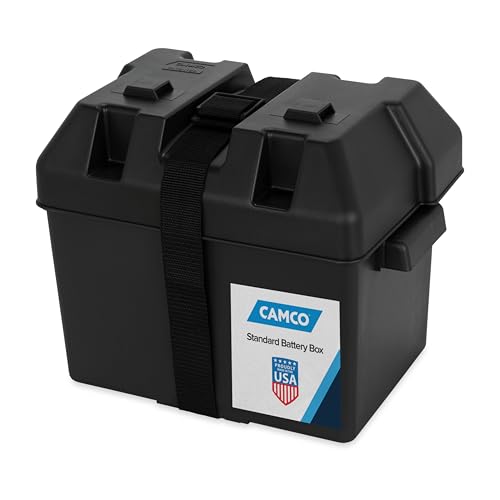
- Fits Group 27, 30, and 31 batteries
- Includes strap, clamps, and stainless screws
- Corrosion-resistant polypropylene body
Best For: RV and trailer battery installations
Dual-Battery Capacity
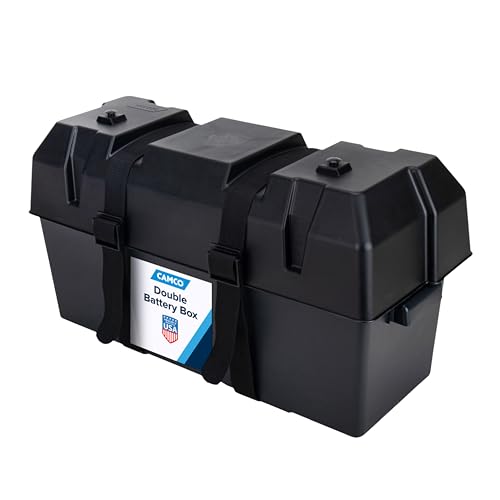
- Holds two GC2 or Group 24/24M batteries
- Two straps and four clamps included
- Heavy-duty corrosion-resilient polymer
Best For: RV owners storing two compatible batteries
Best High-Capacity Organizer – Ontel Battery Daddy 180-Battery Case
Among battery boxes for household storage, the Ontel Battery Daddy stands out for its high capacity and double-sided layout. It organizes up to 180 batteries in a clear, latching case while helping keep loose batteries separated and easy to find.
Best For: Households, technicians, and emergency kits that need to store many battery sizes in one portable case.
Pros:
- Stores up to 180 batteries, including AA, AAA, 9V, C, coin cell, and D sizes.
- Clear cover provides at-a-glance visibility without opening the case.
- Includes a battery tester for checking single-use and rechargeable batteries.
- Built-in handle, secure latches, and locking lid support portable storage.
Cons:
- Batteries are not included.
- Its large capacity may be more than needed for smaller collections.
With six compartments and a compact rectangular design, this is a practical choice when capacity and visibility matter more than minimal size.
Best Marine Power Center – Newport Trolling Motor Battery Box
Newport Trolling Motor Smart Battery Box Power Center with USB and DC Ports, Medium
Check Price On AmazonFor boat owners comparing battery boxes, the Newport Smart Battery Box is designed as a portable 12V power center for trolling motors and marine electronics. It provides external connections, charging ports, circuit-breaker protection, and a built-in battery meter without requiring the lid to be opened.
Best For: Kayaks, jon boats, and small watercraft using compatible 12V lead-acid batteries.
Pros:
- External terminals allow connections to a trolling motor and electronics without opening the box.
- Built-in USB and 12V DC ports can power compatible devices.
- Integrated 10A and 60A circuit breakers help protect against overloads.
- Includes a battery meter, secure lid, stable base, and rubber feet.
Cons:
- Compatible only with lead-acid batteries, not lithium-ion batteries.
- Designed for 12V systems and may not suit other battery configurations.
This box is more than a protective enclosure: it is a tidy marine power hub for users who want accessible connections and basic power monitoring on the water.
Best Wall-Mountable Storage – Amazon Basics 110-Battery Case
The Amazon Basics case is a straightforward option among battery boxes for organizing common household cells. Its transparent cover, carrying handle, and wall-mountable design make it easy to see, store, and access up to 110 batteries.
Best For: Homes, workshops, and storage areas that need a medium-capacity battery case with flexible placement.
Pros:
- Holds up to 110 batteries, including AA, AAA, C, D, 9V, and coin cells.
- Includes a tester for checking 1.5V and 9V batteries.
- Transparent cover makes the contents visible without opening the case.
- Can be carried by hand or mounted on a wall.
Cons:
- The lift-off lid does not provide the same latching closure as some cases.
- It is not water resistant.
With a 110-battery capacity and six compartments, this case balances everyday storage with convenient visibility and mounting options.
Best RV and Off-Grid Power Case – LiTime Smart Battery Box
For RV, trailer, marine, and off-grid setups, the LiTime Smart Battery Box combines battery containment with external power access. It fits Group 24, 27, and 31 batteries and adds a voltmeter, 12V outlets, USB charging, cables, and overload protection.
Best For: Outdoor power users who need a portable enclosure for a compatible Group 24/27/31 battery and multiple device-charging options.
Pros:
- Compatible with lithium, lead-acid, gel, and other battery types in Groups 24, 27, and 31.
- Built-in voltmeter provides real-time battery monitoring.
- Offers two 15A cigarette ports, QC3.0, and Type-C charging ports.
- Includes 6AWG cables, M8 ring terminals, and a 16A automatic-reset circuit breaker.
Cons:
- Compatibility depends on the battery fitting the specified internal dimensions.
- Its 16.54-inch length and 12.6-inch height require more storage space than compact battery cases.
With a lightweight plastic body and external connections, this is a versatile power-management case for users who need more than simple battery protection.
Best Large-Capacity Organizer – Fireproof Battery Vault with Tester
For households managing a large mixed collection, this battery box combines individual foam slots with a battery tester and protective construction. It is designed to organize more than 200 AA, AAA, C, D, 9V, and button batteries while offering water-, shock-, and dust-resistant storage.
Best For: Families and hobbyists who need high-capacity battery storage with portability and a tester included.
Pros:
- Holds over 200 batteries across several common sizes.
- Fire-resistant silicone-coated fiberglass is rated to withstand temperatures up to 2000°F.
- Individual foam slots help prevent slipping and contact between battery terminals.
- Includes a BT-168 tester and a durable carrying handle.
Cons:
- Batteries are not included.
- Its soft-sided organizer format is less suited to permanently securing a vehicle battery.
This is a practical choice when capacity and household organization matter most. The tester adds useful battery-management convenience, while the zipper case and foam insert provide added containment and portability.
Best for Marine and RV Use – NOCO Group 27 Snap-Top Battery Box
This NOCO battery box is built for Group 27 12-volt batteries used in boats, RVs, campers, trailers, vehicles, and similar applications. Its rigid snap-top design, mounting options, cable-entry ports, and included hold-down hardware make it suited to installed battery protection rather than household battery sorting.
Best For: Marine, RV, automotive, and deep-cycle Group 27 battery installations that need secure mounting and cable-routing flexibility.
Pros:
- Reinforced honeycomb construction resists impacts, acid, gas, UV exposure, and oil.
- Supports direct mounting or the included strap-mount system.
- Provides front and side cable-entry options, with optional ventilation holes.
- Includes a 48-inch hold-down strap, mounting tray, and four self-tapping screws.
Cons:
- Designed for Group 27 batteries, so it is not a universal fit for every battery size.
- It does not function as a household organizer for AA, AAA, or button batteries.
Choose this model when your priority is securing and protecting a full-size 12-volt battery in a mobile or marine setup. Confirm the battery group size and available mounting space before ordering.
Best Portable Fireproof Option – DocSafe Battery Organizer with Tester
The DocSafe battery box is a portable organizer for mixed household battery sizes, with fire-resistant silicone-coated fiberglass, foam cutouts, and a BT-168 tester. Its two zippered pockets provide extra space for the tester or additional batteries, making it useful at home, in a car, or while traveling.
Best For: Users seeking a portable, fire-resistant storage bag for more than 200 mixed batteries and a tester.
Pros:
- Stores over 200 AA, AAA, C, D, 9V, and button batteries.
- Silicone-coated fiberglass is rated for temperatures up to 2000°F and passed UL94-V0/5VA flame-retardant testing.
- Foam cutouts keep batteries separated and organized.
- Includes a compatible battery tester and two zippered accessory pockets.
Cons:
- Batteries are not included.
- The bag has a single listed main compartment, so organization depends on the foam layout and accessory pockets.
DocSafe stands out for combining high capacity with a travel-friendly bag format and added storage pockets. It is a strong fit for organized household storage, provided you want a soft organizer rather than a rigid vehicle battery enclosure.
Marine-Ready Protection – Attwood 9067-1 Group 27 Battery Box
For boat and RV owners comparing battery boxes, the Attwood 9067-1 is a strong fit for larger Group 27 lead-acid batteries. Its vented polypropylene housing, included mounting hardware, and high-capacity hold-down strap are designed for secure installation in demanding outdoor environments.
Best For: Boat and RV owners needing a vented Group 27 battery box with robust battery retention.
Pros:
- Fits Group 27 batteries up to 10.5 inches high.
- Integrated ventilation helps release hazardous battery gases.
- 40-inch strap is rated for 350 pounds of force.
- Impact-tested, acid-resistant polypropylene construction works across a wide temperature range.
Cons:
- Designed for Group 27 batteries rather than multiple battery sizes.
- Its exterior dimensions may require more installation space than a compact box.
The Attwood stands out when ventilation, compliance, and hold-down strength matter. Confirm the interior and exterior measurements before installation, particularly in a tight marine or RV compartment.
Versatile RV Storage – Camco Large Group 27-31 Battery Box
The Camco Large Battery Box is a practical choice for RV and trailer setups using Group 27, 30, or 31 batteries. This USA-made battery box includes the retention hardware needed for installation, along with extra headroom for battery terminals.
Best For: RV and trailer owners seeking a corrosion-resistant box for Group 27, 30, or 31 batteries.
Pros:
- Accommodates Group 27, 30, and 31 batteries.
- Includes a lift-off lid, woven hold-down strap, foot clamps, and stainless steel screws.
- Lightweight polypropylene construction resists corrosion.
- Provides 2 inches of additional headroom for battery terminals.
Cons:
- It is a large box, so installation space should be checked carefully.
- The supplied notes do not identify an integrated venting feature.
With broad group-size compatibility and included mounting components, this Camco model is a flexible option for many trailer and RV battery compartments. Measure the available space and battery height before ordering.
Dual-Battery Capacity – Camco Double Battery Box
When one battery box is not enough, the Camco Double Battery Box provides room for two compatible batteries in a single enclosure. Its corrosion-resilient polymer body and included straps and clamps make it suited to RV and other installations that need organized dual-battery storage.
Best For: RV owners using two 6V Group GC2 batteries or two 12V Group 24/24M batteries.
Pros:
- Holds two 6V Group GC2 or two 12V Group 24/24M batteries.
- Includes two straps and four strap clamps with screws.
- Heavy-duty polymer construction resists corrosion.
- Meets specified USCG and ABYC requirements when used with two 6V Group GC2 batteries.
Cons:
- The larger double-battery footprint requires substantial installation space.
- Compatibility is limited to the listed battery group configurations.
This Camco model is the most suitable of these battery boxes for a two-battery setup. Its long interior accommodates paired batteries, but verify the 21.5-by-7.375-by-11.1875-inch interior dimensions against your compartment before installation.
How We Picked These Battery Boxes
We selected products across the main battery-storage categories rather than treating every box as interchangeable. The list includes organizers for loose AA, AAA, C, D, and 9V cells; cases with built-in testers; and larger enclosures designed for Group 24, 27, or 31 batteries used in boats, RVs, vehicles, and off-grid systems.
We also considered practical design details such as lid security, carrying handles, mounting straps, wall-mount capability, terminal access, ventilation, outlet options, water resistance, and stated fire-safety features. Always confirm the manufacturer’s specifications before storing a particular battery chemistry or installing a box in a vehicle.
Quick Comparison
- Household organization: Battery Daddy and Amazon Basics cases prioritize high capacity, visibility, and easy access for loose batteries.
- Testing and emergency readiness: Tester-equipped organizers help identify weak or depleted cells before they go into a device.
- Marine and RV use: Newport, NOCO, Attwood, and Camco models are aimed at larger 12V batteries and installation-oriented storage.
- Power access: Newport and Litime designs add features such as 12V, USB, or DC connectivity for portable setups.
- Specialized protection: Fire-resistant or water-resistant organizers are useful where extra containment is a priority, but they are not a substitute for following battery-storage safety guidance.
Key Buying Factors for Battery Boxes
Battery Size and Capacity
Start with the batteries you actually own. Household organizers are measured by cell count and may separate battery sizes, while marine and RV boxes are sized by battery group number. A box that is too tight can make terminals difficult to access; one that is too large may allow movement during transport.
Ventilation and Installation
Lead-acid batteries can require ventilation, especially in enclosed vehicle or marine compartments. Choose a vented model when the battery type and installation call for it, and check whether the box includes a strap, mounting points, or hardware. Follow local installation requirements and the battery maker’s instructions.
Protection and Construction
Look for a secure lid, durable plastic, protected terminals, and a stable base. For small-cell storage, dividers and a clear lid reduce sorting time. For portable power, inspect the quality and placement of outlets, cable openings, and handles.
Battery Chemistry and Safety
Confirm compatibility with alkaline, lithium, rechargeable, AGM, or other battery types before use. Keep loose cells from contacting metal objects, separate damaged or swollen batteries, and recycle depleted batteries through an approved program. Fireproof claims can vary, so read the product’s tested limits and instructions carefully.
Who Should Buy Which Battery Boxes?
Choose a high-capacity organizer with a tester if you need a central household battery supply. Pick a compact wall-mountable case when saving drawer or shelf space matters. For boats, campers, and RVs, use a correctly sized battery box with appropriate ventilation and restraint. Choose a power-center style model when USB, DC, or 12V access is more important than simple containment. If your priority is added protection during storage, consider a fire-resistant or waterproof organizer—but verify its dimensions and battery-chemistry compatibility first.