Finding the right light for indoor plants is easier when you can adjust brightness as plants grow, seasons change, or natural light varies. The best dimmable grow lights offer flexible coverage without forcing every plant into the same lighting setup.
This roundup compares 10 options across bulbs, clip-on lamps, panels, and smart designs. Use the guide below to match light output, controls, coverage, and installation style to your plants and growing space.
Best 10 Dimmable Grow Lights Picks for 2026
Best Overall Panel
70W Dimmable Full-Spectrum Grow Light

- 11,000 lumens from a 70W LED panel
- Four-level dimmer for adjustable brightness
- Quiet fanless aluminum heat dissipation
Best For: Seedlings and vegetative plants in a 2-by-2-foot area
Best High-Output Bulb

- Remote-controlled four-level dimming
- 4-, 8-, and 12-hour timer options
- 3,800-lumen full-spectrum 4000K output
Best For: High-output supplemental light in an E26 fixture
Best Smart Pair
Programmable Dimming Grow Bulbs

- Sunrise-to-sunset automatic brightness mode
- Recurring 2-to-22-hour timer
- Two standard E26/E27 bulbs included
Best For: Automated supplemental lighting for houseplants
Best Low-Wattage Bulb

- Four-level remote dimming and timer
- Focused PAR20 design for nearby plants
- 5W output with 500 lumens
Best For: Small plants and focused shelf lighting
Flexible Clip-On Pick

- Four adjustable gooseneck heads
- 10 dimming levels and three modes
- Automatic 4–18-hour cycle timer
Best For: Flexible coverage across multiple indoor plants
Best for Everyday Use
SANSI 30W Full-Spectrum Grow Bulb

- Remote-controlled four-level dimming
- 4-, 8-, and 12-hour timer settings
- 3,000 lumens from a standard E26 bulb
Best For: Bright, convenient lighting in an existing lamp
Under-Cabinet Pick
4-Piece Ultra-Thin Panel Grow Lights

- Four flexible, low-profile light panels
- 10 dimming levels and three modes
- Automatic 3-, 9-, and 12-hour timer
Best For: Shelves, cabinets, and compact growing setups
Best Natural-Looking Bulb
Briignite Full-Spectrum A19 Grow Light

- Natural-looking full-spectrum output
- Up to 1,000 lumens using about 11 watts
- Fits standard E26 fixtures
Best For: Indoor growers seeking a discreet bulb for herbs and leafy greens
Best Adjustable Setup
LEOTER 80-LED Dimmable Grow Light
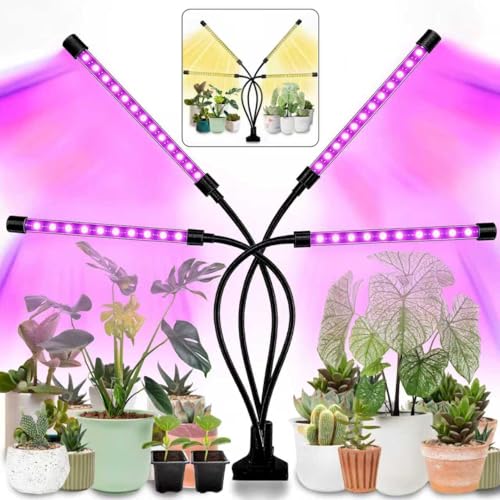
- 10 intensity levels and three spectrum modes
- Four flexible gooseneck light heads
- 3-, 9-, and 12-hour timer options
Best For: Shelves, desks, and small indoor plant collections
Best Multi-Pack Bulbs
3-Pack Dimmable A19 Grow Lights

- Three full-spectrum E26 bulbs
- 9 watts and up to 1,000 lumens per bulb
- 400–740nm range for all growth stages
Best For: Multiple indoor fixtures growing herbs, flowers, fruits, or vegetables
Best Overall Panel – 70W Dimmable Full-Spectrum Grow Light
For growers who need broad coverage and adjustable intensity, this 70-watt panel is a practical choice among dimmable grow lights. Its balanced spectrum, strong output, fanless aluminum cooling, and hanging design suit seedlings and vegetative plants in an indoor 2-by-2-foot area.
Best For: Seedlings, herbs, flowers, and vegetative plants needing panel-style coverage.
Pros:
- Four-level dimmer accommodates different plant types and growth needs.
- Full-spectrum output combines 660nm red with 3000K and 5000K white LEDs.
- Delivers up to 11,000 lumens while using 70 watts.
- Fanless aluminum heat sinks provide quiet heat dissipation.
Cons:
- Hanging-mount design may require hooks or suitable overhead space.
- Its coverage is specified for a 2-by-2-foot vegetative area rather than a larger grow space.
This is the strongest fit for shoppers who want a dedicated, energy-conscious grow panel with straightforward manual dimming and quiet operation.
Best High-Output Bulb – SANSI 40W Dimmable Grow Bulb
This SANSI bulb is a convenient option for indoor growers who want dimmable grow lights in a standard E26 socket. The remote provides four brightness levels and scheduled operation, while the full-spectrum 4000K output is designed for plants ranging from herbs to flowering houseplants.
Best For: High-output supplemental lighting for indoor potted plants in an E26 fixture.
Pros:
- Remote control offers 25%, 50%, 75%, and 100% brightness settings.
- Includes 4-, 8-, and 12-hour timing functions.
- Produces up to 3,800 lumens and 57 µmol/s PPF while using 40 watts.
- Ceramic heat-sink technology supports heat conduction and reliability.
Cons:
- Requires a compatible E26 socket or fixture.
- Its BR30, 60-degree beam is less suited to broad-area coverage than a panel.
Choose this bulb when you prefer remote adjustments and scheduling without moving the plant or unplugging the light, especially for a concentrated group of indoor plants.
Best Smart Pair – Programmable Dimming Grow Bulbs
These two smart bulbs make it easy to add dimmable grow lights to ordinary E26 or E27 fixtures. Their sunrise-to-sunset Sunshine Mode changes brightness automatically, while the built-in timer can run for 2 to 22 hours per day on a repeating schedule.
Best For: Houseplant owners who want automated daily lighting from standard sockets.
Pros:
- Sunshine Mode simulates changing brightness from sunrise to sunset.
- One-time timer setup supports recurring 2-to-22-hour daily schedules.
- Two-bulb pack provides flexible coverage for multiple plants or fixtures.
- Full-spectrum 380nm-to-800nm light is rated at 4500K.
Cons:
- Should not be connected to external dimmers because flickering or conflicts may occur.
- At 9 watts and 1,037 lumens per bulb, these are intended more for supplemental than high-intensity lighting.
This pair stands out for convenience: the built-in controls handle daily brightness changes and scheduling without requiring a separate smart-home setup.
Best Low-Wattage Bulb – SANSI 5W Dimmable Grow Light
For a single small plant or a focused shelf setup, this 5-watt SANSI bulb offers dimmable grow-light control without the output or energy use of a larger panel. Its remote includes four brightness levels and timer settings, while the PAR20 shape directs light toward the plant.
Best For: Small indoor plants needing focused, low-energy supplemental light.
Pros:
- Remote-controlled brightness ranges from 25% to 100% across four levels.
- Includes 4-, 8-, and 12-hour timing options.
- Uses 5 watts and provides 500 lumens with a 53.85 µmol/s/㎡ PPFD rating at 1 foot.
- PAR20 design and secondary lens focus light, while ceramic cooling supports a rated 25,000-hour life.
Cons:
- Its 500-lumen output is better suited to small or nearby plants than broad coverage.
- Requires an E26 socket and is sold as a single bulb.
This is a sensible pick when precise positioning, low power consumption, and remote scheduling matter more than illuminating a large collection of plants.
Flexible Clip-On Pick – Black 168-LED Grow Light Set
If you need dimmable grow lights for several indoor plants, this clip-on set offers flexible positioning and broad adjustability. Its full-spectrum bars provide 10 dimming levels, three lighting modes, separate light controls, and a cycle timer for consistent daily supplementation.
Best For: Indoor plant owners who want adjustable, clip-mounted coverage for multiple plants or shelves.
Pros:
- Four flexible gooseneck light heads provide versatile positioning and wider coverage.
- Ten dimming levels and separately controllable LED bars help tailor light to plant needs.
- Automatic 4-, 8-, 12-, or 18-hour cycle timer can repeat daily without manual operation.
- Full-spectrum 6000K lighting includes red and sunlight-white LEDs.
Cons:
- Designed for indoor use and is not waterproof.
- Clip mounting may be less suitable for permanent cabinet or ceiling installations.
This is a practical choice when setup flexibility matters most. The multiple heads, strong clips, and extensive dimming range make it easy to adapt the light as plants grow or move between locations.
Best for Everyday Use – SANSI 30W Full-Spectrum Grow Bulb
This SANSI bulb is a straightforward option for anyone who wants dimmable grow lights in a standard E26 socket. The 30W full-spectrum LED uses a remote for four brightness levels and timed operation, making it convenient for plants already positioned under a lamp fixture.
Best For: Growers who want a bright, socket-based bulb with remote dimming and scheduling.
Pros:
- Four brightness settings range from 25% to 100% and can be adjusted by remote.
- Built-in 4-, 8-, and 12-hour timing options simplify daily plant-light routines.
- Produces 3,000 lumens with a listed PPFD of 260 μmol/s/㎡ at 1 foot.
- Full-spectrum 400–780nm output and a listed CRI of 98 provide a natural-light-like profile.
Cons:
- Only one bulb is included, so coverage depends on the fixture and plant arrangement.
- It uses a 4000K cool-white color temperature rather than a warmer decorative light.
Choose this model when you prefer the simplicity of replacing a regular E26 bulb instead of installing panels or clip lights. Its remote control and strong listed brightness make it particularly convenient for a single plant area.
Under-Cabinet Pick – 4-Piece Ultra-Thin Panel Grow Lights
These dimmable grow lights are designed for discreet shelf, cabinet, greenhouse, or planting-tent installations. The four ultra-thin panels offer full-spectrum output, three lighting modes, 10 dimming levels, and a repeating timer while taking up very little vertical space.
Best For: Shelves, cabinets, and compact plant setups that need distributed, low-profile lighting.
Pros:
- Four slim 11.81-by-3.14-inch panels can be arranged for different layouts.
- Ten dimming levels from 10% to 100% allow more precise intensity adjustments.
- Three lighting modes help control the illuminated coverage area.
- 3-, 9-, and 12-hour cycle settings repeat automatically each day.
Cons:
- Requires corded electric power and included setup hardware such as adhesive or zip ties.
- The listed 6500K color temperature may look quite cool in living spaces.
- Warranty information must be obtained directly from the seller.
This four-panel kit is the strongest fit for space-conscious installations. Its thin aluminum-backed panels and flexible mounting options make it easier to spread light beneath shelves or across a compact growing area than a single bulb.
Best Natural-Looking Bulb – Briignite Full-Spectrum A19 Grow Light
For growers who want dimmable grow lights with a conventional bulb shape, the Briignite A19 is an easy option for standard fixtures. Its full-spectrum output appears natural white rather than purple or red, making it more comfortable in living spaces while supporting herbs, leafy greens, and other indoor plants.
Best For: Indoor growers who want a natural-looking full-spectrum bulb for standard E26 sockets.
Pros:
- Full-spectrum lighting is designed for plants at all growth stages.
- Produces up to 1,000 lumens while using about 11 watts.
- Standard E26 base fits common light fixtures.
- Aluminum and plastic construction supports heat dissipation and a stated lifespan of up to 25,000 hours.
Cons:
- The supplied notes do not describe a built-in dimming control.
- It is intended for indoor use only.
The Briignite is a practical choice when appearance and simple installation matter more than adjustable intensity. Verify that your existing dimmer is compatible before relying on it as a dimmable grow-light setup.
Best Adjustable Setup – LEOTER 80-LED Dimmable Grow Light
The LEOTER is among the more flexible dimmable grow lights in this roundup, combining 10 intensity levels with three spectrum modes. Its four adjustable heads, clip-on mounting, and timer make it useful for directing light across indoor plants without installing a permanent fixture.
Best For: Indoor plant owners who need adjustable positioning, scheduled operation, and multiple light settings.
Pros:
- Offers 10 dimmable intensity levels and three spectrum modes.
- Includes 80 LEDs with full-spectrum, red, and blue light combinations.
- Four 360-degree flexible gooseneck heads help target individual plants.
- Built-in 3-, 9-, and 12-hour timer settings support automatic daily operation.
Cons:
- The timer must be reset if the light loses power.
- It is not waterproof and is intended for indoor use.
- A USB connection and corded power setup may require convenient outlet placement.
With its clamp, flexible heads, and detailed controls, the LEOTER is a strong fit for shelves, desks, and small plant collections. It offers more placement and intensity control than a standard replacement bulb.
Best Multi-Pack Bulbs – 3-Pack Dimmable A19 Grow Lights
This three-pack provides dimmable grow lights in a familiar A19 bulb format, making it convenient to illuminate multiple standard fixtures. Each 9-watt bulb uses a full-spectrum 400–740nm range and delivers up to 1,000 lumens for indoor herbs, flowers, fruits, and vegetables.
Best For: Growers who want several replaceable E26 bulbs for spreading full-spectrum light across indoor plants.
Pros:
- Three bulbs help cover multiple fixtures or plant areas.
- Full-spectrum 400–740nm lighting is intended for all growing stages.
- Each bulb uses 9 watts and is described as replacing up to a 100-watt traditional bulb.
- Standard E26 bases make installation straightforward.
Cons:
- The supplied information does not specify a dimmer or control included with the bulbs.
- They are rated for indoor use only.
- The stated average operating life is 20,000 hours, shorter than some competing options.
This pack makes sense when you need consistent bulb-style coverage in several locations. Its dimmable designation is useful, but confirm compatibility with your fixture or wall dimmer before installation.
How We Picked These Dimmable Grow Lights
We focused on practical features that affect everyday plant care: adjustable brightness, full-spectrum or supplemental spectrum output, timer controls, installation flexibility, coverage, and bulb compatibility. The selection includes compact lights for a single houseplant, larger multi-LED fixtures, E26 bulbs, clip-on designs, and under-cabinet panels.
Because advertised wattage and LED counts do not always translate directly into usable plant light, shoppers should also consider coverage area, distance from the leaves, heat, and whether the fixture provides enough intensity for the plant type.
Quick Comparison
| Type | Best For | Useful Features |
|---|---|---|
| Bulb | Single plants or existing lamps | E26 compatibility, simple installation |
| Clip-on lamp | Small collections and shelves | Flexible positioning, multiple timer settings |
| Panel | Groups of plants or cabinets | Broad, even coverage |
| Smart bulb | Automated routines | Programmable schedules and dimming |
Key Buying Factors for Dimmable Grow Lights
Brightness and Coverage
Choose a fixture based on the number and size of plants it must illuminate. A low-wattage bulb can work well for one small plant, while a panel or multi-head fixture is usually better for several plants. Adjustable brightness helps prevent excessive intensity when the light must sit close to foliage.
Spectrum and Plant Needs
Full-spectrum lighting is a versatile choice for foliage plants, seedlings, herbs, and many flowering plants. Red and blue supplemental modes can be useful when you want targeted support, but they are not automatically better than a balanced white full-spectrum setting.
Timers, Controls, and Placement
Built-in timers reduce daily maintenance and help maintain a consistent photoperiod. Remote controls are convenient for bulbs and hard-to-reach fixtures, while smart models suit users who want programmable schedules. Check the clamp range, gooseneck reach, cord length, and bulb-base compatibility before buying.
Heat and Operating Cost
LEDs generally use less energy than older grow-light technologies, but any light can produce heat when operated close to leaves. Leave appropriate clearance, keep ventilation paths open, and use the lowest brightness that supports healthy growth.
Who Should Buy Which Dimmable Grow Lights?
Choose an E26 grow bulb if you already have a desk lamp, floor lamp, or hanging fixture. A clip-on model is a practical choice for shelves, propagation areas, and small plant collections that need adjustable positioning. Select a panel when you need more uniform coverage across a cabinet or group of plants.
Smart Dimmable Grow Lights are best for shoppers who value automation and repeatable schedules. Compact low-wattage bulbs suit individual low-light houseplants, while higher-output bulbs and multi-LED fixtures are better for seedlings, herbs, and plants positioned farther from the light. When uncertain, prioritize adjustable output and a timer so you can start conservatively and increase exposure as needed.